



December 26, 2025 15:03
Sweet Millions During Wartime: How New Year’s Gifts Are Procured in 2025
Power and heating outages, Russian shelling, and constant anxiety—despite all this, Ukrainians stubbornly cling to a sense of celebration. From October onward, the annual marathon of “sweet procurements” begins in Prozorro, although the most forward-thinking contracting authorities start ordering New Year’s gifts as early as spring. Hundreds of institutions purchase confectionery, assemble gift sets, and prepare to distribute them on behalf of various magical figures—Saint Nicholas, Santa Claus, or even… Ihor Terekhov.
Analysts from DOZORRO Transparency International Ukraine analyzed how budgetary institutions procured sweets this year: who secured the most expensive contracts, which region ordered the most, and how much these gifts cost the public budget.
Sweet procurements: volumes and value
In 2025 (as of December 20), nearly 1,800 agreements worth UAH 208.7 million had already been concluded for the purchase of confectionery, according to data from the BI Prozorro public analytics module. At that time, an additional 14 procurements with an estimated value of UAH 5.6 million were still ongoing. The peak of ordering occurred in October and November—these months saw the highest number of procurements announced and contracts concluded, totaling UAH 39 million and UAH 117 million respectively. Some contracting authorities concluded agreements for New Year’s sweets as early as spring or summer, but such cases were relatively rare.
This year, more than one million New Year’s gift sets and over three tonnes of loose confectionery were ordered—likely to be packaged manually by institutional staff. However, these figures may contain inaccuracies, as contracting authorities enter the data manually, and it is often incorrect or inconsistent. For example, in one procurement, the specification listed the quantity of gifts as “1 lot,” while the contract itself referred to 640 New Year’s gifts. There are also dozens of procurements worth hundreds of thousands of hryvnias where several different items were purchased simultaneously—for example, cocoa powder, New Year’s packages, and Roshetto Peanut wafer bars under a single agreement. Such transactions were excluded from our calculation of the number of New Year’s gift sets, as BI Prozorro did not allow us to automatically determine either the quantity of gift sets purchased or the volume of confectionery.
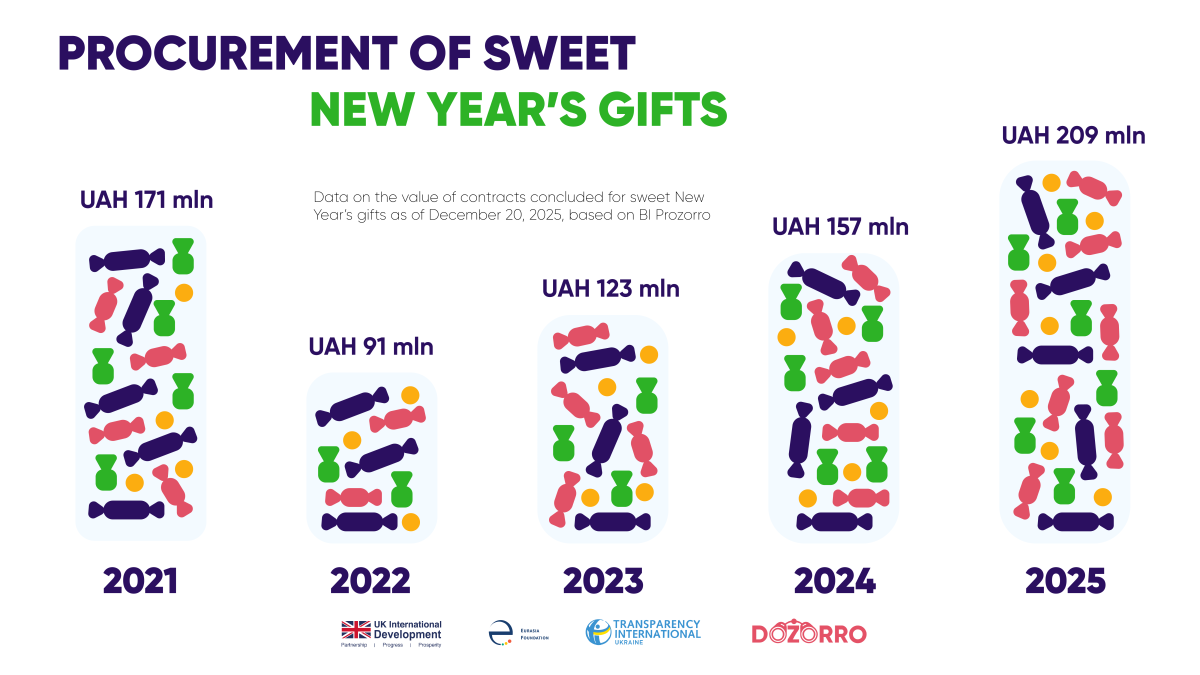
The total value of this year’s procurements has already exceeded pre-war levels: in 2021, UAH 171 million was contracted for New Year’s sweets. However, it is important to consider not only price growth but also the increase in the number of children for whom gifts are purchased—namely, internally displaced children and children of military personnel who have been killed, gone missing, or are in captivity. Compared to previous years, the total contract value has also increased. Last year, UAH 157 million was spent on sweets; in 2023—UAH 123 million; and in 2022—UAH 91 million.
By contract value, 36% of procurements were conducted via request for price quotations. Another 34% were carried out through special open bidding. In 30% of cases, contracting authorities concluded direct contracts, mostly for amounts below UAH 100,000. However, there were exceptions. Fourteen contracting authorities signed direct contracts exceeding this threshold. Eight of them operate in the Kharkiv, Dnipropetrovsk, and Donetsk regions and justified deviation from standard procedures by citing their location in areas of active hostilities. The same justification was used by a contracting authority from the Novhorod-Siverskyi community in Chernihiv region, which is included in the list of territories of active combat operations and is located approximately 40 km from the Russian border. An additional UAH 405,000 contract was concluded directly by the Department of Education of the Saksahanskyi District in Dnipropetrovsk region, citing urgent need and tight delivery deadlines. A contracting authority from Khmelnytskyi region also referred to compressed timelines. Other contracting authorities resorted to direct contracts because tenders failed due to the absence of bidders.
A separate issue worth emphasizing is the lack of detail in direct procurements. In most reports and contracts published in Prozorro, contracting authorities do not specify how many gift sets were purchased, which sweets are included and in what quantities, who the manufacturer is, or the total weight of each package.
Regional leaders
In 2025, Kyiv region contracted the largest amount for the purchase of New Year’s gift sets. State and municipal contracting authorities in the region concluded 203 contracts worth UAH 44 million. The absolute leader among all contracting authorities by contract value was the Ukrzaliznytsia’s “Production Support Center” branch, which alone contracted UAH 13.4 million for sweet gift sets.
Kharkiv region ranked second. Local institutions procured sweet gifts worth UAH 27 million through 84 contracts. The most expensive procurement in the region was carried out by the Municipal Children’s Food Processing Plant of the Kharkiv City Council, which concluded a contract worth UAH 12.2 million.
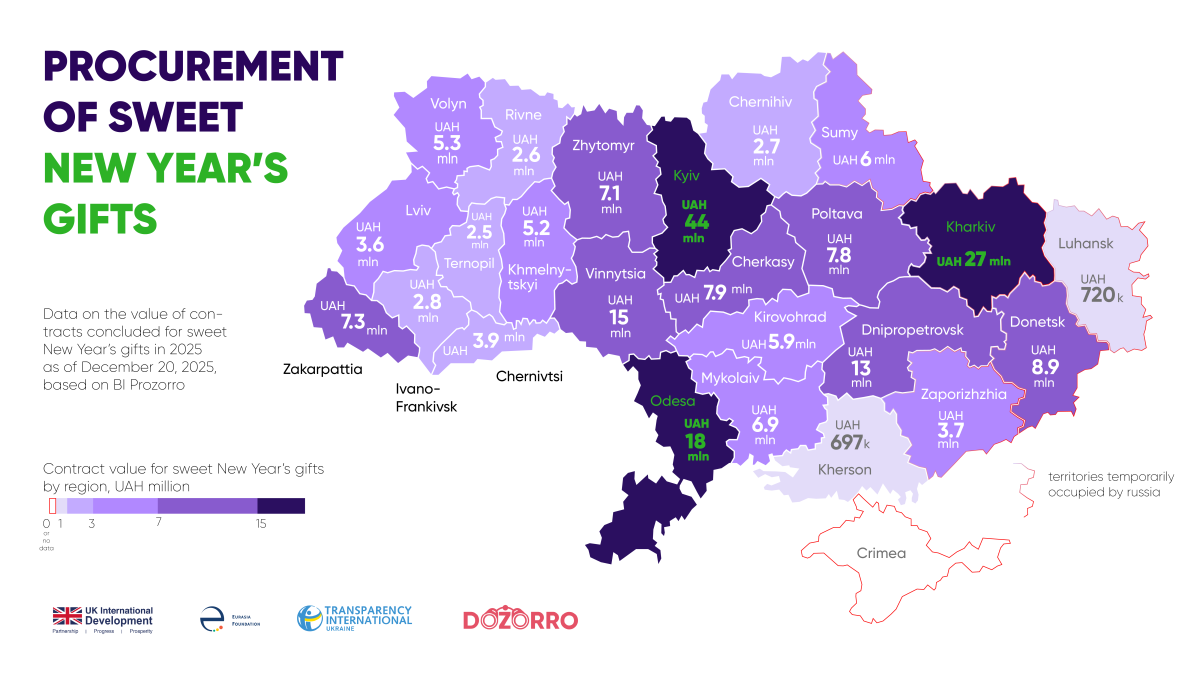
Next in the ranking is Odesa region, where 83 contracts worth UAH 17.8 million were concluded. The largest procurement in the region was carried out by the municipal institution Center for Financing and Economic Activities of Educational Institutions of Odesa’s Peresyp District, which contracted UAH 2.3 million.
Vinnytsia region ranked fourth, with 284 contracts totaling UAH 14.8 million. The largest contract in the region was concluded by the Department of Social and Youth Policy of the Regional State Administration, amounting to UAH 1.3 million.
Rounding out the top five is Dnipropetrovsk region, where 97 contracts worth UAH 13.1 million were signed. The largest single contract in the region—UAH 1.1 million—was concluded by the Department for Family, Youth and Sports Affairs of the Executive Committee of the Kryvyi Rih City Council.
The smallest volumes of sweet procurements were recorded in Kherson region, part of which remains under occupation—only 8 contracts worth UAH 697,000. Luhansk region is also among those with the lowest procurement volumes, with 11 contracts totaling UAH 720,000.
According to BI Prozorro data, an average of three bidders participated in procurements for New Year’s gifts nationwide. The highest level of competition was observed in Chernivtsi and Rivne regions, with five bidders per procurement, while the lowest was in Kherson region, where only one bidder participated per procurement on average.
Top suppliers of New Year’s gifts in 2025
The leading supplier by total contract value is The Land of Free LLC. The company concluded 33 contracts worth UAH 20.5 million and is one of the most active participants in the sweet procurement market. The company’s largest order was awarded by Ukrnafta—UAH 4.9 million for the supply of 11,353 gift sets, each weighing 800 g and containing 50 confectionery items. The unit price was UAH 360.40 per set (excluding VAT). The gifts will be packaged in a plywood “Birdhouse Feeder” and supplemented with a greeting card and six three-dimensional stickers.
Second place went to Sweet Gifts Workshop LLC, which concluded 64 contracts totaling UAH 18.8 million. Its largest contract this year—UAH 1.6 million—was awarded by the Youth Policy and Children’s Affairs Department of the Bakhmut City Council. Under this contract, Sweet Gifts Workshop LLC will supply 3,821 gift sets, each weighing 840 g. Every set includes 53 confectionery items and a mandatory sticker pack. The price per set is UAH 431.28, including VAT.
Sweet Trader LLC ranks third, having concluded 46 contracts worth UAH 13.7 million. The company’s largest order was awarded by the Department of Youth and Sports of the Mykolaiv Regional State Administration, with a contract value of UAH 1.7 million. Under this contract, Sweet Trader LLC will supply 10,000 gift sets, each weighing 400 g. The unit price is UAH 165.66, including VAT. Each gift set contains 32 confectionery items—two of each type—from four manufacturers: ROSHEN, Kharkivianka, Ukrainian Confectioner, and Lucas. The range includes milk fondant, jelly, caramel, hard candy, and grillage confectionery. The packaging also has distinctive features: it is made of cardboard with a New Year’s design and includes a 3D game, which children can use for entertainment.
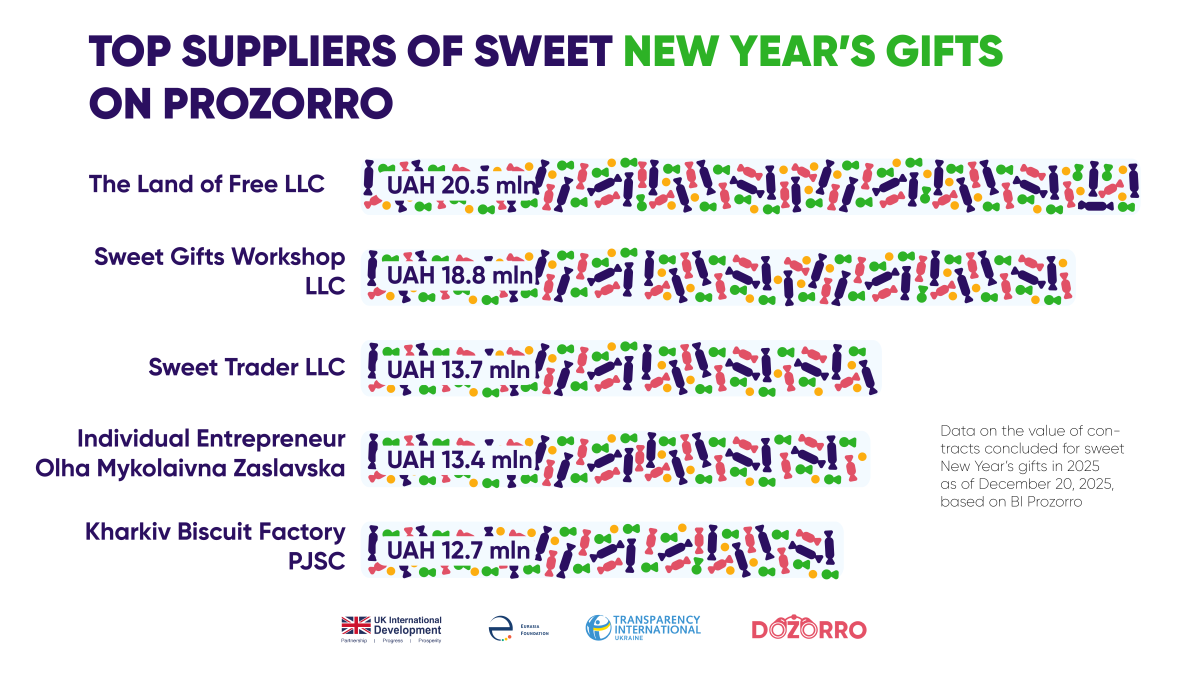
Fourth place went to Individual Entrepreneur Olha Mykolaivna Zaslavska. The entrepreneur concluded a single contract, which was nevertheless the largest New Year’s gift procurement in 2025—UAH 13.4 million—with the already mentioned Ukrzaliznytsia’s “Production Support Center” branch. Under the contract, 78,132 “New Year’s Miracle” gift sets, each weighing 705 g, were ordered. Each package contains 58 confectionery items produced by Roshen LLC, Zhytomyrski Lasoshchi Trading House, and Dominik TM. The unit price is UAH 171.96, including VAT.
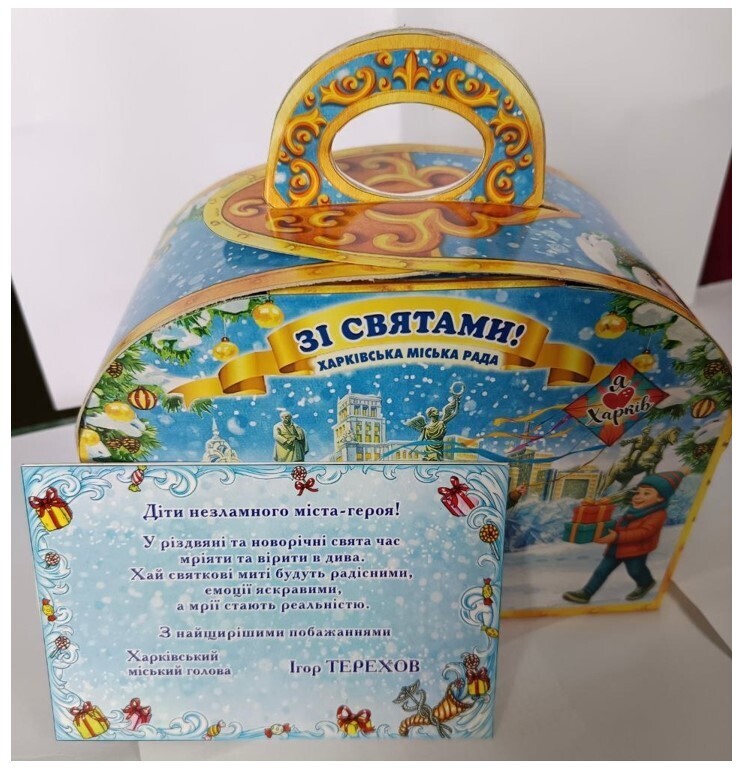
Kharkiv Biscuit Factory PJSC rounds out the top five. The company concluded 11 contracts totaling UAH 12.7 million, of which UAH 12.2 million accounts for a single large contract with the already mentioned Municipal Children’s Food Processing Plant of the Kharkiv City Council. Under this agreement, the factory will supply 91,056 gift sets priced at UAH 133.98 per unit, including VAT. Each gift will include a greeting card mentioning Kharkiv Mayor Ihor Terekhov. The use of community funds to place personal political messaging appears questionable and may be interpreted as political promotion.
Special mention should be made of Scientific and Production Enterprise Argon LLC. Although the company does not rank among the top five by contract value, it is the leader by number of contracts, having concluded 105 agreements worth UAH 3.6 million. This indicates procurement in small lots, but in large quantities. The company primarily works with kindergartens and lyceums in Vinnytsia region.
Prices and composition of gift sets
New Year’s gifts for children were also procured via Prozorro Market, an electronic catalogue of goods and services that significantly simplifies business participation in public procurement. Because the catalogue specifies the number of gift sets purchased upfront, it allows for easier assessment of average market prices.
As of November 20, 35 procurements had been recorded. The price range of gift sets varied from UAH 69.72 to UAH 406.25. Through Prozorro Market, 181,269 packages of sweets were purchased for a total of UAH 31.9 million. The average price per gift set amounted to UAH 176.6. The most common gift weight was 500 g, the largest—1 kg, and the smallest—450 g.
The lowest price among all New Year’s sweet procurements in 2025 was recorded in the city of Oleksandriia in Poltava region. There, the Department of Culture and Tourism purchased 1,500 sweet gifts for UAH 11.8 thousand, or UAH 7 per unit. In response to our inquiry, the contracting authority explained that it had purchased chocolate and marmalade candies for children who participated in games during the Christmas tree lighting event in a local park.
Another example comes from educators of the Prolisne Settlement Council in Kharkiv region. They ordered 2,205 packs of “Do Kavy Pryazhene Moloko” biscuits, each weighing 185 g, from the Vinnytsia Confectionery Factory. The total contract value was UAH 43.3 thousand (UAH 19.62 per unit). The biscuits were intended for children during celebrations of Saint Nicholas Day, Christmas, and New Year’s events in December.
Among the most expensive New Year’s gifts this year are those procured by the Stanytsia Luhanska Settlement Military Administration of Luhansk region. The contracting authority purchased 50 gift sets packaged in a wooden box, branded “Milka & Kinder – A Gift for One Champion”, weighing 860 g each. The contract value was UAH 57.8 thousand, or UAH 1,155 per gift, which corresponds to the market price of such a set.
Even more expensive gift sets were ordered by the Department of Social Policy of the Nikopol City Council. For UAH 152 thousand, the authority purchased 105 gifts, priced at UAH 1,450 per unit, excluding VAT. These gifts were intended for children of military personnel who were killed in the war, went missing, or are held in captivity.
This material was prepared within the framework of the “Digitalization for Growth, Integrity, and Transparency” (UK DIGIT) project, implemented by the Eurasia Foundation and funded by UK Dev. The material was produced with the financial support of the UK Government’s International Development Assistance Programme. The contents of this material are the sole responsibility of Transparency International Ukraine; the views expressed do not necessarily reflect the official policy of the Government of the United Kingdom.
Source: glavcom.ua


