


Anti-corruption policy at the local level remains unsystematic and uneven, and most city councils only partially meet European approaches to good governance. This emerges from research by Transparency International Ukraine’s Transparent Cities program, in which analysts assessed the development level of the integrity and anti-corruption ecosystem and its compliance with EU requirements.
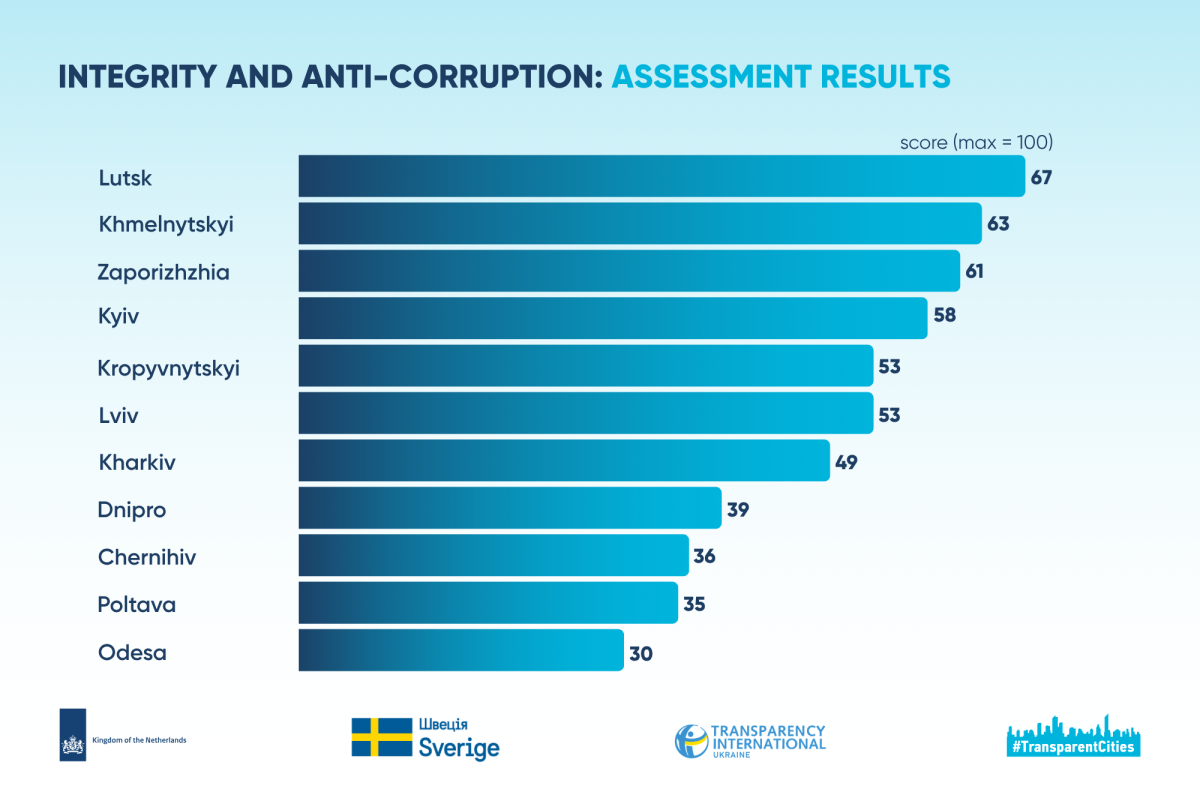
Program experts evaluated Kyiv and 10 regional centers (Dnipro, Zaporizhzhia, Kropyvnytskyi, Lutsk, Lviv, Odesa, Poltava, Kharkiv, Khmelnytskyi, Chernihiv) across 40 criteria. Municipalities could receive a maximum of 100 points.
The average implementation rate of the assessed criteria across the cities was 49.5%.
Lutsk demonstrated the highest result—67 out of 100 possible points. Khmelnytskyi took second place with 63 points, and Zaporizhzhia placed third with 61 points. The lowest scores were Odesa (30), Poltava (35), and Chernihiv (36).
To assess how cities implement European standards on anti-corruption and ethical conduct, analysts checked: whether the city has relevant legal regulations and authorized officials responsible for anti-corruption work; whether city councils are connected to NACP tools—particularly the Unified Whistleblower Reporting Portal; whether councils publish results of their own anti-corruption monitoring. They separately reviewed open databases to determine whether local officials or council members appeared as violators of anti-corruption legislation.
In 2025, only three cities had published corruption risk registers and active anti-corruption programs. Six city councils approved codes of ethics or rules of ethical conduct for officials, while only three approved similar rules for council members. Khmelnytskyi was the sole city where all these tools existed simultaneously.
Only two city councils—Kropyvnytskyi and Kharkiv—took the necessary steps to establish an effective whistleblowing tool in their communities. They approved rules for whistleblower encouragement and procedures for handling corruption reports. Also, these municipalities have at least 10 municipal enterprises and 10 municipal institutions connected to the Unified Whistleblower Reporting Portal, and links to it can be found on their official websites.
Analysts identify one of the main problems as the near-complete absence from city council websites of monitoring results on the current state of the integrity sphere.
Most city councils do not publish information about untimely or non-submission of declarations, information about reports of conflicts of interest by council members and officials, data on those held accountable for corruption offenses, or results of reviews of reports concerning ethical violations. Such information should be collected by authorized units of city councils and made public. Without it, it is impossible to understand whether corruption risks are declining or whether the integrity system is actually working. In 2025, only Kyiv of the 11 cities published some of these monitoring results.
“European integration must already be ‘lived’ in the practical sphere of local self-government, because it is in communities where people interact with authorities daily, receive services, see how budget funds are used, how decisions are made, and whether integrity mechanisms work. Therefore, transparency, accountability, ethical conduct by officials, and proper management of corruption risks cease to be ‘best practices’ and become part of the standards by which Ukraine’s readiness for EU membership will be assessed,” noted Olesia Koval, Transparent Cities Program Manager.
The Transparent Cities program recommends that city councils not limit themselves to the formal existence of documents, but instead build a comprehensive integrity system: create corruption risk registers and develop anti-corruption programs based on them, adopt codes of ethics for officials and council members, connect municipal enterprises and institutions to the Unified Portal for Whistleblower Reports, and regularly publish monitoring results in the integrity sphere.
For cities not included in the sample, analysts developed a self-assessment form. This will allow communities to independently check which tools are already working and which require further refinement.
It should be recalled that research on integrity and anti-corruption in cities is part of the pilot European City Index, which the Transparent Cities program launched in 2025. Its aim is to assess Ukrainian communities’ readiness to implement EU good governance standards at the local level. The program has already evaluated how cities comply with European standards in local government openness, the development of e-services and open data ecosystems, and in public finance.
This research is made possible with the support of the MATRA Programme of the Embassy of the Kingdom of the Netherlands in Ukraine, and with the financial support of Sweden within the framework of the program on institutional development of Transparency International Ukraine.
Content reflects the views of the authors and does not necessarily correspond with the position of the Embassy of the Kingdom of the Netherlands in Ukraine or the Government of Sweden.
European integration must already be 'lived' in the practical sphere of local self-government, because it is in communities where people interact with authorities daily, receive services, see how budget funds are used, how decisions are made, and whether integrity mechanisms work. Therefore, transparency, accountability, ethical conduct by officials, and proper management of corruption risks cease to be 'best practices' and become part of the standards by which Ukraine's readiness for EU membership will be assessed
Olesia Koval


