




September 8, 2026 16:39
The HACC Is Gaining Momentum: What Will Help Lock In the Progress
This September marks seven years since the High Anti-Corruption Court began its work. And for the first time ever, the number of pending cases at the HACC has not grown but has slightly shrunk. The change is still modest in scale, yet a years-long trajectory has, for the first time, reversed direction.
The court is steadily improving how it works: single-judge proceedings, new judges on the bench, and a more active use of agreements with the accused have all begun to pay off. But it is too early to call this a settled trend.
The HACC’s progress could still be undone by troublesome limitation periods, procedural abuses, the opacity of certain plea agreements, and the origin of the money posted as bail. Some of these problems the court cannot solve on its own — they require decisions from parliament that have been put off for years. So it is worth understanding not only what has helped the HACC pick up the pace, but also what is keeping these first positive results from becoming a lasting trend.
Some of these problems the court cannot solve on its own — they require decisions from parliament that have been put off for years.
Andrii Borovyk
Where these positive numbers come from
To my mind, the most telling thing is not the impression the figures themselves make, but what lies behind them. From the very start, hundreds of cases flowed into the HACC, and for years the backlog of pending cases grew relentlessly — from 149 in 2019 to 327 in 2025. This not only reflected the court’s rising workload; it also gave the HACC’s opponents grounds to question whether it should exist at all.
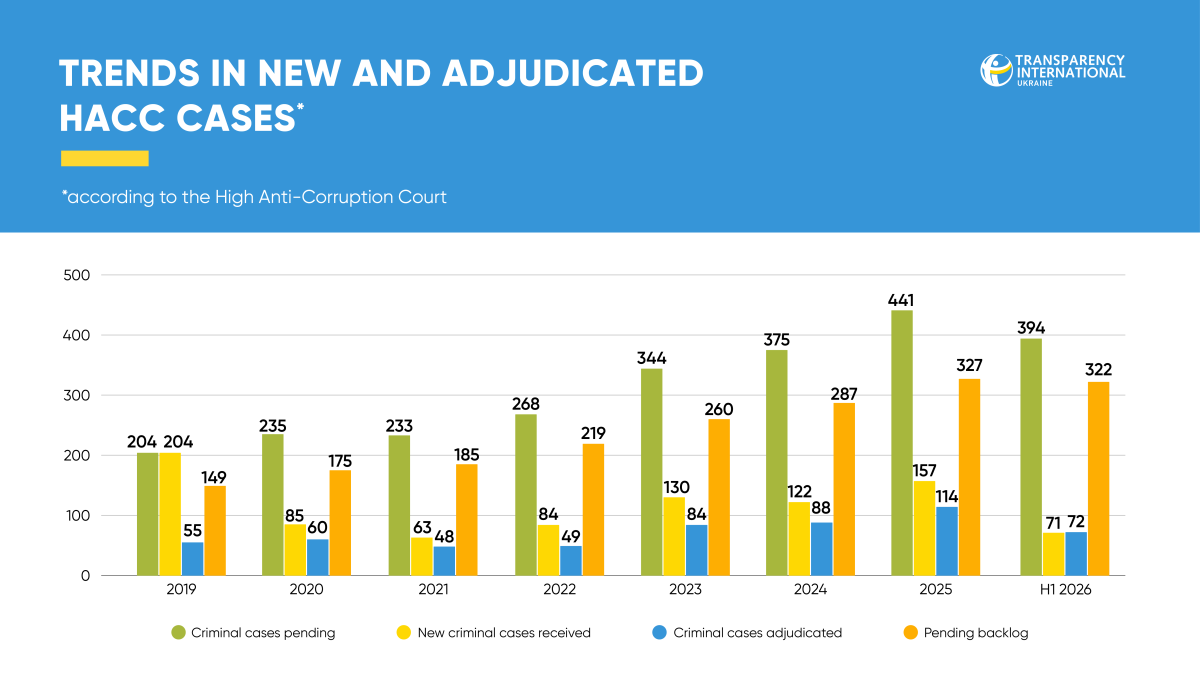
But as the court built up experience and worked on its own mistakes, the picture began to shift. In 2025, the HACC heard a record 114 criminal cases, and in the first half of 2026 the number of cases heard (72) exceeded, for the first time, the number of new ones filed (71). The years-long accumulation of pending proceedings finally halted — and even edged down, from 327 to 322 cases.
As for verdicts, in the first half of 2026 alone the HACC handed down 65: 82 persons were convicted and 8 acquitted. Given that the court delivered 109 verdicts in all of 2025, the current figures again point to a marked rise in its output. It also applied special confiscation to 10 persons, confiscating almost UAH 71.8 million in the process.
Over seven years, the HACC has handed down 431 verdicts concerning 601 persons: 398 convictions and 33 acquittals, with 211 of the convictions based on agreements. Those convicted include judges, prosecutors, heads of state enterprises, members of the government, and former and sitting members of parliament. Custodial sentences have gone, among others, to sitting MP Anatolii Hunko, former Prosecutor General’s Office official Dmytro Sus, former MP Ruslan Solvar, and Orest Furdychko, former director of the Institute of Agroecology of the NAAS.
A separate result of the HACC’s work is the civil forfeiture of unjustified assets: property worth almost UAH 230 million in total has been seized from 48 officials.
These figures capture only part of the picture. To see the fuller one, it matters how many convictions have entered into legal force, how many of those convicted are actually behind bars, and how many of them are senior officials. It is just as important to distinguish between the fines, confiscations, and compensation for damage to the state that have been imposed and those that have actually been enforced. The corresponding measure of the Rule of Law Roadmap was due to be implemented by the end of 2026.
Voluntary payments under agreements — contributions for the needs of the Armed Forces, in particular — serve a public good, but they are not a punishment, and they are hard to classify as the recovery of resources the state has lost. Even so, they show how the tools of criminal justice are being used to help replenish the budget.
So where did this positive change come from? There are several explanations.
First, single-judge proceedings — introduced in law back in 2024 — have proven their effectiveness in practice: the share of cases heard by a single judge has risen from 22% to 29% of all proceedings before the HACC.
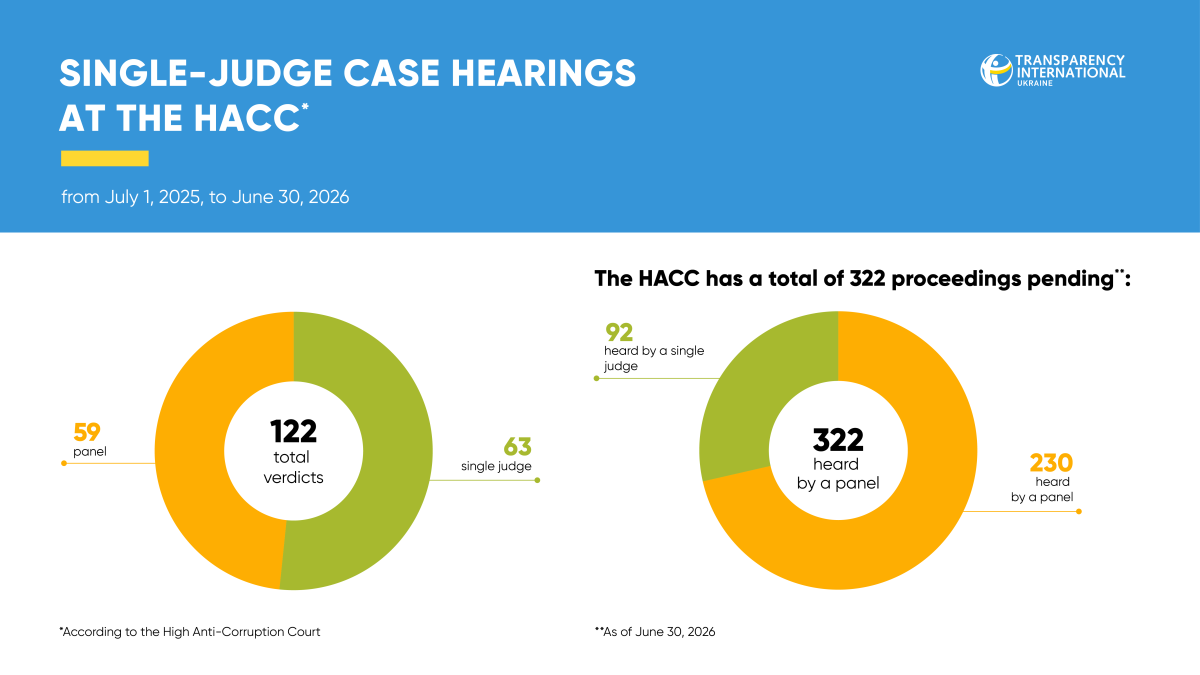
The difference in time is striking. Single-judge cases wrap up in about 11 months on average, whereas panel proceedings drag on for nearly 3 years and 9 months. In some instances a single judge proved faster still: the case of Viktoriia Poltavchenko, acting director of one of the state enterprises of an NAAS institute, took the court just 5 months. Even the longer proceedings in this format stay within relatively moderate bounds — the case of Anatolii Khmilkivskyi, a member of the Bilhorod-Dnistrovskyi District Council in Odesa Region, took exactly one year.
Another factor likely to reinforce this momentum is the court’s long-awaited new personnel. The two judges appointed through the second HACC competition are already presiding over a number of high-profile proceedings, which has noticeably eased the court’s load. And since the President of Ukraine has by now appointed a further 17 winners of the competition to judgeships at the HACC and its Appeals Chamber, the scale of the reinforcement will grow further still. The appointment of another 5 judges, meanwhile, remains in limbo.
It is also worth looking at the make-up of verdicts over the past 12 months — from July 1, 2025, to June 30, 2026. In that time, the number of verdicts based on agreements rose to 72, up from 58 in the previous 12 months, although their share of all convictions slipped slightly, from 66% to 62%.
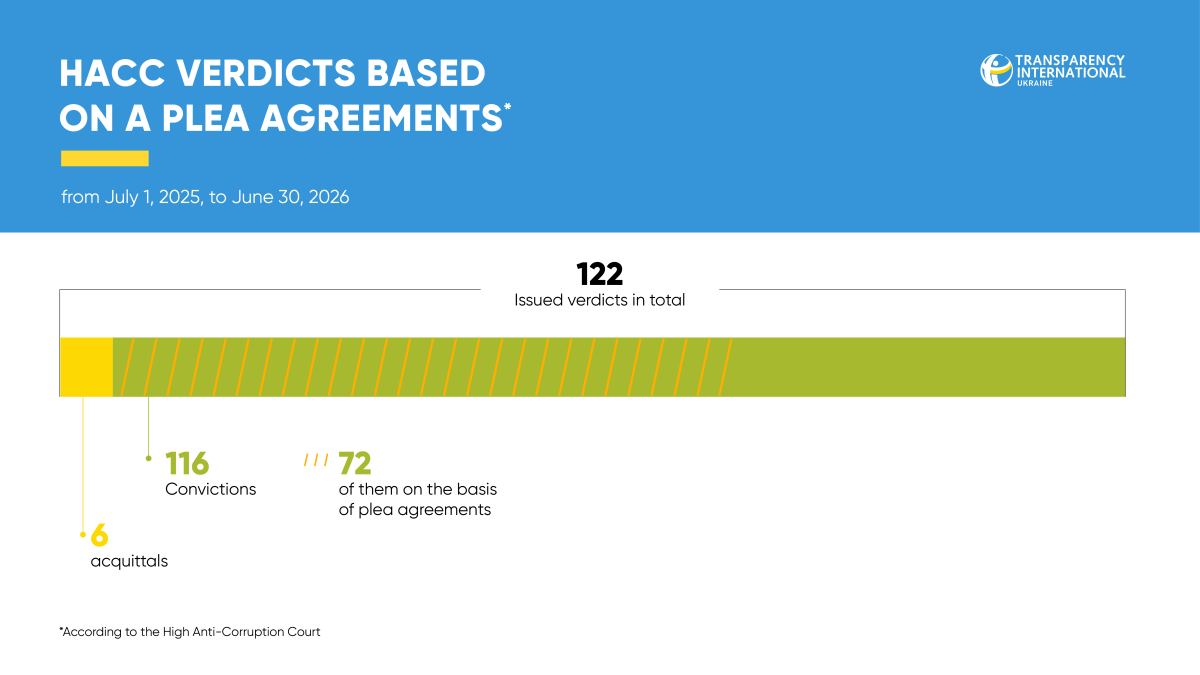
For the first time, too, there have been cases where a person convicted under an agreement still serves an actual, if shorter, sentence. Under one of the highest-profile agreements of the past year, former Chairman of the Supreme Court Vsevolod Kniaziev was nonetheless sentenced to 4 years behind bars. The approach to transparency is changing as well: in the case of Oleksii Basan, head of the Agency of Local Roads of Poltava Region, the court sealed only part of the information from public access rather than the entire verdict, as had usually been the practice. This is still an exception rather than the norm, but the very fact that the approach is being used matters.
That said, a rising number of agreements does not in itself prove they are effective. In top-level corruption cases, their value lies not only in a faster verdict but also in incriminating testimony against other participants and the organizers of schemes. Such information cannot always be made public right away, so as not to harm the ongoing investigation. But in due course it should be assessed whether that testimony led to new verdicts. For now, SAPO’s policy on concluding agreements and its criteria for “public interest” are not always clear, and some verdicts are sealed in full. So the SAPO and the HACC need not only to use this tool but also to explain its purpose and results to the public convincingly.
The numbers explain why the public views such agreements warily. Almost half of the accused undertook to transfer between UAH 10,000 and UAH 20 million for the needs of the Armed Forces, yet defendants received actual — if reduced — prison terms in only three cases. Nor did the parties agree on large fines as an additional punishment. According to a TI Ukraine survey, 60% of Ukrainians consider actual punishment — imprisonment or the confiscation of property — the main criterion of an effective fight against corruption.
It is important to understand the nature of the progress described here. It is not that the HACC has “learned” to work more effectively under unchanged conditions; rather, it shows that the tools adopted earlier by the legislature — often imperfectly drafted, riddled with gaps and ambiguities — have finally begun to yield measurable results in practice.
Single-judge proceedings, for one — unquestionably a step forward — still lack a consistent approach to when the accused may demand that a panel of judges hear the case after all. And unjustified exceptions that bar single-judge hearings for certain categories of officials (for instance, cases involving MPs’ false asset declarations) narrow the mechanism’s potential. Yet even in this half-built form, single-judge proceedings work — and, as we can see, to tangible effect.
It is not that the HACC has “learned” to work more effectively under unchanged conditions; rather, it shows that the tools adopted earlier by the legislature — often imperfectly drafted, riddled with gaps and ambiguities — have finally begun to yield measurable results in practice.
Andrii Borovyk
Why the upward trend in the HACC’s efficiency is still fragile
The reason is that the external problems — the ones whose solution depends above all on parliament — have gone unaddressed for years. Which means the progress achieved could be lost at any moment.
Take the ineffective regulation of limitation periods, which we have consistently documented since 2023: it has not merely gone unresolved but has grown worse. A lengthy trial in a top-level corruption case does not, in itself, interrupt the running of the limitation period, so proceedings can end not in a finding of guilt but in the person’s release once the time set by law has elapsed. Interrupting the period would mean that, after an event defined by law, the count starts anew rather than resuming from the point where it was suspended. Over the past year, the number of people released from liability because those periods expired rose from 13 to 22, and those released from punishment from one to nine.
The lion’s share of these closures fall under Articles 364 and 368 of the Criminal Code — among the very articles used to classify top-level corruption. On this ground, those released from liability include former Minister of Agrarian Policy Mykola Prysiazhniuk, suspected of securing an unlawful win for private firms in Agrarian Fund tenders worth more than UAH 521 million, and all four defendants at once in the case of corruption at the Odesa Port, with damages exceeding UAH 21 million. The specific problems that led to these limitation periods expiring — and the handling of such cases more broadly — can be followed on our HACC Decided platform.
Pressure on the court and attempts to reassess its institutional capacity — like what unfolded around the Vlasenko-Buzhanskyi Temporary Investigative Commission — add no stability either. We studied the commission’s report and concluded that the document rests on selective analysis and contains a good many illogical and manipulative conclusions.
The HACC’s effectiveness cannot be reduced to the ratio between the cost of running it and the money recovered for the budget. The court’s core task is independent and fair justice in top-level corruption cases, and its public value is measured also by the inevitability of punishment and by trust in its rulings.
At the same time, the public has every right to know the financial side of the HACC’s work too: how much the state spends to run it, and what volume of confiscations, fines, and compensation has not only been imposed but actually enforced. The absence of consolidated data does not make this a manipulative question — it points to the need for a separate analysis.
The commission’s own chair, Serhii Vlasenko, publicly alleged pressure and political persecution by the NABU, the SAPO, and the HACC even before the commission had finished its work — which alone casts doubt on the impartiality of its final conclusions. Episodes like this divert the court’s resources and attention from its core job.
One more point worth stating plainly again: the HACC is a body of justice, not part of an investigator-prosecutor tandem. That means the court’s task is not to produce results together with the NABU and the SAPO, but first and foremost to test the quality of their work impartially. And that is precisely why, among other things, the court must acquit defendants where the prosecution has failed to prove its case.
Let me also recall that the NABU and the SAPO are only one side of the process, alongside defense attorneys and the accused. The fact that detectives and prosecutors are pursuing ever more high-profile investigations of senior officials raises the stakes for the court, but it does not make the HACC an “extension” of the investigation. On the contrary, the prominence of these investigations underscores just how critically important the Anti-Corruption Court’s institutional independence is.
And although most high-profile proceedings — such as the Midas and Dynasty cases — are still at the investigation stage, the HACC has already shown its consistency and impartiality in choosing preventive measures for the defendants in them. The case against Yuliia Tymoshenko, by contrast, moved from pretrial investigation to trial fairly quickly. In preparing for the hearing, the defense deployed the argument that no judge could be impartial toward the politician given her long-standing rhetoric. For now, the case is at the preparatory hearing stage.
And although most high-profile proceedings — such as the Midas and Dynasty cases — are still at the investigation stage, the HACC has already shown its consistency and impartiality in choosing preventive measures for the defendants in them.
Andrii Borovyk
What it will take to turn a hint of positive change into a trend
Without legislative change, the positive trend will remain fragile. It could swing unpredictably from case to case and from period to period, depending on which proceedings happen to reach their conclusion in a given year.
To consolidate the trend, parliament needs to:
- Adopt amendments to Article 49 of the Criminal Code that genuinely interrupt — rather than merely suspend — the running of limitation periods in top-level corruption cases.
- Give the court effective tools against the abuse of procedural rights — in particular, the power to impose monetary penalties on defense attorneys.
- Abolish the automatic closure of cases over the formal expiry of pretrial investigation time limits.
- Remove the ambiguity around the point of transition to panel proceedings and scrap the unjustified exceptions to single-judge proceedings.
For years we have watched the people’s elected representatives fail to pass these changes — even though they have been raised time and again at various levels. Perhaps one reason has been that more and more MPs are themselves becoming defendants in corruption cases. Perhaps it lies in the stagnation of the Rada’s own work in the eighth year of this convocation. But these and other arguments can no longer stand as excuses for not making the changes that are needed.
New challenges have emerged, too — tied not only to the size of bail in top-level corruption cases but also to the origin of the funds that third parties and companies post on suspects’ behalf. A telling example is the bail for former minister Herman Halushchenko, which the court reduced from UAH 200 million to UAH 150 million. According to the investigation, this money was collected and laundered through dozens of enterprises and more than a hundred financial transactions, after which four companies transferred it to a dedicated HACC account. Among those the investigation suspects of organizing the scheme is Iryna Mudra, former Deputy Head of the Office of the President. Mudra herself, meanwhile, had bail set at UAH 20 million.
These cases raise a broader question: who should verify that bail money is of lawful origin, and at what stage — and should the court react if the money comes from companies with a questionable financial history? The same goes for the compensation, restitution, and payments to the Armed Forces made under agreements: is the origin of these funds, and of the payers themselves, ever checked? The relevant legislative initiatives have already been registered in the Verkhovna Rada, but their consideration remains in limbo. We will describe the possible mechanisms for such checks, and the specifics of concluding plea agreements in top-level corruption cases, in separate materials.
How transparent and well-reasoned bail decisions are will determine trust in preventive measures in top-level corruption cases. The effectiveness of agreements, by contrast, should be judged by other criteria: the fairness of the punishment, the value of the incriminating testimony, the recovery of lost resources for the state, and a result the public can understand.
Since returning from recess, MPs have not taken up a single anti-corruption initiative. They even struck from the agenda the draft Anti-Corruption Strategy for 2026–2030 — and the timely adoption of that document, by the end of September, is tied not only to a coherent fight against corruption but also to Ukraine’s financial support under the Ukraine Facility Plan. This matters for the HACC as well: without a coherent state anti-corruption policy, the legislative amendments the court needs will keep being passed piecemeal or postponed.
As long as parliament keeps putting off the decisions that are needed, the progress the HACC has achieved will remain fragile.
For years we have watched the people's elected representatives fail to pass these changes — even though they have been raised time and again at various levels. Perhaps one reason has been that more and more MPs are themselves becoming defendants in corruption cases. Perhaps it lies in the stagnation of the Rada's own work in the eighth year of this convocation.
Andrii Borovyk
Source: zn.ua


