


ARMA’s Next Head: How the Selection Will Work and Who Can Apply
January 9, 2026
Until January 19, 2026, the Commission tasked with selecting the Head of ARMA will accept applications from anyone wishing to lead the institution. Let’s unpack why it matters that qualified and ethical professionals apply for this position, and how the competition will be conducted.
Until January 19, 2026, the Commission tasked with selecting the Head of ARMA will accept applications from anyone wishing to lead the institution. Let’s unpack why it matters that qualified and ethical professionals apply for this position, and how the competition will be conducted.
One of the most significant anti-corruption outcomes of 2025 was the launch of the reform of the Asset Recovery and Management Agency (ARMA). In addition to important improvements in governance and the introduction of external audits of the Agency, the new law contains meaningful changes to how the institution’s leadership will be selected.
It is worth noting that ARMA has not been particularly fortunate with its leaders—something that, in part, shows why reform became unavoidable. The first Head, Anton Yanchuk, held the position for more than three years and left amid scandal: to this day, the High Anti-Corruption Court is considering a corruption case in which he is one of the defendants. After Yanchuk’s dismissal, things did not get easier—ARMA was run for more than three years by acting heads, whose integrity and transparency also raised questions. Meanwhile, the competition for a new Head repeatedly stalled and was re-announced.
Eventually, in the summer of 2023, ARMA was headed by Olena Duma. Even before she won the competition, we had many questions about her candidacy, particularly regarding her competence and impartiality. Later, even more questions emerged: as Head of ARMA, Ms Duma appeared to prioritize PR over results, while the Agency’s real operational problems only deepened. And although the need to reform ARMA had been growing for some time, it was under Olena Duma’s leadership that the institution’s shortcomings became especially acute, while her reaction to criticism was markedly negative.
On July 30, 2025, the law that launched ARMA’s genuine reform entered into force. These changes are a response to years of governance problems and a chronic crisis of trust in the institution. And, oddly enough, on that very day Olena Duma submitted her resignation. This became the starting point for a new competition for ARMA’s Head—now to be conducted under the new rules. At this moment, it is critically important that strong, independent, and motivated candidates participate, people capable of turning ARMA into an effective state instrument rather than a constant source of scandals.
One of the most significant anti-corruption outcomes of 2025 was the launch of the reform of the ARMA. The new law contains meaningful changes to how the institution’s leadership will be selected.
Andrii Borovyk
What exactly has changed in the approach to the competition
The new selection procedure gives a key role to experts delegated by international partners: without their votes, it becomes impossible to adopt any decision. This is a significant step forward compared to the previous model, which left the competition more vulnerable to undue political influence.
Previously, the selection commission consisted of three representatives of the Verkhovna Rada and one representative each from the Prosecutor General, the NABU Director, the Minister of Justice, the Head of the State Financial Monitoring Service, and the Minister of Finance. The new model, by contrast, provides for a six-member commission appointed by the government. At the same time, the Cabinet of Ministers must appoint half of its members based on nominations from international development partners.
The pool of potential candidates has also expanded. From now on, not only lawyers, as in prior selections, but also economists may apply, which significantly broadens the range of professionals. In addition, the law introduced a mandatory requirement that the new Head of ARMA command one of the official languages of the Council of Europe.
The law also detailed the integrity and professional competence criteria for candidates—shortcomings that TI Ukraine repeatedly highlighted in its publications. The political neutrality requirement has been strengthened as well: candidates must now have no ties to political parties for two years, whereas previously the cooling-off period was one year.
Finally, the selection procedure has been supplemented with a stage involving practical tasks. By decision of the commission, additional testing or other assignments may also be introduced. The current commission selecting ARMA’s Head has already approved all of these elements.
The new selection procedure gives a key role to experts delegated by international partners: without their votes, it becomes impossible to adopt any decision.
Andrii Borovyk
Who can take part in the competition and how
As provided by the new law, preparations for the new selection of ARMA’s Head began practically immediately after Olena Duma’s dismissal. On September 25, the Cabinet of Ministers appointed members of the selection commission, and on November 20, it held its first meeting.
Then, on December 19, the start of document submission was announced—anyone willing to take part may apply until January 19.
As I have already mentioned, the competition is now open to a wider circle of candidates. A person may apply for the position of ARMA Head if they are a citizen of Ukraine, have a higher legal or economic education, at least five years of professional experience and at least three years of managerial experience, are fluent in the state language and one of the official languages of the Council of Europe, and meet integrity and competence requirements. All requirements are set out in detail on the Cabinet of Ministers’ website.
However, submitting documents is only the first stage. In addition to the above, the Commission has approved the criteria and methodology for evaluating candidates as well as the procedure for conducting the competition. It also described in detail all stages that applicants will need to pass.
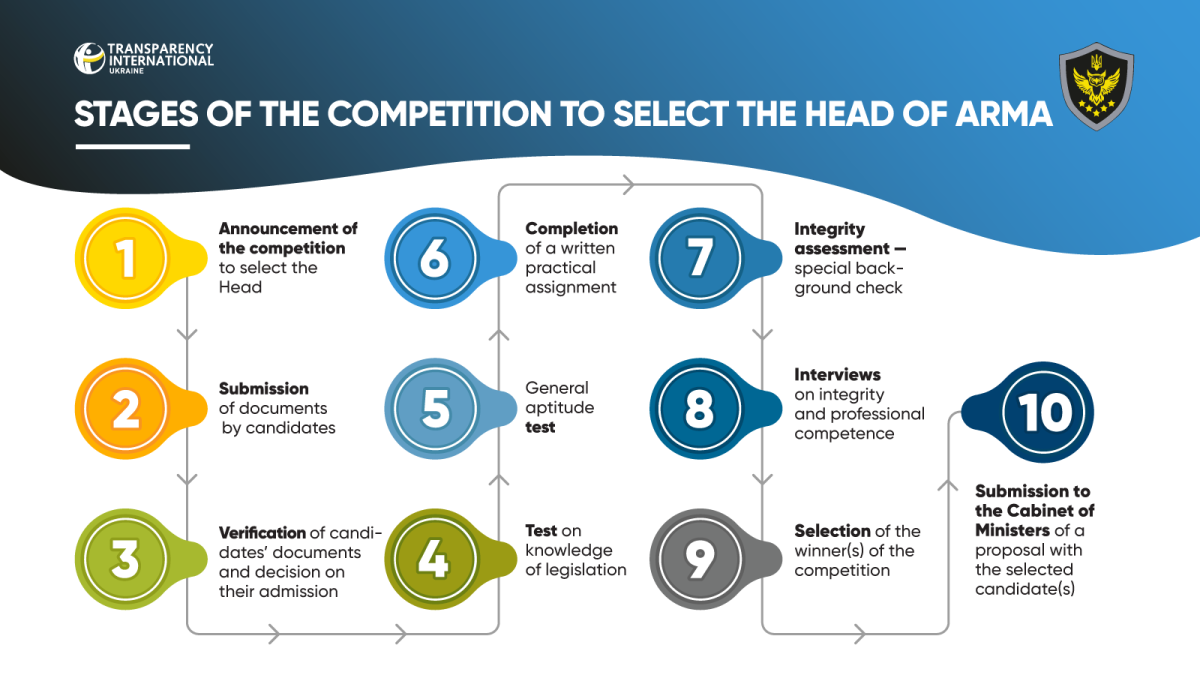
The competition itself is intended to be as transparent as possible. Before adopting the above-mentioned evaluation criteria and methodology and the competition procedure, the Commission presented them for public comment and reviewed all feedback received in order to refine these documents. In addition, at its most recent meeting, commission members explained how knowledge and skills would be assessed and stated that the practical assignments completed by participants would be made public.
And, of course, all interviews assessing integrity and professionalism will also be public—so anyone interested will be able to watch and form their own impression of who may go on to lead the Asset Recovery and Management Agency.
On December 19 the start of document submission was announced—anyone willing to take part may apply until January 19.
Andrii Borovyk
***
ARMA’s reform is a necessary step towards building an effective system for managing seized assets obtained through corruption and other crimes. The institution was created to prevent losses, both for asset owners and for the state, if seized assets are ultimately confiscated. But so far, the Agency has not achieved these goals. And, unfortunately, an obstacle has too often been the reluctance of previous Heads to initiate and properly implement the necessary changes.
That is precisely why meaningful reform of ARMA is impossible without professional leadership of the institution. We therefore call on all ethical professionals to apply for the competition.
The institution was created to prevent losses, both for asset owners and for the state, if seized assets are ultimately confiscated. But so far, the Agency has not achieved these goals.
Andrii Borovyk
Source: biz.nv.ua


