


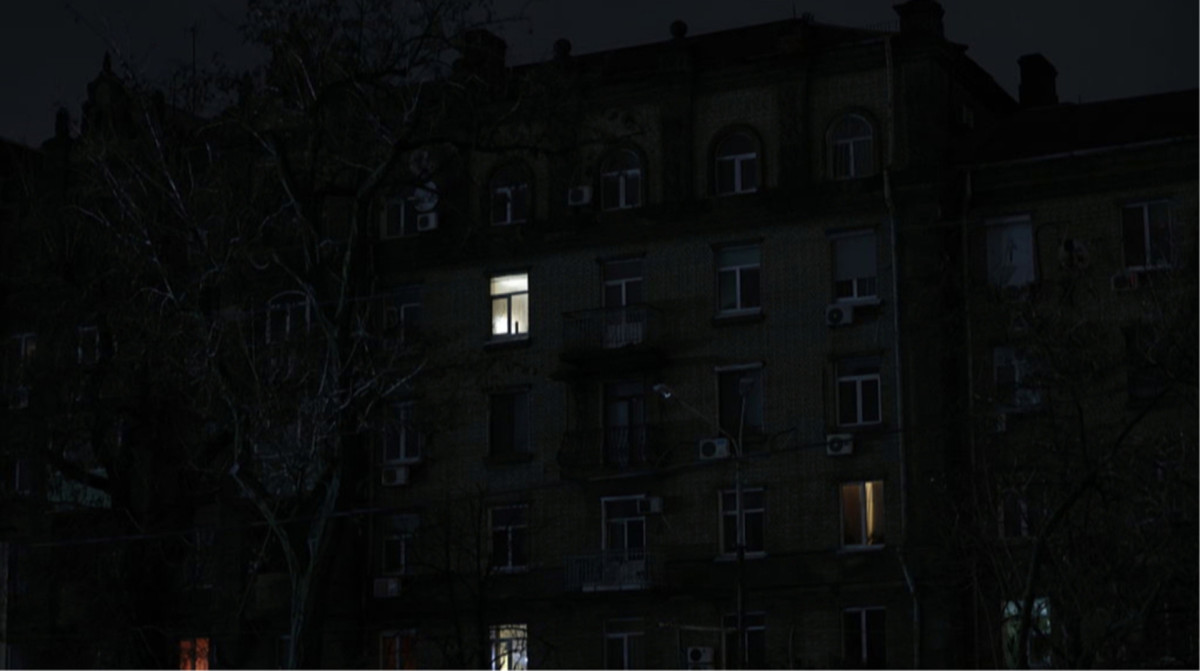

For Ukrainians, the New Year began with massive strikes on energy infrastructure. Russia has not abandoned its goal of leaving the country in darkness and cold. As a result of drone and missile attacks, thousands of people were left without electricity and heating. Kyiv is experiencing one of the most severe energy crises in its history. After another strike on the night of December 19–20, more than 5,000 apartment buildings were again left without heating. In some areas, electricity has been out for several days at a time, and ground-based electric public transport is not operating.
However, the situation is difficult not only in the capital. Emergency outages caused by Russia’s ongoing strikes on energy infrastructure continue in Odesa, Sumy, Kharkiv, and Chernihiv regions. Scheduled rolling outages by the hour have become the norm across the country.
In such harsh conditions, it may seem as if cities did not prepare for this scenario. The DOZORRO TI Ukraine team analyzed what municipalities purchased through Prozorro last year to see whether that is really the case.
UAH 20 billion under contract
In 2025, UAH 20 billion was contracted through Prozorro to strengthen cities’ energy resilience. This funding covered equipment as well as installation and repair work and the development of design documentation. A year earlier, contracts for these needs totaled more than UAH 13 billion—meaning demand for energy autonomy increased by almost 1.5 times.
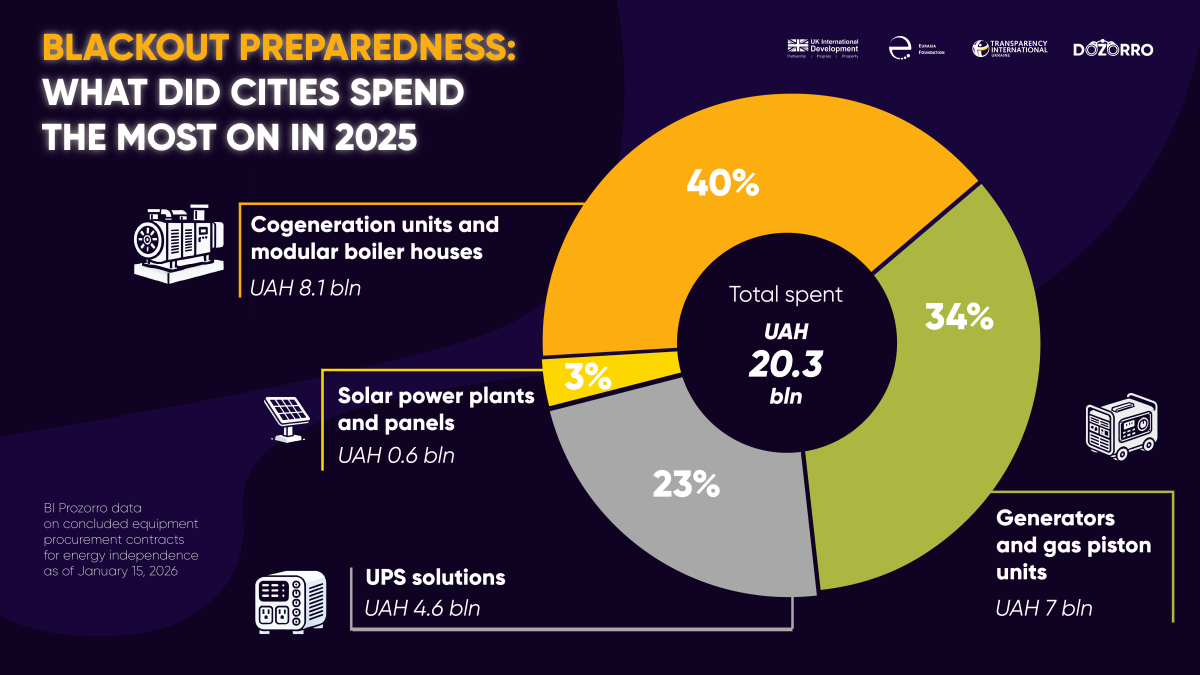
The largest share of contracts last year went to procurements aimed at ensuring heating—UAH 8.1 billion. Of this amount, UAH 3.4 billion involved agreements for modular boiler houses, while the rest related to cogeneration units, primarily work to install them. The most frequently ordered items last year were uninterrupted power solutions—batteries, inverters, charging stations, and related services. In addition, procuring entities purchased solar power plants, generators, and other equipment.
By contract value, 29% of procurements were conducted through special open tenders, 64% through direct contracts, 3% via request for price quotations, and another 4% via the simplified procurement procedure.
According to BI Prozorro’s public analytics module, an average of 2.4 companies submitted bids for procurements of goods, services, and works aimed at improving cities’ energy resilience.
Procurements totaling more than UAH 3.2 billion are still active. Among them is one of the year’s largest tenders, run by Kryvorizka Teplotsentral JSC. The company is procuring the construction of cogeneration gas piston units with a total electric capacity of 75.2 MW. The agreement is planned to be signed with Production-Commercial Enterprise Kotlogaz LLC, which estimated the cost of the works at UAH 1.3 billion.
In Sumy region, last year’s procurement of six block-type gas modular boiler houses is still ongoing. Contracts worth UAH 256 million are expected to be signed with Brovary Factory of Boiler Equipment Ardenz Additional Liability Company, and Atonmash LLC at the request of the Capital Construction Department of the Shostka City Council.
Leading regions
The clear leader by the value of signed contracts was the Kyiv region—UAH 9.6 billion, nearly half of all funding. However, this does not mean the equipment purchased was intended exclusively for the capital region. Kyiv is home to major procuring entities that purchase and install expensive equipment that later benefits the country as a whole. Most notably, Gas Transmission System Operator of Ukraine LLC and Ukrhydroenergo PJSC. If these major procuring entities are excluded, the contracted amount in Kyiv region falls to approximately UAH 3.3 billion. The largest contracts specifically for local communities were signed for cogeneration units in the capital and for uninterrupted power supply equipment for the system that controls the safe movement of metro trains.
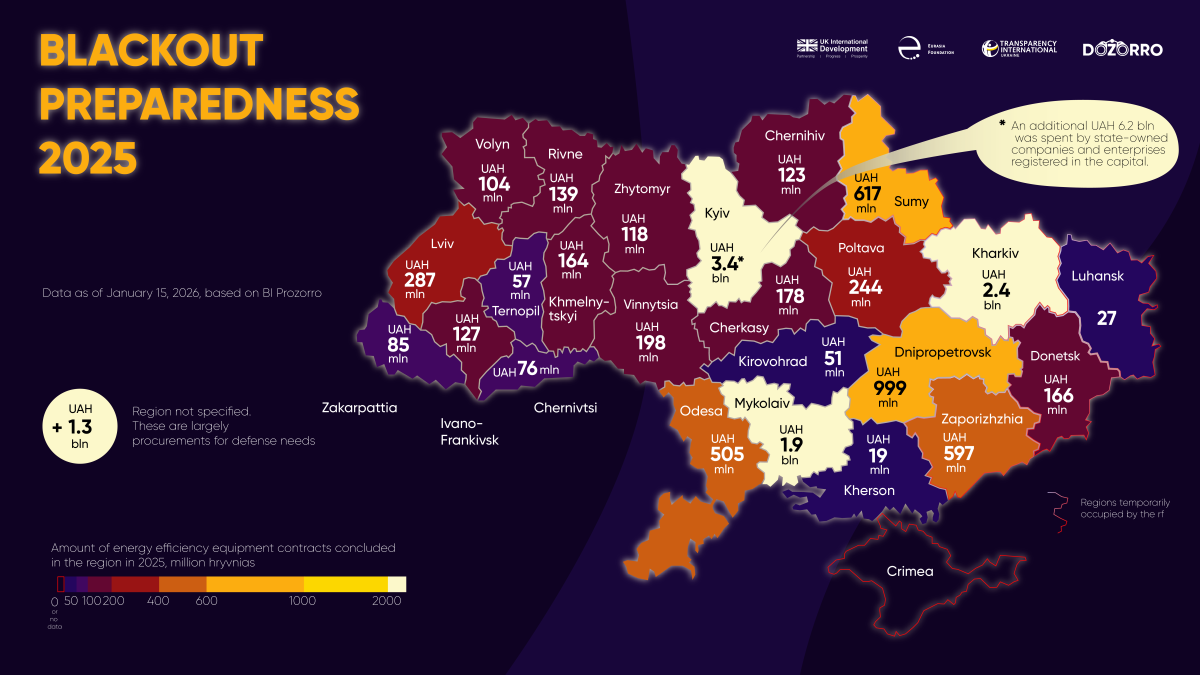
Second in the ranking is Kharkiv region, where local procuring entities contracted nearly UAH 2.4 billion. Most of this amount consisted of contracts for district heating equipment.
Next comes Mykolaiv region with UAH 1.9 billion, of which UAH 1.7 billion went toward securing heating in Mykolaiv. In fourth place is Dnipropetrovsk region with UAH 999 million, including almost UAH 200,000 allocated to solar power plants. Rounding out the top five is Sumy region with UAH 617 million; most contracts there related to ensuring heating in the city of Sumy.
Another UAH 1.3 billion falls under procurements where the region was not specified, meaning they could not be included in the regional analysis. Ninety-nine percent of those procurements were for defense needs.
Uninterrupted power supplies
Last year, uninterrupted power supply (UPS) solutions were among the most common items in the Prozorro system. Batteries, inverters, and charging stations help keep critical systems running during emergency outages. A total of UAH 4.6 billion was contracted for these items and related services.
The largest value of contracts for this equipment was signed by PrivatBank—UAH 364 million. In November, the bank ordered Chinese LiFePo4 battery packs of various capacities for 6–20 kW inverters, as well as three inverters with installation. Delivery is scheduled by the end of 2026.
Kyivteleservice Specialized Municipal Enterprise also invested heavily in backup power. The company ensures the operation of television as well as wired, wireless, and satellite communications in the capital. In total, the company contracted UAH 133 million for backup power solutions. It procured 213 UPS systems with installation and related equipment, including batteries and solar inverters. It also purchased 172 UPS kits for Wi-Fi in educational institutions—systems that keep working during outages and allow equipment to be controlled remotely. In addition, the company ordered 95 anti-vandal UPS systems with remote monitoring and installation. All of this equipment was expected to be delivered by the end of 2025.
Backup power was also a major focus for the Kyiv Metro. In March, June, and October, Kyiv Metropolitan Municipal Enterprise contracted UAH 165 million for nine German-made BENNING UPS systems for railway automation devices. These systems keep signaling, interlocking, and track-blocking systems operating during emergency power outages. Six systems have already been delivered, and the remaining three are to be installed by the end of May.
What was procured for heating
To ensure Ukrainian cities could keep heat and electricity on even during attacks on the energy system, in 2025 they actively procured gas piston cogeneration units—also known as mini-CHP plants. These units produce electricity and heat simultaneously, run on gas, and provide autonomous heating and power supply.
In 2025, Prozorro recorded more than a thousand procurements related to purchasing and installing cogeneration units. The total contract value was about UAH 4.7 billion, with most of the funds directed specifically to installation. This is likely because many communities received cogeneration units free of charge from international partners. According to Ukraine’s Ministry for Communities and Territories Development, 566 cogeneration units, 368 modular boiler houses, and 28 gas turbine units were delivered to the country. Some of this equipment is already operating, while the rest is still being installed.
Kharkiv Metro Municipal Enterprise was the only entity last year that purchased cogeneration units. The company signed three agreements with the Czech company RSE s.r.o. totaling UAH 628 million and procured 13 cogeneration units—five in January, three in April, and five in June. The units ordered in January and April were to be delivered by the end of the year, while those ordered in June are scheduled for delivery by June 2026.
The peak month by contract value for cogeneration installation was November (UAH 786 million), while the highest number of contracts was signed in December (157).
The Kyiv region contracted the largest amount for installing cogeneration units and arranging protective infrastructure for them—more than UAH 1.9 billion. All these contracts were commissioned by Kyivteploenergo Municipal Enterprise. Some of the work was to be completed by the end of the year, with the rest scheduled for 2026.
Second place was Kharkiv region, with contracts worth UAH 1.6 billion. About a third of that amount was allocated by Kharkiv Heat Networks Municipal Enterprise to build and deploy modular gas cogeneration units across the city. Some were installed last year; others are to be built in 2026.
Third is Zaporizhzhia region—UAH 423 million. The largest project was commissioned by the Capital Construction Department of the Zaporizhzhia Regional State Administration. It involves reconstructing the district heating system with the installation of gas piston cogeneration units. The work was estimated at UAH 270 million, with completion planned for October 2026.
In addition, about UAH 3.4 billion was spent in 2025 on procuring block-modular boiler houses, as well as their installation and repair. The largest project is being implemented in Mykolaiv. The Department of Urban Planning, Architecture, Capital Construction, and Development Project Support of the Mykolaiv Regional State Administration contracted UAH 1.7 billion to build a distributed heat generation network and supply 18 block-modular boiler houses of various capacities for the city. Toward the end of last year, local media reported that installation work was nearing completion—the boiler houses are expected to keep the residential sector heated even during enemy strikes or disruptions at the CHP plant.
In Sumy, the city council’s Infrastructure Department ordered 20 block-modular boiler houses in November for UAH 448 million. By December 25, 2025, 16 boiler houses were to be delivered by Brovary Factory of Boiler Equipment Ardenz Additional Liability Company, while the remaining four were to be supplied by Atonmash LLC.
Generators: backup for critical infrastructure
Generators—gasoline, diesel, and gas—help maintain the operation of key facilities and emergency services. They were not only procured but also installed, serviced, and repaired. Generators were most commonly procured by municipal enterprises, Ukrhydroenergo PJSC, NAEC Energoatom SE, Gas Transmission System Operator of Ukraine LLC, as well as military units. As in 2024, demand in 2025 remained strong for turbogenerators—gas turbine generator sets that produce electricity by burning gas to spin a turbine. These units are used for autonomous or backup power supply for large facilities and entire segments of the power system, particularly in emergencies or during mass outages.
The year’s largest procurement concerned gas turbine equipment. Ukrnafta JSC contracted UAH 1.9 billion for it with the German contractor Siemens Energy AB, with delivery expected in 2025.
Gas Transmission System Operator of Ukraine LLC was not far behind. The company signed two contracts to purchase seven gas turbine generator sets worth UAH 1.3 billion in total. The units were to be delivered last year. In addition, for UAH 603,000 the company ordered five gas turbine engines with a capacity of 6.5 MW each, together with an installation kit. One is expected to be received this year, and another five in 2027.
Among other major generator buyers is Kyivvodokanal PJSC, which ordered nine diesel generators worth UAH 243 million. Delivery is expected by the end of February 2026.
It is also important to remember that, alongside domestic procurement, international partners provided substantial assistance to supply medical and other critical facilities with electricity. The EU and Germany jointly financed the purchase of 143 generators, which were transferred to Ukraine’s Ministry of Health for more than 100 medical facilities across 20 regions.
Solar power plants
Last year, cities continued procuring solar power plants for schools, hospitals, and other institutions.
The most active procuring entity was the Dnipro City Council. Its Department of Humanitarian Policy signed five agreements to purchase solar power plants of various capacities worth UAH 194 million—and they have already been installed. Another UAH 21.3 million for solar power plants to equip lyceums was contracted by the Centralized Procurement Organization Municipal Enterprise of the Dnipro City Council.
All these procurements were carried out in cooperation with Synergy Installation and Construction LLC, with which contracts totaling more than UAH 200 million were signed. This is what made Dnipropetrovsk region the leader by the value of solar power procurement.
The installation of solar power plants in municipal educational institutions is expected to continue. This is envisaged in the Safe Educational Environment Program for 2023–2027, approved by a decision of the Dnipro City Council.
The procurement analysis shows that Ukrainian cities did prepare for blackouts in 2025. And this was not the first year of such transactions: last year, the value of contracted energy equipment was 1.5 times higher than in 2024. Beyond Prozorro procurements, international partners also transferred a significant share of the equipment. Still, this is not enough to fully protect the country from the consequences of attacks on energy infrastructure. Could preparations have been stronger? Probably, yes. However, during cold and dark days, it is important to remember that responsibility lies with Russia, which strikes energy facilities almost daily. For our part, we should draw lessons from this year’s experience and invest in preparations for next winter already now—approaching the process in a more strategic and systematic way.
This material was prepared within the framework of the “Digitalization for Growth, Integrity, and Transparency” (UK DIGIT) project, implemented by the Eurasia Foundation and funded by UK Dev. The material was produced with the financial support of the UK Government’s International Development Assistance Programme. The contents of this material are the sole responsibility of Transparency International Ukraine; the views expressed do not necessarily reflect the official policy of the Government of the United Kingdom.
Source: glavcom.ua


