


Joint Statement
by Refat Chubarov, Chairman of the Mejlis of the Crimean Tatar People, and Andrii Borovyk, Executive Director of Transparency International Ukraine
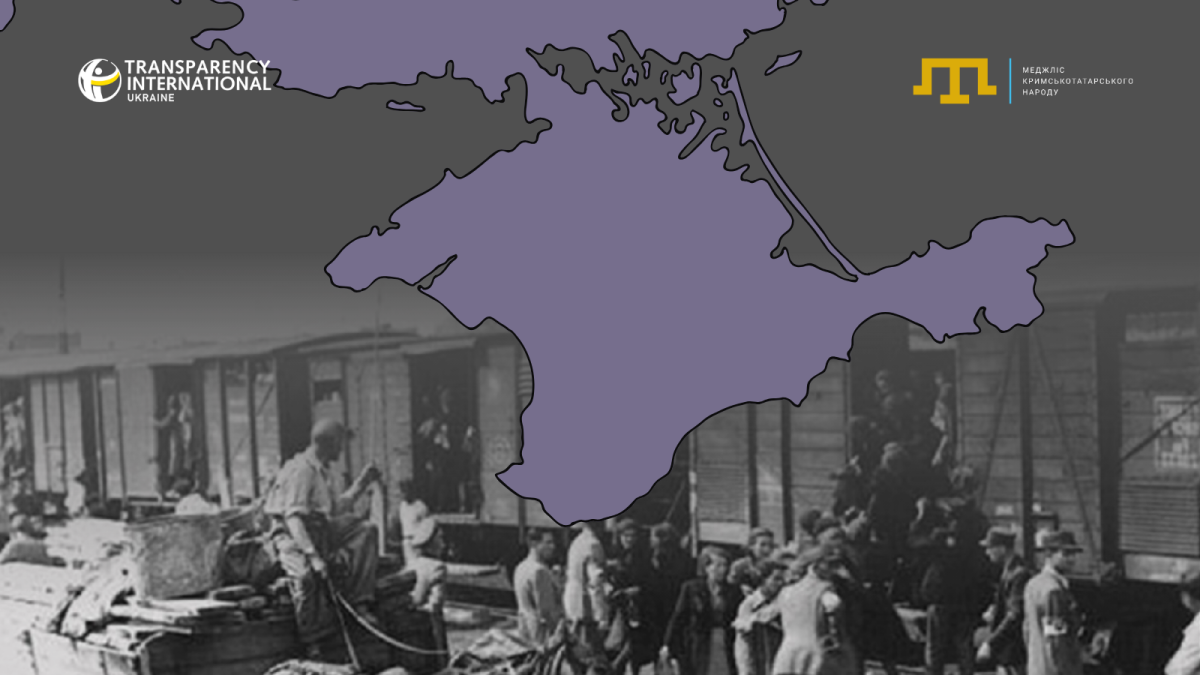
Each year on May 18, Ukraine and the world commemorate the victims of the genocide of the Crimean Tatar people — the 1944 deportation, which took the lives of tens of thousands and shattered the fates of several generations of Crimean Tatars.
Eighty-two years on, the scenario is repeating itself. With the occupation of Crimea, the Russian authorities began systematically persecuting the Crimean Tatar people. Unlawful searches, arrests, enforced disappearances of civic activists and journalists, and the ban on the Mejlis of the Crimean Tatar People — all of this is a deliberate policy aimed at destroying Crimean Tatar identity. Today, 181 of the 358 political prisoners unlawfully held in Crimea are Crimean Tatars. Crimes of this kind demand a clear response.
Andrii Borovyk, Executive Director of TI Ukraine, and Refat Chubarov, Chairman of the Mejlis of the Crimean Tatar People, call on international partners to step up sanctions pressure on the Russian state, its leadership, and all of its officials. They must answer for the repression and persecution of the indigenous Crimean Tatar people.
Today, the Russian Federation is the most heavily sanctioned country in the world — the natural consequence of long-standing crimes under international law that the global community left unaddressed for too long. The 1944 genocide of the Crimean Tatar people, the ongoing occupation of Crimea, and the full-scale armed invasion are not isolated episodes but a consistent imperial policy aimed at destroying nations. The sanctions imposed in response to the aggression against Ukraine must be a decisive step toward systemic accountability for the Russian Federation under international law and toward making punishment inevitable.
However, a serious risk remains that the policies of certain states toward Russia may shift, as we are once again hearing of moves to ease economic pressure on an aggressor that systematically violates international law. Unity in imposing and enforcing sanctions is essential to their effectiveness, and any easing of pressure by individual states undermines the overall result.
The European Union is currently preparing its 21st sanctions package, expected to be adopted in the summer of 2026. Yet despite the 20 packages already in force, Russia continues to find the resources to wage its war. That is why it is critical to impose secondary sanctions against third countries and companies that help Russia circumvent the restrictions and sustain its aggression.
“It is essential that the international community does not stop here: sanctions pressure must deepen, reach new sectors of the aggressor’s economy, and become part of a broader mechanism of justice — for Ukraine, for the Crimean Tatars, and for all who have suffered from Russian imperialism,” said Andrii Borovyk, Executive Director of TI Ukraine.
“Governments, world leaders, and the international community as a whole must speak with one voice against the Russian Federation’s deliberate policy of driving the indigenous Crimean Tatar people from their homeland, Crimea. These actions are a continuation of the genocidal policies pursued against the Crimean Tatars by the Russian Empire and later by the Soviet Union. The Russian Federation must be compelled to withdraw its occupying forces from the territory of Ukraine, including the Autonomous Republic of Crimea and the city of Sevastopol,” said Refat Chubarov, Chairman of the Mejlis of the Crimean Tatar People.
Memory without accountability is not justice!
It is essential that the international community does not stop here: sanctions pressure must deepen, reach new sectors of the aggressor's economy, and become part of a broader mechanism of justice — for Ukraine, for the Crimean Tatars, and for all who have suffered from Russian imperialism.
Andrii Borovyk


