



In 2025, the Transparent Cities program launched a pilot study format to assess how ready Ukrainian cities are for EU integration. The criteria of the European City Index are aligned with key EU integration documents. The program’s experts have already assessed how municipalities ensure openness on their websites, handle e-services and open data, manage public finances, and counter corruption. The sixth and final stage of the study was an analysis of accountability.
Under martial law, maintaining and expanding the accountability of local self-government bodies is a critical prerequisite for sustaining dialogue with society. Regular and meaningful reporting is one of the key ways for city authorities to obtain feedback from residents, and for the community to influence decision-making outside the electoral process.
Overall, accountability shows whether a city council is able to explain its decisions, obtain feedback, and adjust its work. When these practices are embedded in procedures and function regularly, they make the institution stronger. Decisions depend less on individual officials, residents understand what the authorities are doing, and the city council keeps its capacity for mature dialogue even in times of crisis.
The Accountability subindex aims to establish whether city councils are answerable to citizens. It thereby rounds off the comprehensive assessment of transparency, effectiveness, and EU alignment of municipal governance in 2025.
Research methodology
As with the previous subindexes, the EU integration dimension of this study draws on three sources: the 12 Principles of Good Democratic Governance developed by the Council of Europe as the main benchmark for effective and honest public administration at all levels; the provisions of the Ukraine Facility Plan; the recommendations of the European Commission’s Enlargement Reports for 2023–2025.
In its 2025 Report, the EC analyzed public administration reform across six areas, one of which is the accountability of public administration itself. It concluded that Ukraine’s system of public accountability remains broadly functional, although a number of mechanisms still need improvement (Section 2.1.2 of the Report). These assessments primarily concern the national level. However, the requirement of accountability to citizens applies equally to local authorities as part of the multilevel governance Ukraine aspires to.
The indicators were also developed through the lens of the SIGMA principles (Support for Improvement in Governance and Management), a joint initiative of the OECD and the European Commission. SIGMA identifies accountability as one of the core foundations of good public governance: authorities must report on their decisions and actions, and citizens must have legally guaranteed access to this information.
EU integration requires cities to implement new requirements and, at the same time, to build the institutional capacity to apply them consistently. Accountability is one lens for testing this. Does the municipality have stable reporting rules, effective channels of engagement, and a practice of explaining its performance to the community?
The pilot sample included the city councils of 10 regional capitals (Dnipro, Zaporizhzhia, Kropyvnytskyi, Lutsk, Lviv, Odesa, Poltava, Kharkiv, Khmelnytskyi, Chernihiv) and the city of Kyiv. The selected cities represent different levels of transparency according to the program’s previous studies; all macro-regions of Ukraine; different wartime contexts, including both rear cities and cities included in the List of Territories of Potential Hostilities.
Analysts assessed the cities’ accountability against 40 indicators, with a maximum score of 100 points. The Subindex combined three groups of criteria that examine accountability at different levels, from the official publication of documents to the actual conduct of officials when dealing with citizens.
More than half of the assessment criteria in this area concerned formal accountability (21 indicators with a maximum score of 43 points). Experts checked whether the city council had published its key annual reports for 2025: monitoring of the Territorial Community Development Strategy; the work of individual standing committees; citizens’ appeals and requests for public information; reports on humanitarian aid, regulatory policy, anti-corruption activities, informatization, and open data.
Six indicators in this group were assessed on a “single entry point” basis. If a separate thematic section of the website was absent, was not structured, or did not contain a link to the report, the city received 0 points. Almost all of the required “single entry points” had been examined in the previous five subindexes. The only new one analysts looked for was a section on barrier-free accessibility.
Six indicators concerned two reports that must be presented publicly, directly to the community: the mayor’s report on their own performance and the budget execution report. Two more indicators in the group addressed open datasets that local self-government bodies are required to publish: “Reports, including on handling requests for information” and “Results of the information audit.”
Analysts collected data on the 2025 annual reports in July 2026.
A separate group of indicators was assessed through content analysis. These 15 criteria, with a maximum score of 45 points, evaluated how the city council communicates its reporting. The content analysis covered posts published during the active reporting period, from December 1, 2025 to March 15, 2026, in four places: the news section of the city council’s website; the official social media pages of local self-government bodies; five local media outlets; social media beyond the official channels.
The final group of four indicators concerned “mystery checks” (maximum 12 points). They were designed to test the quality and substance of the authorities’ engagement with the community. The checks simulated an ordinary citizen contacting the city council through two channels. The first channel was a formal written request for public information on the 2025 budget execution report. It was assessed on compliance with the 5-day deadline and on the substance of the response. The requests were sent on April 1, 2026. Khmelnytskyi City Council received its request on April 23, 2026 because of a technical failure during the initial submission. The second channel was a phone call to the city council’s official contact number about the 2025 report on municipal property management. It was assessed on whether the call was answered and whether a substantive consultation was provided within no more than two redirections between departments. The program’s experts made the calls on July 28, 2026.
Research results
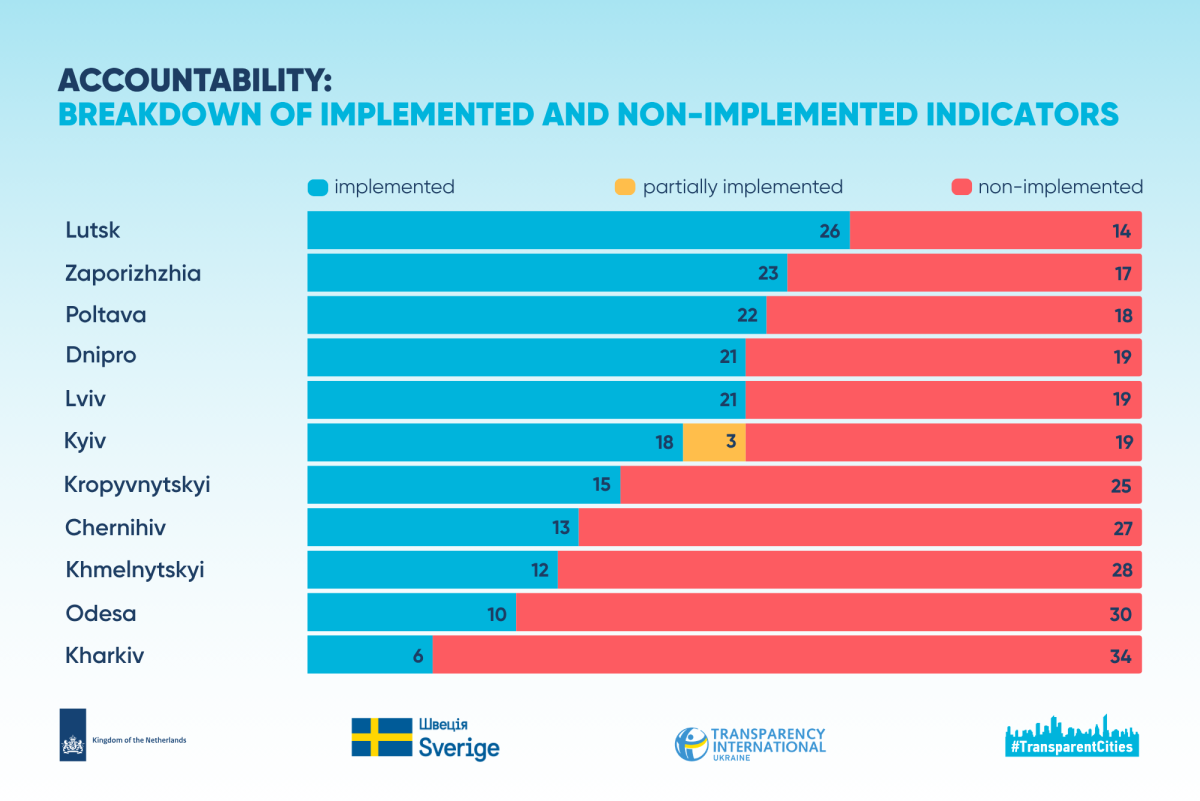
The average level of compliance with the 40 indicators of the “Accountability” block is 43.3%.
Lutsk achieved the highest result: 68 out of 100 possible points. Zaporizhzhia came second with 60 points, followed by Poltava with 58. Kharkiv (14), Odesa (24), and Khmelnytskyi (29) scored the lowest.
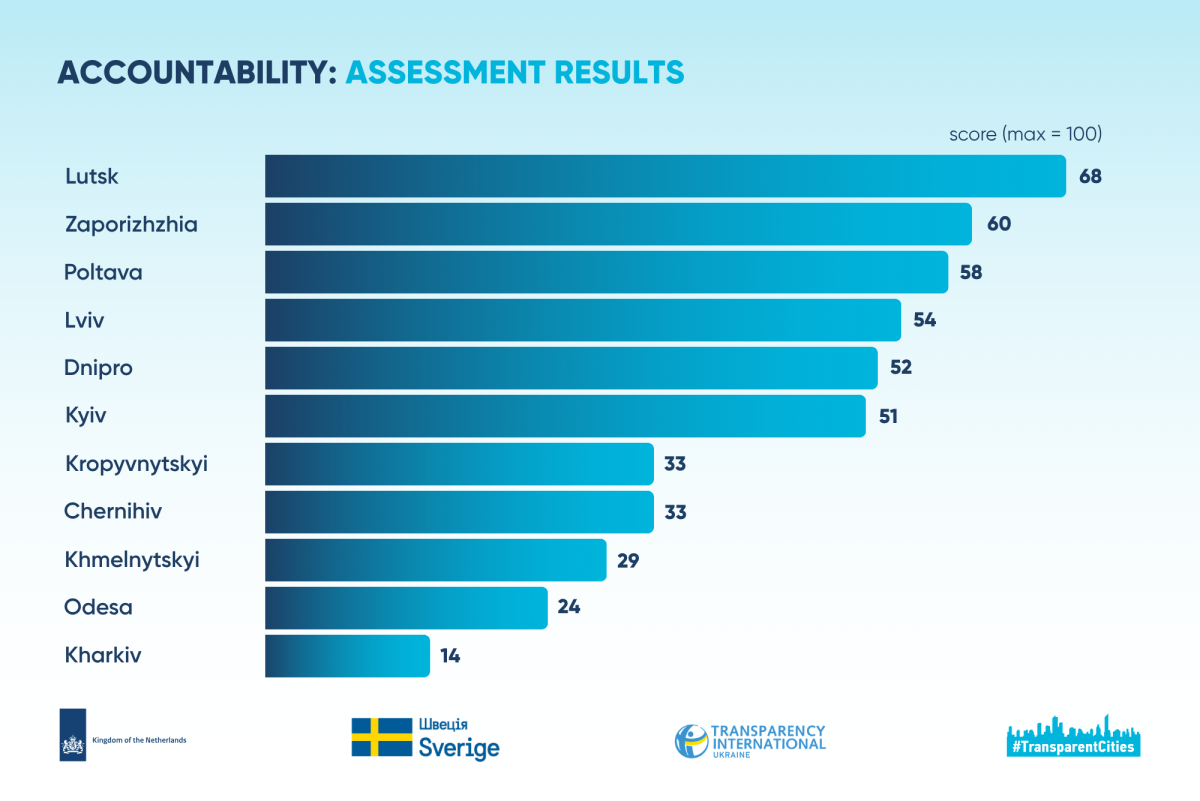 This block of the study produced the most uneven results. The gap between the highest and lowest scores was 54 points, the largest of all six Euroindex areas examined. The results reflect a lack of a systematic approach among municipalities. Cities that formally published many reports did not necessarily communicate them properly. Conversely, cities that scored highly thanks to posts about their reports on external platforms often failed to properly publish even basic annual reports on their official websites. The correlation between content analysis results and the publication of annual reports on websites proved weak.
Lutsk met 13 of the 15 media content analysis indicators, the best result among all 11 cities (39 out of 45 points). The city actively initiated coverage of its reports on various platforms. In particular, it communicated the largest number of report categories, covering as many as eight categories in the news section of its official website. Lutsk is also one of three cities that presented the 2025 budget execution report at an executive committee meeting and published the video recording of that meeting. Paradoxically, however, the city council performed only moderately in formally publishing reports on its official website, scoring just 20 out of 43 possible points. In addition, the Lutsk mayor did not hold a public reporting meeting with the community.
Zaporizhzhia and Poltava show less dramatic gaps between indicator groups, but both also take a selective approach to accountability. In both cities, the acting mayors reported on their performance in 2025. Zaporizhzhia did somewhat better at publishing text reports, with 18 points against Poltava’s 16. These included reports on the implementation of the Social and Economic Development Program, regulatory policy, and the informatization program. Zaporizhzhia also received the maximum score for the mystery-check criteria. Poltava, meanwhile, scored higher on the content analysis indicators (36 vs. 30 points). This was thanks to the attention local media and social media users paid to the city council’s reports.
 Khmelnytskyi, which had ranked highly in previous studies, performed poorly this time. Its case shows that individual good practices do not equal institutional capacity. The city did fairly well with the formal publication of reports on its website (17 points). For instance, it was the only municipality to publish a report on the results of monitoring the community development strategy. However, two weaknesses placed Khmelnytskyi among the laggards: the mayor held no public reporting meeting with the community, and the city communicated its reports poorly (only 6 out of 45 points in the content analysis).
Odesa and Kharkiv showed systemic disregard for several dimensions of accountability at once. Odesa received zero points for 30 of the 40 indicators. Its communication effort was practically nonexistent (three out of 45 points for the content analysis indicators), and its formal publication of reports on the website was sporadic (12 out of 43 points). Kharkiv City Council failed every mystery check conducted and published only 4 of the 15 requested text reports on its official website.
Finally, Kyiv once again delivered a mediocre result (51 points), which highlights imbalances in the capital’s governance. On the one hand, Kyiv was one of two cities to score the maximum 12 points for the mystery-check criteria, providing prompt and competent responses to requests and calls. On the other hand, formal publication of reports on official resources proved a problem for the capital (15 out of 43 points). Kyiv also failed the requirements for mayoral reporting. Vitalii Klychko has not reported to the community since late 2021, and the Transparent Cities program is currently making every effort to change this.
Formal Publication of Annual Reports
Cities performed best at publishing the reports of their anti-corruption officers on the NACP Integrity Portal. The officers of all 11 municipalities uploaded this report. In Kyiv, however, it was submitted only by the KCSA Department for Corruption Prevention and Detection, and not by the responsible unit of the Kyiv City Council.
10 cities informed the public about their handling of requests for public information in 2025. The program’s experts highlight the KCSA’s approach to publishing such data: its report is comprehensive yet easy to understand thanks to charts and other visualizations. The opposite example is Kropyvnytskyi, where the information formally exists but only as very limited statistics. Zaporizhzhia was the only city where information on handling requests could not be found.
9 of the 11 cities published a written 2025 budget execution report. 8 city councils reported on their official websites on how they handled citizens’ appeals in 2025. The exceptions were Zaporizhzhia, Lviv, and Chernihiv.
Only three cities posted a report on the availability and distribution of humanitarian aid in the relevant thematic section of their websites (Zaporizhzhia, Poltava, and Chernihiv). Likewise, only three posted a report on the results of the information audit (Dnipro, Kropyvnytskyi, and Lviv).
The program’s experts also looked at how cities implemented certain targeted programs, in particular informatization programs. Reports on the implementation of such a program were published in Zaporizhzhia, Kyiv, and Kropyvnytskyi. Interestingly, Zaporizhzhia and Kyiv published their digitalization program reports as scanned copies of paper documents.
Kyiv and Chernihiv posted, in a dedicated barrier-free accessibility section, a report on the implementation status of the Action Plan for the National Barrier-Free Environment Strategy.
In strategic planning, only Khmelnytskyi published, in its “Development Strategy” section, a report on the results of monitoring the implementation of the Territorial Community Development Strategy for 2025. The other 10 cities in the sample did not publish such a report on the relevant thematic pages.
Meetings with the Community: The Mayor’s Report and the Budget Execution Report
Public reporting by city leaders to the community is an important indicator of how willing the authorities are to step out of the “comfort zone” of paper reports and engage in live dialogue. Residents should be able to review the results in advance, ask questions, hear the authorities’ reasoning, and give feedback. They are, after all, the ones who put those authorities into their city council seats.
In this assessment block, analysts set strict requirements for mayors’ reports. They checked three attributes: an announcement of the open meeting with the community at least 24 hours before the event; publication of a written report; a video recording of the meeting. The program has repeatedly issued recommendations on the mayor’s report. All these elements were therefore assessed together, meaning they were credited only if an open meeting with the public actually took place.
The study found that cities conflate two legally distinct types of mayoral reports defined by the Law of Ukraine on Local Self-Government in Ukraine. The law distinguishes between: the mayor’s report to the territorial community on their own performance, delivered at an open meeting that the mayor is required to hold twice a year; the mayor’s report to the city council on the performance of the council’s executive bodies. In practice, city councils merge these two reports and give them various names.
According to publicly available information, the heads of Dnipro, Zaporizhzhia, Lviv, and Poltava held public reporting meetings. However, no city properly ensured all three required attributes: the announcement of the Lviv mayor’s report was published the evening before the event; the video recording of the Zaporizhzhia acting mayor’s report was never published; none of the 11 cities gave the public access to the mayor’s written report within the statutory deadline of seven days before the open meeting.
The requirements for the budget execution report were somewhat softer. Analysts reviewed video recordings of council sessions and executive committee meetings held in the first quarter of 2026, looking for a public presentation of the 2025 budget execution results. Written reports were credited even if no public presentation took place.
Lviv, Poltava, and Khmelnytskyi held separate events to present the budget report. Lviv chose an interesting format: a presentation at the Lviv Coffee Manufacture café. The Poltava authorities initiated public consultations on budget information. Kropyvnytskyi also published a separate announcement of the presentation of this report, although the presentation itself took place at an executive committee meeting. Overall, Kropyvnytskyi was the only city where all three attributes were recorded for the 2025 community budget execution report.
The report was presented at a Dnipro City Council session and at a Lutsk executive committee meeting. In both cases, however, there were no separate announcements informing the community that the presentation would take place at those scheduled meetings. At one Odesa City Council session, approval of the report was put to a vote. The council members, however, used the discussion time for this agenda item to ask the city’s new leadership questions about the community’s finances in general.
Communicating Annual Reporting
The Transparent Cities program believes that accountability only begins when a document is uploaded to the website. The information gap between the authorities and the community cannot be closed unless the results of the authorities’ work reach residents in an understandable form. The content analysis shows that the communication culture of local self-government is highly fragmented. The program has already discussed these findings with representatives of local authorities and regional media. As noted above, the analysis covered four types of sources: two were the local self-government bodies’ own channels, and two were external.
1) Official channels of local self-government bodies: website news sections and social media pages
On official websites, experts analyzed news items only. Cities have long been filling their news feeds, especially with operational updates, yet annual reports were rarely covered properly there. Lutsk performed well. During the period under review, it published ten news items covering as many as eight different categories: annual reports of several departments and municipal enterprises, as well as reports on the implementation of individual programs.
By contrast, in Odesa, Kharkiv, and Kropyvnytskyi, analysts could not find a single item about annual reports in the news feeds of the official websites. One news item each was recorded on the Kyiv City Portal and on the Chernihiv City Council website. In the capital, for instance, it was only an item about the report of the Department of Territorial Control.
Dnipro and Lviv had an extremely narrow focus, posting news only about the mayor’s report. In Poltava, the official website served mainly as a billboard for the acting mayor’s report. Four of the five news items concerned this category, and they described the reporting process rather than its substance. Notably, the other cities that published at least some news about reporting did try to include substantive content, such as key indicators and achievements by area.
The municipalities’ official pages on Facebook, X, Instagram, TikTok, YouTube, and Telegram proved underused. These could be the most direct and accessible tool for explaining complex reports in plain language. Yet fewer posts were recorded there than news items on the official websites (44 vs. 53).
Only four cities cleared the minimum assessment threshold of more than five posts about reporting on their official social media pages: Zaporizhzhia, Lutsk, Lviv, and Poltava. Far fewer social media posts disclosed the content of the reports. Zaporizhzhia stands out here: all of its social media posts briefly summarized the substantive parts of the reports in easy-to-read bullet points.
The remaining cities hardly treated their own social media as a tool for annual accountability. The official pages of the Kyiv, Odesa, Kharkiv, and Chernihiv city councils stayed silent on the results of 2025. They entirely ignored the opportunity to engage their audiences in assessing the authorities’ performance.
2) Media and social media users
The study showed that, in the assessed communities, annual reporting has not yet become a socially significant event that generates public debate.
Seven cities succeeded in initiating local media coverage of their annual reporting. Media in Dnipro published the largest number of initiated posts. However, this coverage proved thematically narrow, focusing on Mayor Borys Filatov personally. Media in Poltava worked differently, giving fairly wide circulation to thematically diverse materials. Journalists picked up and covered reports by various departments, backing them with quotes from the authorities.
In Odesa, Kharkiv, and Khmelnytskyi, by contrast, local media were lost as a reporting channel. The few mentions that did appear often contained no direct quotes from local self-government representatives and did not disclose the content of the documents.
On social media beyond the city councils’ official channels, reporting was discussed more actively than in other types of sources. Eight cities managed to initiate posts here. The addition was Kharkiv, where city council members described their work over the year in detail on their personal pages.
Opinion leaders’ pages and local community pages are the most “lively” environment. However, the assessed municipalities did not use this potential to explain their work. Communication was mostly passive, so the discussion took shape on its own. At times it was more emotional than it would have been had the local authorities spoken candidly about their own work. In Kyiv, for example, users discussed the reports of several departments in a predominantly negative tone.
Mystery Checks of Substantive Engagement
The first round of mystery checks involved sending a request for public information asking for the 2025 local budget execution report. The results show fairly high discipline: 9 of the 11 city councils responded within the statutory five-day deadline. They also provided fully substantive responses, supplying the requested documents as PDF attachments or as direct links to the relevant website pages.
Only two cities, Lviv and Kharkiv, failed to meet the requirements. Kharkiv City Council responded one working day late. The letter arrived on the sixth rather than the fifth working day after the request, which violates the deadline set by the Law of Ukraine on Access to Public Information. In Lviv, the response was signed on the seventh day. This was already late under the statutory requirement, although the signing date at least confirms that the document was ready. However, the letter misspelled the requester’s email address. The response was actually received only on June 3, 2026, almost two months after the request was sent, and only after analysts made additional phone calls to the city council.
The second round involved phoning the city council for a consultation on the 2025 report on municipal property management. This test revealed significant problems in day-to-day communication. Nine of the 11 city councils answered the initial call. However, in only six cities did analysts reach the department holding the requested information (Zaporizhzhia, Kyiv, Kropyvnytskyi, Lutsk, Lviv, and Odesa). Only three municipalities (Zaporizhzhia, Kyiv, and Lviv) gave a competent and substantive answer by phone, explaining how to access the report or other summary information on municipal property.
This part of the check revealed a gap between two types of accountability. Most cities handled the written request for public information successfully, as it is a formal channel with clear statutory deadlines. A phone call, by contrast, comes closest to an ordinary resident’s everyday experience of getting an answer from the authorities, without official correspondence and weeks of waiting. This format proved the most difficult for city councils.
Zaporizhzhia and Kyiv were the only cities to score the maximum 12 points in the mystery-check block, showing exemplary responsiveness in both written and oral communication. Kharkiv, on the other hand, received 0 points in this area, ignoring both the written information request and the analysts’ phone calls.
Key findings and recommendations
The average compliance rate of 43.3% and the wide gaps between cities’ scores point to a lack of a systematic approach to accountability among local authorities. The wide range of scores can also be explained by fundamental differences between the indicator groups. Some checked whether formal documents existed, others checked how reports were communicated externally, and the rest simulated direct interaction between the authorities and residents.
The results clearly show that city councils do not regard accountability as an area worth investing communication resources in. Reporting is not yet seen as an integral part of the management cycle. It is either a matter of meeting formal requirements or, less often, a PR tool used during heavily promoted mayoral appearances. Because of this limited approach, municipalities systematically miss the chance to explain their work to the community and to highlight aspects of it that usually remain invisible to residents. And this is happening at a time when trust in local authorities is low.
Sporadic successes in the mystery checks point to the need to put engagement with the public on a more orderly footing. At present, a citizen’s experience with the city council depends on chance: the mood of a particular staff member, or whether the council happens to be able to process your request properly and on time. The cities that passed the program’s first round of mystery checks last year are not the same ones that did well in this study. Clearly, stable mechanisms for engaging with the community are either not embedded in city council rules and procedures, or compliance with them is not properly monitored.
In light of these findings, the program recommends that all cities, not only those in the pilot sample, take the analysis results into account and focus on the necessary systemic solutions:
- Institutionalize annual reporting. Define a reporting calendar, responsible persons, clear deadlines, and standards for publishing and publicly presenting reports.
- Regulate how the council engages with citizens through existing communication channels. Establish rules and assign responsibility for processing requests for public information, calls to the city hotline and to departments’ official numbers, and comments and messages on social media. The goal is to make residents’ experience of dealing with the authorities consistently successful.
- Follow the management cycle “plan → implementation → report → feedback → adjustment.” Do not cut off the life cycle of processes and decisions at the implementation stage. This is especially important when implementing strategies, city targeted programs, and policies. The community should see a clearly recorded result. Those making subsequent decisions on an issue should rely on the outcomes and feedback received when adjusting their next steps.
- Invest in strengthening the capacity of the councils’ communications teams. Staff need training to turn reports into communication products, so that reports become quality news stories initiated by the city council itself. We recommend starting with the advice of the program’s communications experts and analysts on building effective dialogue with residents.
In addition, we urge cities to implement the following practical recommendations:
- Fill the thematic sections of city council websites with reporting documents. Review the structure of the city council’s web resources and give users access to permanent thematic sections. These sections should collect and regularly update reference information and provide correct links to documents. This applies in particular to sections on the local budget, corruption prevention and counteraction, regulatory policy, and humanitarian aid. Reports by the mayor, council members, standing committees, executive bodies, and municipal enterprises should also be placed logically, alongside all other relevant information on their activities.
- Publish the results of monitoring the implementation of strategic documents. Make it mandatory to publish and disseminate reports on monitoring the implementation of the Territorial Community Development Strategy. The same applies to reports on the implementation of the Social and Economic Development Program and other strategic planning documents.
- Regularly inform the public about progress on current targeted programs and action plans. Always publish such information in a logical place, either a dedicated section on city targeted programs or the relevant thematic pages. For example, a link to the report on the implementation status of the Action Plan for the National Barrier-Free Environment Strategy logically belongs in the barrier-free accessibility section.
- Hold open public reporting meetings of the mayor with the community twice a year. When preparing for these events, the city council must ensure the mandatory attributes: an announcement published at least 24 hours before the meeting, and preferably seven or more days in advance; the mayor’s written report published no later than seven days before the meeting; an online livestream of the event, with the video recording kept publicly available. In addition, check whether the territorial community charter has an updated provision requiring an open meeting specifically twice a year. Make sure citizens can ask the mayor questions before and during the meeting in various formats, such as an online form, comments under the livestream, or questions from the floor.
- Hold a public presentation of the previous year’s budget execution report. The event must be accompanied by a separate announcement for the community, even if the report is presented during a city council session or an executive committee meeting. The announcement should include a link to the written budget execution report and a link to the livestream of the event or meeting.
- Ensure proper publication of open datasets related to reporting. The “Reports, including on handling requests for information” dataset should contain information on all city council reports, not only reports on handling information requests. The “Results of the information audit” dataset should list the types of information the city council holds, as identified by the annual audit, rather than links to written audit reports. Carefully review the Ministry of Digital Transformation’s recommendations on publishing datasets (update frequency, resource names, resource formats, etc.) and follow them.
City councils must recognize that accountability is an opportunity to explain their decisions and results, obtain feedback, and turn it into better decisions. When these mechanisms are embedded in rules, roles, and day-to-day processes, they depend less on individual people and remain effective through staff changes and crises. Such institutions are able to meet European requirements and systematically introduce new governance standards.
The program has prepared recommendations for each city council in the study, which will serve as roadmaps for improving their accountability work.
The indicator-by-indicator results for each city are available at the link.
For cities not included in the pilot study, the program team has prepared a self-assessment form to evaluate compliance of the sector with European standards.
This research is made possible with the support of the MATRA Programme of the Embassy of the Kingdom of the Netherlands in Ukraine, and with the financial support of Sweden within the framework of the program on institutional development of Transparency International Ukraine.
Content reflects the views of the authors and does not necessarily correspond with the position of the Embassy of the Kingdom of the Netherlands in Ukraine or the Government of Sweden.


