



February 10, 2026 10:15
Advances for the Authorities, or Why It Is Too Early to Celebrate Ukraine’s Score in the Corruption Perceptions Index 2025
Ukraine’s result in this year’s Corruption Perceptions Index is 36 points out of 100 and 104th place out of 180 countries. Over the year, Ukraine’s score in Transparency International’s study increased by 1 point. What drove this result, and are there signs of further growth for Ukraine in the Index? Let’s take a closer look.
What Ukraine’s result in the Corruption Perceptions Index tells us
This year’s country scores in the Corruption Perceptions Index (CPI) show that the corruption problem is only intensifying worldwide. Ukraine’s situation broadly aligns with these trends. And although this year’s score is still below the global average of 42, Ukraine did post minimal growth from last year’s 35 to 36 points.
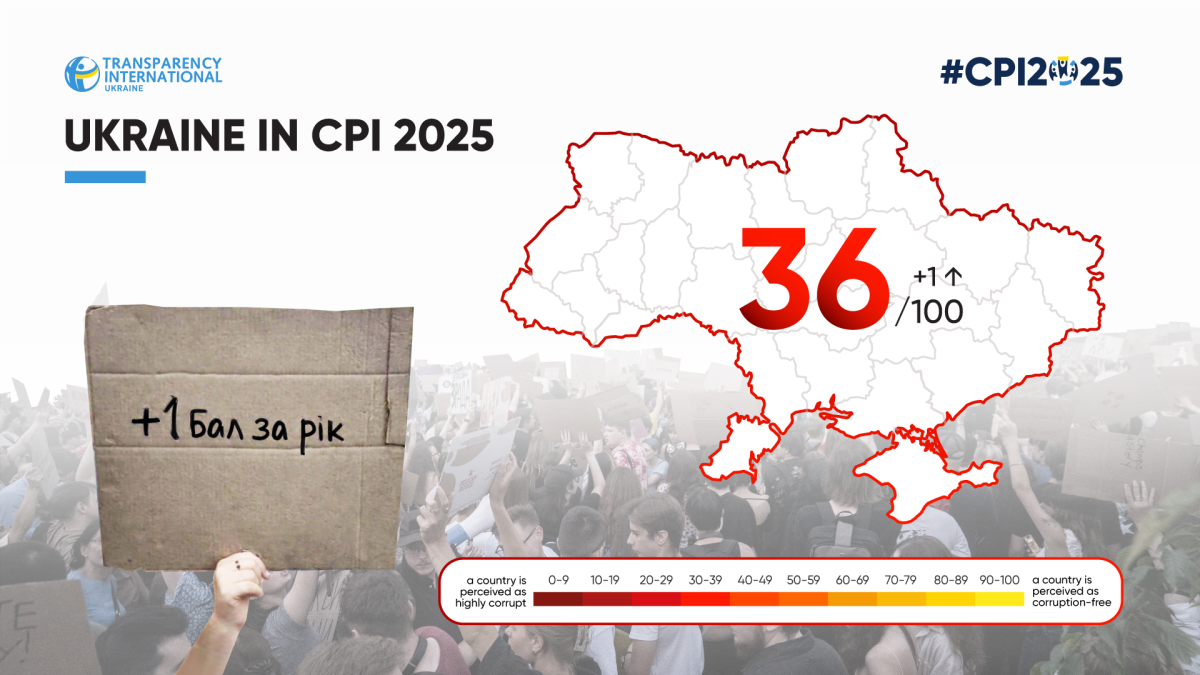
This is a minimal step—arguably within the margin of error, unfortunately. Of course, the fact that we are not losing even the positions we already hold is a kind of positive signal to the international community. But our country has not delivered any major breakthroughs either.
The Corruption Perceptions Index is not just one of the largest corruption studies in the world; it is also a marker that helps analyze a country and compare it with others over time. It is important to understand that the Index reflects real trends only when assessed as a progression, taking into account fluctuations over several years. That is exactly how CPI scores can be used to identify the overall state of corruption perceptions in a given country and how that country is perceived globally.
If we look at the hard numbers from recent years, Ukraine’s progress in CPI appears restrained. After gaining +3 in 2023 and reaching a total of 36 points, the country has remained at this same level, alternately losing and then regaining 1 point since then. Our progress is more visible over the past ten years: we have been adding points in the Index—very slowly, but steadily.
This year’s 36 points are not a gift, but an achievement made possible by the anti-corruption reform launched after the Revolution of Dignity. At the same time, a detailed analysis of the results shows that CPI sources assessed Ukraine’s anti-corruption progress very cautiously overall. The main shift in Ukraine’s score came from one source—the Bertelsmann Transformation Index—which added as many as 5 points. This assessment tracks whether officials exposed for corruption were held accountable or punished. In other words, it directly captures how Ukraine and the world perceive the effectiveness of the NABU and the SAPO.
Interestingly, the July events, when civil society defended the independence of these institutions, were also reflected in the assessment. Although the very fact of government pressure on anti-corruption bodies was unquestionably a negative example, the successful pushback against that pressure was evaluated positively by international analytical agencies.
CPI sources emphasize that the persistence of Ukrainian NGOs, civil society, and journalists in defending anti-corruption institutions was crucial for further reform progress in Ukraine. In global communications around CPI 2025, these events are presented as a vivid positive example against the broader backdrop of stagnation in anti-corruption efforts worldwide.
At the same time, recognition of Ukrainian civil society’s achievements and stronger institutional capacity at the NABU and the SAPO is not a substitute for systemic reform, and a 1-point increase is still a change within the margin of error. That is why the declared progress now needs to be urgently reinforced by real, systemic action from the authorities, and this is exactly where 2025 fell short.
The persistence of Ukrainian NGOs, civil society, and journalists in defending anti-corruption institutions was crucial for further reform progress in Ukraine.
Kateryna Ryzhenko
The CPI point gained is an advance that can still be used well
What we did not see in 2025 was the comprehensive reform package promised by the authorities. Even though some processes were launched, many recommendations and commitments from the previous year had to be rolled over to 2026.
Last year the Cabinet approved Transformation Road Maps in the areas of the rule of law, public administration reform, and democratic institutions, and parliament finally voted for ARMA reform. But the NACP audit remains blocked; over the course of the year, the Verkhovna Rada still failed to establish a commission for selecting candidates to the Accounting Chamber; and a number of legislative initiatives intended to improve the effectiveness of investigating and adjudicating corruption cases never found the necessary “political will.”
And, as the final touch on this negative picture, international experts’ participation in the Selection Commission for appointing HQCJ members was terminated. This precedent may be highly damaging for future competitions to staff public institutions. A risk already hinted at in several points from the much-criticized Vlasenko–Buzhanskyi temporary commission report. The episode involving attorney Oleksii Shevchuk points to additional risks. It demonstrates what kind of selection-commission members purely domestic appointing actors are prepared to nominate, with Prosecutor General Ruslan Kravchenko being one such actor.
The progress achieved so far in fighting corruption has been possible primarily because of the commitments Ukraine has undertaken with international partners. These commitments remain the main incentive that can still drive improvements in anti-corruption policy, and, fortunately, society generally supports implementing these changes.
Over recent years, Ukraine has signed a number of agreements and strategic documents shaping its development path, including the Ukraine Facility Plan, the EU Enlargement Report on Ukraine, the IMF program under the Extended Fund Facility (EFF), the Rule of Law Road Map, and the Plan of 10 Priority Reforms in Anti-Corruption and Rule of Law. In one way or another, these documents account for the need to implement reforms that will continue to significantly affect Ukraine’s scores in the Corruption Perceptions Index.
Overall, in TI Ukraine’s view, 6 steps are needed in 2026 to produce real change in the fight against corruption:
- safeguard the independence of anti-corruption institutions;
- improve outcomes in corruption cases, especially in freezing and confiscating illicit assets;
- enhance the institutional capacity and focus of the National Agency on Corruption Prevention;
- update legislation to ensure swift, high-quality justice;
- expand the involvement of international experts in the selection commission for appointing HQCJ members;
- adopt an Anti-Corruption Strategy and a State Anti-Corruption Program.
Unfortunately, we have discussed most of these steps many times before. Now, it is time to complete our overdue homework.
The progress achieved so far in fighting corruption has been possible primarily because of the commitments Ukraine has undertaken with international partners. These commitments remain the main incentive that can still drive improvements in anti-corruption policy.
Kateryna Ryzhenko
What about the global picture?
CPI 2025 shows that, overall, the corruption situation is worsening. Even in established democracies, corruption is rising amid weakened leadership. And the number of countries scoring above 80 points has fallen from twelve ten years ago to just five this year.
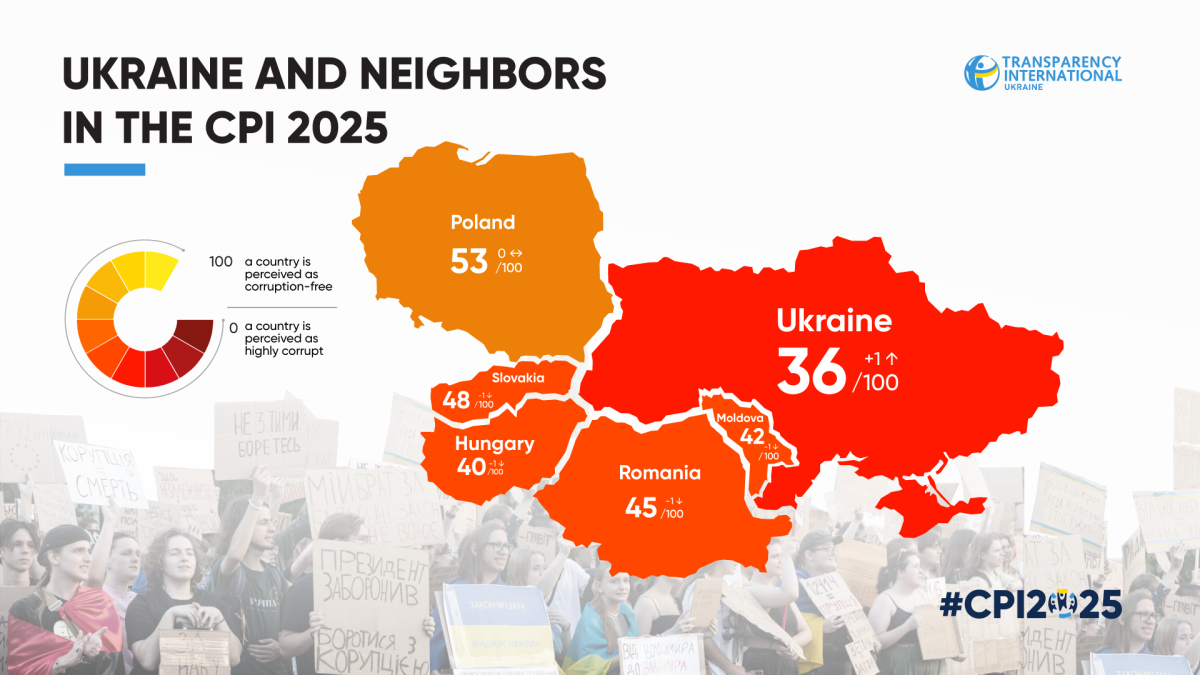
Among Ukraine’s western neighbors, only Poland’s score remained unchanged—53 points and 52nd place in the Corruption Perceptions Index 2025. By contrast, Slovakia (48 points, 61st place), Romania (45 points, 70th place), Moldova (42 points, 80th place), and Hungary (40 points, 84th place) each lost 1 point. That is, despite all of Ukraine’s current challenges, Ukraine became the only country in the region that managed—even if only slightly—to improve its position in the study.
Negative trends are also visible across the European Union and Western Europe: while the average score for these countries was 66 in 2022, it has dropped to 64 this year.
More broadly, country scores in the Index point to an alarming decline across democratic states. Another troubling pattern has been the growing number of restrictions on freedom of expression, association, and assembly in many countries—and this has not been limited to areas with active armed conflict.
A lack of visible anti-corruption progress is also evident among Ukraine’s largest partners. In December 2025, the EU agreed its first Anti-Corruption Directive to harmonize criminal legislation on corruption. But the final version of this document turned out to be far from what was expected: many of the adopted provisions that were supposed to ensure zero tolerance for corruption in EU countries were watered down. In addition, some countries took questionable positions. For example, Italy blocked the criminalization of abuse of office by public officials.
The situation in the United States is even more troubling: in CPI 2025, the U.S. received the lowest score in its history—65. And that is despite the fact that most events of 2025 were not fully reflected in the study. It is therefore already possible to predict that measures by President Trump’s current administration aimed against freedom of expression and toward undermining judicial independence will be reflected even more negatively in future Indexes.
And, unfortunately, these processes inside the United States will have a tangible impact on anti-corruption progress in other countries, because reductions in U.S. financial support for civil society and humanitarian initiatives have weakened global anti-corruption efforts.
More broadly, country scores in the Index point to an alarming decline across democratic states. Another troubling pattern has been the growing number of restrictions on freedom of expression, association, and assembly in many countries—and this has not been limited to areas with active armed conflict.
Kateryna Ryzhenko
***
Our CPI 2025 score shows that, even against a negative global backdrop, Ukraine can and must continue implementing systemic reforms. The position we achieved is the result of changes already set in motion, which are now bearing fruit. And any slowdown harms not only Ukrainians’ daily lives, but also the basis for stronger countries to keep supporting us at this most difficult time.
Source: zn.ua


