




September 30, 2026 12:35
Cities Don’t Always Put Residents’ Needs First: European City Index Results
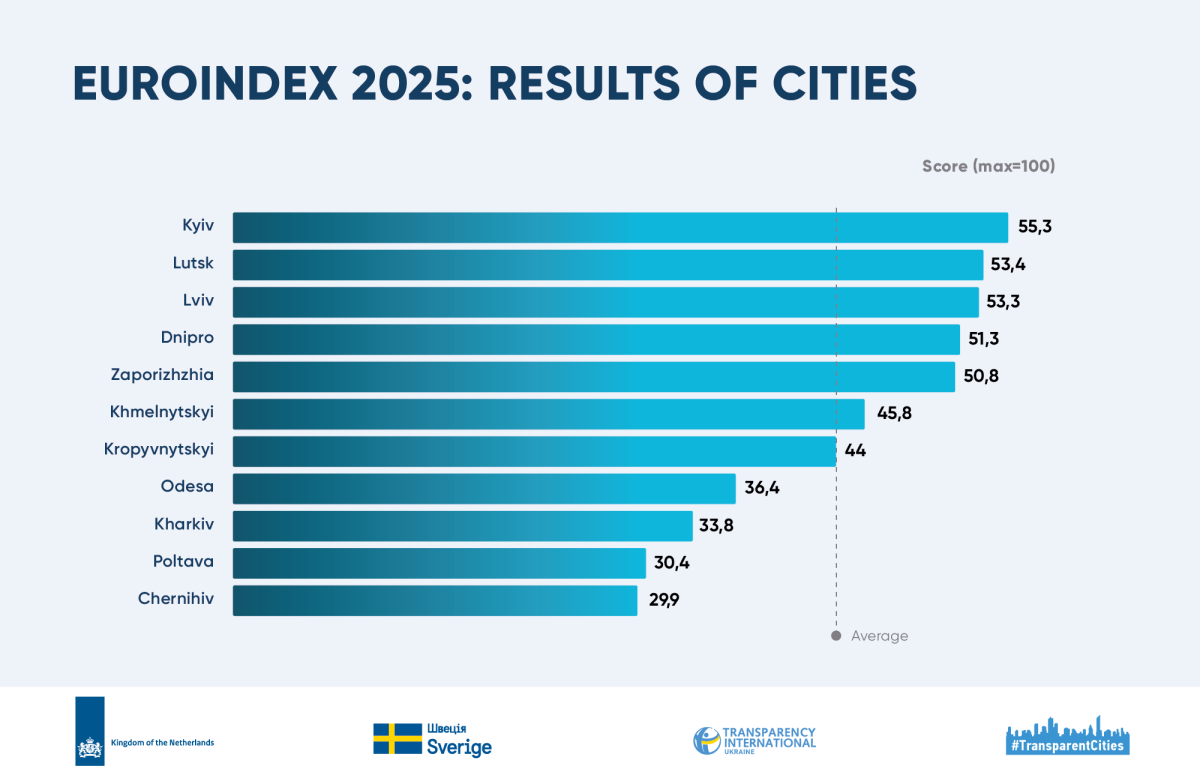
City councils scored an average of 44 out of 100 against European governance standards. The top performers were Kyiv, with just 55.3 points, followed by Lutsk (53.4) and Lviv (53.3). Yet even these cities have considerable room to make their governance more transparent, accountable, and responsive to residents’ needs.
These are the findings of the annual European City Index study conducted by Transparency International Ukraine’s Transparent Cities program. Analysts examined six areas of work of 11 city councils: openness, e-services, open data, public finance, integrity and anti-corruption, and accountability.
The study found that cities are far better at rolling out individual digital solutions than at building feedback mechanisms. Public transport tracking, online kindergarten enrollment, e-petitions, and online booking at Administrative Service Centers have become standard practice in most of the cities studied. Yet only 4 of the 11 mayors reported on their work at an open meeting with the community in 2025, and only 3 city councils had a dedicated page explaining how residents can attend council sessions.
Another problem is that resident participation in decision-making remains largely a formality. None of the 11 cities published a list of public proposals on the draft 2026 budget in its budget section, and 10 cities did not publish minutes of budget hearings or the results of consultations with businesses on procurement.
A key principle of the study was its focus on residents, particularly as users of city websites and e-services (user-centricity). A person should not need to know the structure of the city council or the name of the relevant department, or search through dozens of pages, to find out how to get compensation for damaged housing, view the draft budget, use an e-service, or attend a city council session.
Analysts therefore checked whether city council websites had thematic sections bringing together all up-to-date information on a given issue.
In 2025, such sections existed in 71% of the cases checked. Kyiv performed best, with 14 of 15 sections. Zaporizhzhia, Kropyvnytskyi, Lutsk, and Lviv had 12 each, while Poltava had only 4.
Cities structured information worst precisely where residents need it most: fewer than half had pages on e-services, public access to city council sessions, or the receipt and distribution of humanitarian aid.
“For most people, what matters is finding information and using a service quickly; for others, it is seeing where city funds go and having a say in decisions about their hometown. Unfortunately, a resident-centered approach has yet to become a systematic principle in how city councils operate. This fall, we are scaling up the European City Index to 50 Ukrainian cities. We hope our monitoring and recommendations will help communities move toward a governance model in which information, services, and participation mechanisms are designed around people’s needs,” said Olesia Koval, Transparent Cities Program Manager.
However, follow-up assessments showed that the situation can change quite quickly. Within a year, the average implementation level of openness indicators rose from 53.5% to 72.4%, and city councils created about 10 new “single points of entry.” Kyiv, Lviv, and Poltava developed dedicated e-services sections that they had lacked at the first assessment.
All study results and dashboards are available on the Transparent Cities program website.
This research is made possible with the support of the MATRA Programme of the Embassy of the Kingdom of the Netherlands in Ukraine, and with the financial support of Sweden within the framework of the program on institutional development of Transparency International Ukraine.
For most people, what matters is finding information and using a service quickly; for others, it is seeing where city funds go and having a say in decisions about their hometown. Unfortunately, a resident-centered approach has yet to become a systematic principle in how city councils operate.
Olesia Koval


