




Critique, Not Manipulation: What’s Wrong With NACP’s Statement on Halushchenko’s Asset Declarations
March 5, 2026
The NACP issued an official statement disputing the “falsehood” of the information presented in an article by TI Ukraine expert. I will explain what is wrong with the theses provided by the Agency.
Yesterday, the National Agency on Corruption Prevention issued an official statement disputing the “falsehood” of the information presented in an article by Transparency International Ukraine expert Nataliia Sichevliuk on the verification of the asset declarations of the former Minister of Justice and Energy. In particular, the Agency claims that TI Ukraine, through its analytical materials, “creates a distorted perception of the NACP’s work.”
First and foremost, it must be noted that Transparency International Ukraine has always been consistent in its criticism of certain Agency approaches to financial control, just as it has remained open to direct discussion with the NACP and other stakeholders. Our experts have repeatedly participated in discussions, contributed comments on drafts of NACP regulations, strategic documents, and more. We have been and remain open to communication in any format.
Now, point by point regarding the NACP statement.
TI Ukraine has always been consistent in its criticism of certain Agency approaches to financial control, just as it has remained open to direct discussion with the NACP and other stakeholders.
Andrii Borovyk
On the Agency’s insistence on using the term “automated verification,” which is absent from the law
The concept of “automated verification” was added by the NACP to the current Procedure for Conducting a Full Verification of the Declaration of a Person Authorized to Perform the Functions of the State or Local Self-Government back in December 2023 (the Procedure). This Procedure is the document that “sets forth the procedure by which the National Agency on Corruption Prevention conducts a full verification of the declaration of a person authorized to perform the functions of the state or local self-government.”
Under Section V, Part 1, clause 1 of the Procedure, a full verification is conducted in order of priority based on risk assessment, including where “the declaration is filed by an official holding a responsible or especially responsible position, by a declarant holding a position associated with a high level of corruption risks, the list of which is approved by the National Agency, except for a declaration for which there is a report on the results of an automated verification of the declaration.”
Yes, Herman Halushchenko, who held the positions of Minister of Justice and Minister of Energy, was an official in a “responsible or especially responsible position.”
Halushchenko’s declarations for 2021 and 2024 were precisely the ones that underwent the automated verifications referred to in the provision above from the Procedure for Conducting a Full Verification. We include a screenshot from the NACP website below.
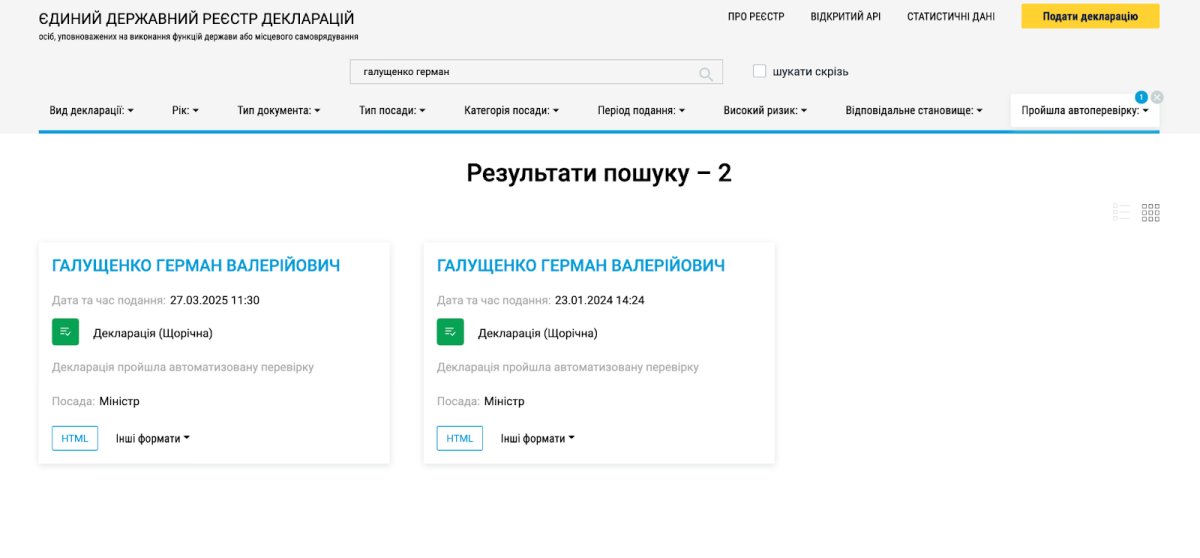
That is exactly why, under the Procedure, they were not selected for a manual full verification that is envisaged by the Law of Ukraine on Corruption Prevention. At the same time, the law does not provide any definition of “automated verification of declarations,” because such a verification should not have existed at all. By insisting that “automated” and “full” verification are two entirely different instruments, the NACP raises even more questions about its free interpretation of the law. The result is that the Agency does not act “within the limits of authority and in the manner” prescribed by the Constitution of Ukraine. Instead, it exercises financial control over declarants under a procedure that does not exist in legislation, while publicly rejecting any connection to the legal norms established by the legislator.
The NACP introduced the artificial concept of automated verification into the Procedure for Conducting a Full Verification, providing that if it is successfully completed, a declaration, under certain conditions, may never be subject to a full verification by an Agency employee.
Moreover, the Procedure also provides that declarations marked as high-risk based on the results of logical and arithmetic control (LAC) will also not be selected for a full manual verification if such declarations have passed an automated full verification. This further weakens the LAC mechanism as well, the rules of which, it should be recalled, remain closed to external observers—just like the rules of automated full verification.
It is precisely this approach to selecting declarations for manual full verification that TI Ukraine criticizes in the article on Herman Halushchenko’s declarations, as well as in earlier publications. In particular, we suggest reviewing the analysis TI Ukraine published immediately after amendments were introduced to the Procedure regarding automated verifications—here.
The term “automated full verification” is used in the article to highlight the problem of the NACP’s increasing move away from conducting full verifications manually. In addition, a similar term is also used in reports by international organizations, for example, in the latest OECD report.
Instead, it exercises financial control over declarants under a procedure that does not exist in legislation, while publicly rejecting any connection to the legal norms established by the legislator.
Andrii Borovyk
On the article’s references to NABU materials concerning the activities of certain legal entities located outside Ukraine
The article clearly describes the tools the NACP could have used to verify Halushchenko’s assets and those of his family members more thoroughly in the course of a manual full verification, including by submitting additional inquiries both to the declarant and to national and international bodies.
The need to strengthen cooperation with foreign states to exchange information as part of the Agency’s financial control is objective. This is also stated in the Independent External Assessment Report on the NACP’s Activity for 2020–2021: “The NACP’s cooperation with the competent bodies of other countries should be intensified, in particular in the area of exchange of data for the purposes of administrative verifications within the NACP’s mandate, for example, on the basis of Art. 43 of the UN Convention against Corruption or on the basis of other provisions of existing international treaties). The NACP should increase its interaction with international organisations and non-governmental organizations from foreign countries.”
Verification of declarations is an administrative procedure that precedes criminal proceedings. It is precisely within administrative and civil procedures that the NACP is not limited in international cooperation. This is also provided for by law, which states that the Agency’s powers include cooperation with state bodies, civil society organizations of foreign states, and international organizations within its competence, as well as exchange of information with competent authorities of foreign states and international organizations. To date, the NACP has also not fully leveraged the potential of regional instruments such as the Regional Data Exchange on Asset Disclosure and Conflict of Interest, which our neighbor Moldova recently joined.
In addition, the NACP should deepen cooperation with national authorities as well. In this context, it is also worth considering whether the Agency could cooperate with NABU on obtaining information in response to requests for international legal assistance in criminal jurisdiction while carrying out financial control.
TI Ukraine does not compare the NACP to law enforcement bodies. Rather, we propose that it use and develop the instruments at the Agency’s disposal to ensure effective manual full verifications of declarations. The fact that the NACP previously obtained access to Europol’s SIENA platform can be assessed positively, as it opened new opportunities for information exchange with law enforcement bodies of EU member states, even though the NACP is not a law enforcement body.
Verification of declarations is an administrative procedure that precedes criminal proceedings. It is precisely within administrative and civil procedures that the NACP is not limited in international cooperation.
Andrii Borovyk
On the NACP’s assessment of TI Ukraine’s expertise
Finally, I would like to comment on the Agency’s claim that TI Ukraine “misinterprets” financial control measures, which “creates a distorted perception of the NACP’s work and undermines trust in the anti-corruption system as a whole.” It should be noted that, in addition to TI Ukraine analysts, the NACP’s activities are assessed by a number of international organizations, including the IMF, the European Commission, and the OECD, among others. In their most recent reports, these organizations are fairly aligned in criticizing the Agency’s approaches to financial control, particularly with respect to full verifications.
For example, the latest European Commission Enlargement Report on Ukraine points to the need to strengthen the e-declaration system so that it can truly prevent and detect unjustified assets effectively. The Commission stated that the system has practical and legal shortcomings, primarily relating to the automated verification process.
And here is what the OECD wrote in its 2025 report regarding the NACP’s automated full verifications: “Statistics from the Register suggest that as of December 2024, there are ca. half a million high risk declarations, of which only 13 600 passed the automatic control, which is an approach to full verification of the declarations that fall within the lower risk range. Even if the NACP increases the proportion of the automated full verifications to 75%, as initially planned, this will not cover the entire range of high-risk declarations. This significant gap between legislation and practice indicates the need to reassess the appropriateness and potentially undesirable consequences of maintaining such a broad list of persons required to file declarations.”
It is also worth mentioning the most recent Independent External Assessment Report of the NACP’s Activity for 2020–2021, in which the commission members stated directly: “The NACP informed the Commission that the issue of the possibility of conducting full verification in an automated mode using the software tools of the Register is being studied. The Commission would like to express doubts that the full verification of the AD could be automated, as under the current mandate of the NACP the procedure was designed for manual checking by authorized persons of the National Agency.”
Therefore, it appears that it is not only TI Ukraine that underscores the need to reconsider the Agency’s approach to automated full verifications and make them more effective.
P.S. From this entire situation, I am glad that Herman Halushchenko’s declarations will, at last, be subject to a full manual verification by the NACP, as they should have been from the very beginning.
In addition to TI Ukraine analysts, the NACP’s activities are assessed by a number of international organizations, including the IMF, the European Commission, and the OECD, among others. In their most recent reports, these organizations are fairly aligned in criticizing the Agency’s approaches to financial control, particularly with respect to full verifications.
Andrii Borovyk
Source: glavcom.ua


