




June 18 marks one year since the adoption of the law reforming the Asset Recovery and Management Agency (the ARMA).
What actually changed after the new law passed, and what else stood out in ARMA’s 2025 report — that is what we examine here.
Optimizing the Agency’s work is not a new need; both experts and international partners have stressed it for a long time. So the new law was meant to systematically transform the very logic of how seized assets are managed.
The shift in approach is already visible in the Agency’s annual report for 2025 — the first prepared under the revised law. It is worth bearing in mind here that some of the data in the report reflects work done under the old rules, while some captures the gradual changes that followed the reform’s adoption.
Yet, as we have written before, the reform itself is not fully implemented: key secondary legislation was adopted late, and the new mechanisms for selecting managers through Prozorro are only beginning to launch for complex assets.
Still, the first report gives the most up-to-date picture of how the Agency actually works, so let us look at the data — through the same lens of questions we raised last year.
As we have written before, the reform itself is not fully implemented: key secondary legislation was adopted late, and the new mechanisms for selecting managers through Prozorro are only beginning to launch for complex assets.
Pavlo Demchuk
Detection and tracing: more requests, fewer assets found
In 2025, ARMA received 9,468 requests to detect and trace assets — a 20% increase over 2024 (7,865).
The number of assets actually found, however, fell across several categories. ARMA located 29,049 land plots, down from 107,066 in 2024 — a figure we flagged at the time as an anomaly. Other categories rose: detected funds reached UAH 36.5 billion against UAH 8.3 billion, corporate rights UAH 58.5 billion against UAH 35.9 billion, and virtual assets stood out most of all — 1.29 million USDT against 2,400 USDT, a roughly 530-fold increase.
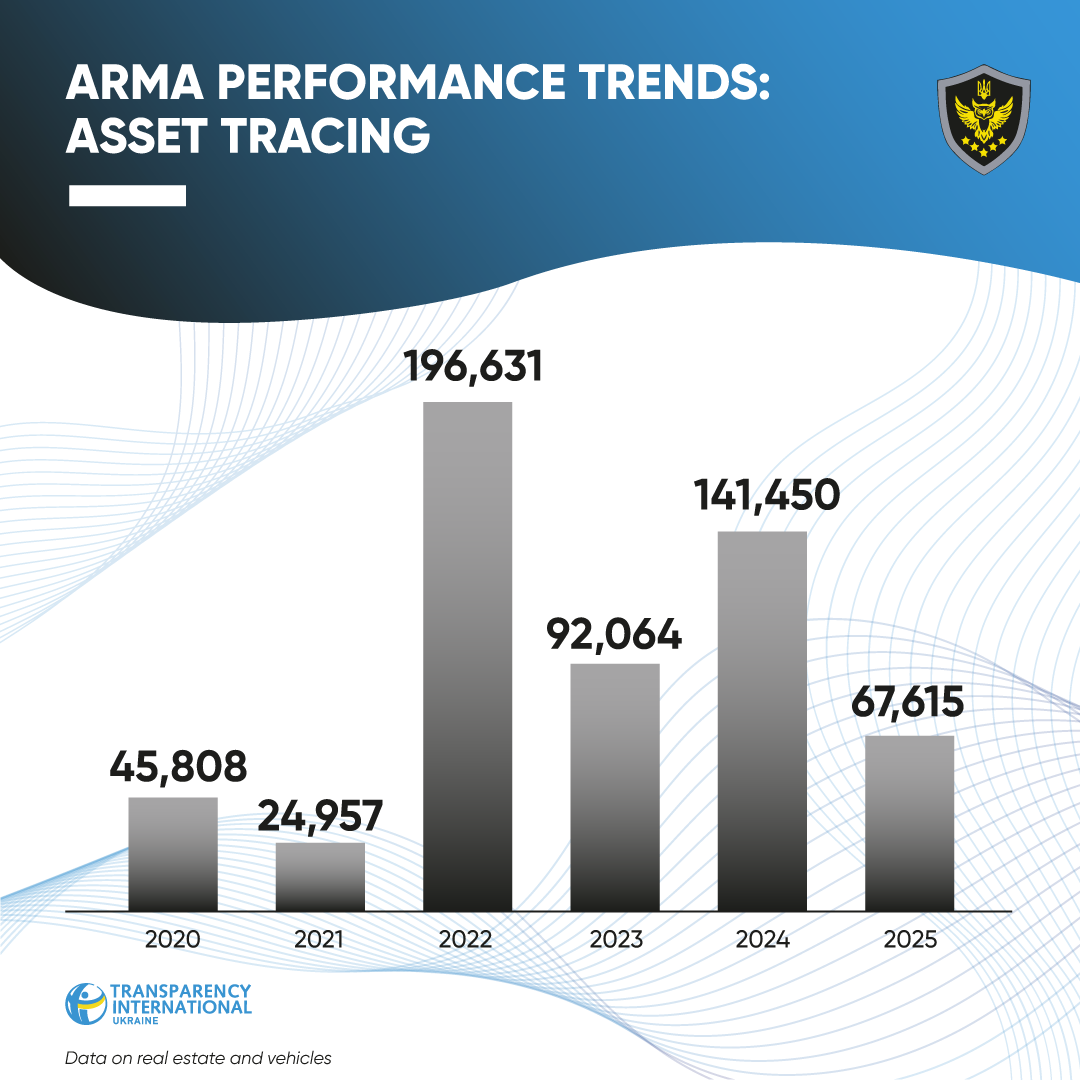
One section is genuinely new: ARMA publicly acknowledges the structural gap between assets traced and assets seized. Only 2% of the property ARMA traces is later seized. The report explains, among other things, that the information ARMA compiles on traced assets cannot be used as evidence in criminal proceedings.
The Agency separately notes that some tracing requests come in proceedings where confiscation — or even the option of special confiscation — is not envisaged at all. The information on traced assets is then used by the prosecution under Article 93 of the Criminal Procedure Code of Ukraine, which governs the rules for gathering evidence and nothing more. In other words, in certain cases ARMA functions as a property-records service for law enforcement.
ARMA also sent 639 international requests in 2025, against 383 in 2024 (up 66%). The numbers are striking, but they raise questions about the quality of each request and the effectiveness of the institution’s foreign track as a whole. The report does detail what was found abroad: 366 properties, 88 vehicles, $5.9 million, and corporate rights worth the equivalent of UAH 924.86 million. How much of this was seized, and which of these decisions foreign competent authorities recognized, remains unknown.
Such decisions by foreign actors do not depend on ARMA alone, of course. But to analyze the state of asset recovery — a function the Agency does hold — the missing piece is information on whether those assets were actually seized abroad.
The Agency separately notes that some tracing requests come in proceedings where confiscation — or even the option of special confiscation — is not envisaged at all. In other words, in certain cases ARMA functions as a property-records service for law enforcement.
Pavlo Demchuk
Asset management: more new agreements, but the revenue still comes from the old ones
Last year we noted that ARMA had concluded only 7 management agreements against 33 announced competitions. In 2025, there are already 40 management agreements under 38 rulings. On paper this is a breakthrough — yet 27 agreements carried over from previous years remain the main source of revenue for the state budget.
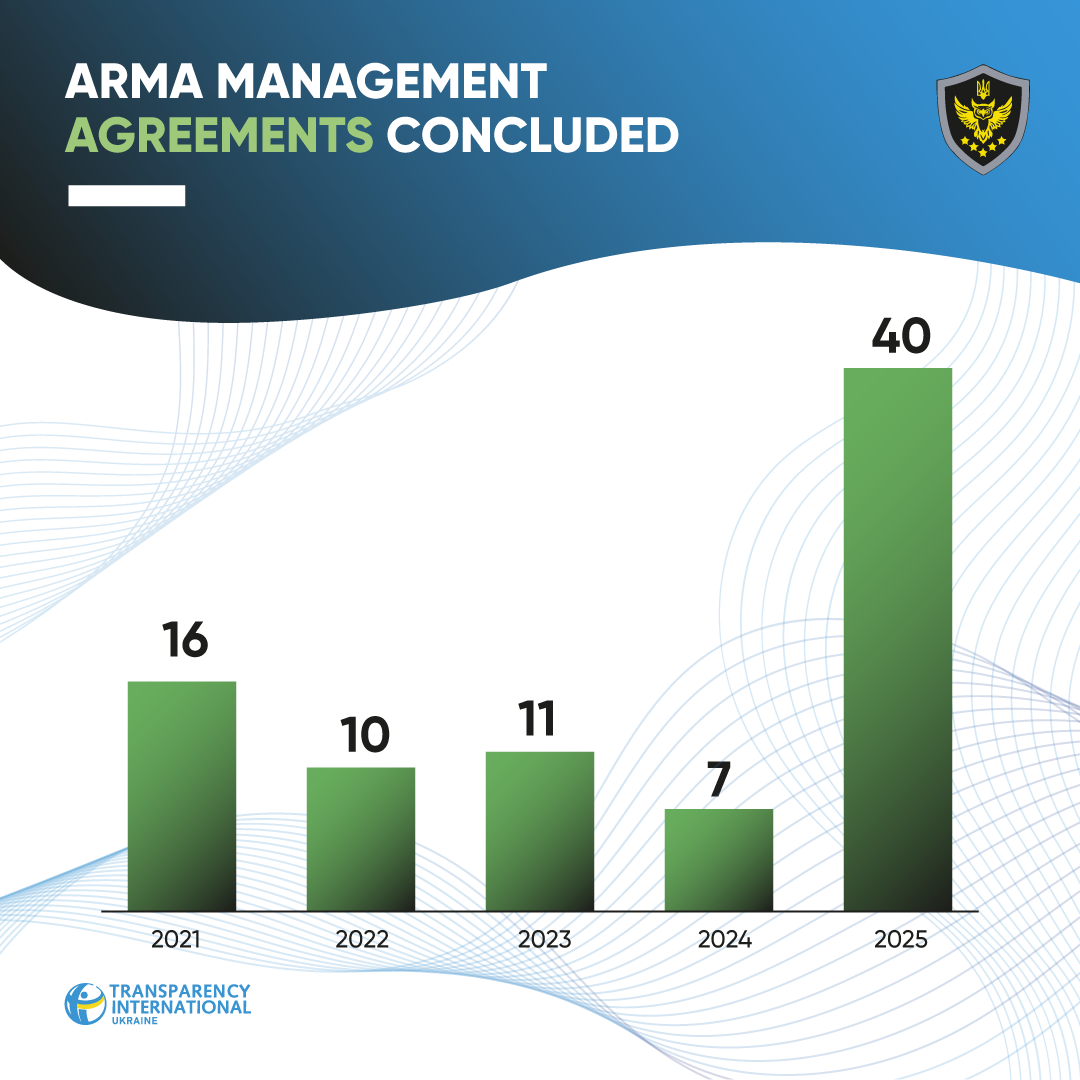
A single agreement — with Ukrnafta over the assets of Ukrnaftoburinnia, signed back in June 2023 — brought UAH 1.074 billion to the budget out of UAH 1.54 billion from management agreements overall. That is roughly 70% of the year’s revenue from one asset. All 38 new agreements signed in 2025, by contrast, account for just 2.5% of revenue (UAH 38.7 million).
The figures on asset sales in 2025 are also contradictory. The Agency organized 184 auctions, of which only 41 succeeded (about 22%). Nearly four out of five auctions produced no result. This calls for a separate explanation — on how the lots were assembled, and on starting prices and the appeal of the assets.
The key thing left out of the report: as of its publication, the new mechanisms for selecting managers through Prozorro still had not been launched, even though they were supposed to be operating by January 30, 2026. This means that, overall, the transfer of assets to managers under the new rules is significantly delayed.
The key thing left out of the report: as of its publication, the new mechanisms for selecting managers through Prozorro still had not been launched, even though they were supposed to be operating by January 30, 2026. This means that, overall, the transfer of assets to managers under the new rules is significantly delayed.
Pavlo Demchuk
Oversight of managers: more activity, but the quality questions remain
In 2024, ARMA carried out only 10 on-site inspections of managers — one of the key figures we criticized. In 2025, there are already 38 on-site inspections and 348 desk reviews, for 386 oversight actions in total. These produced 27 orders to managers and 5 established instances of mismanagement.
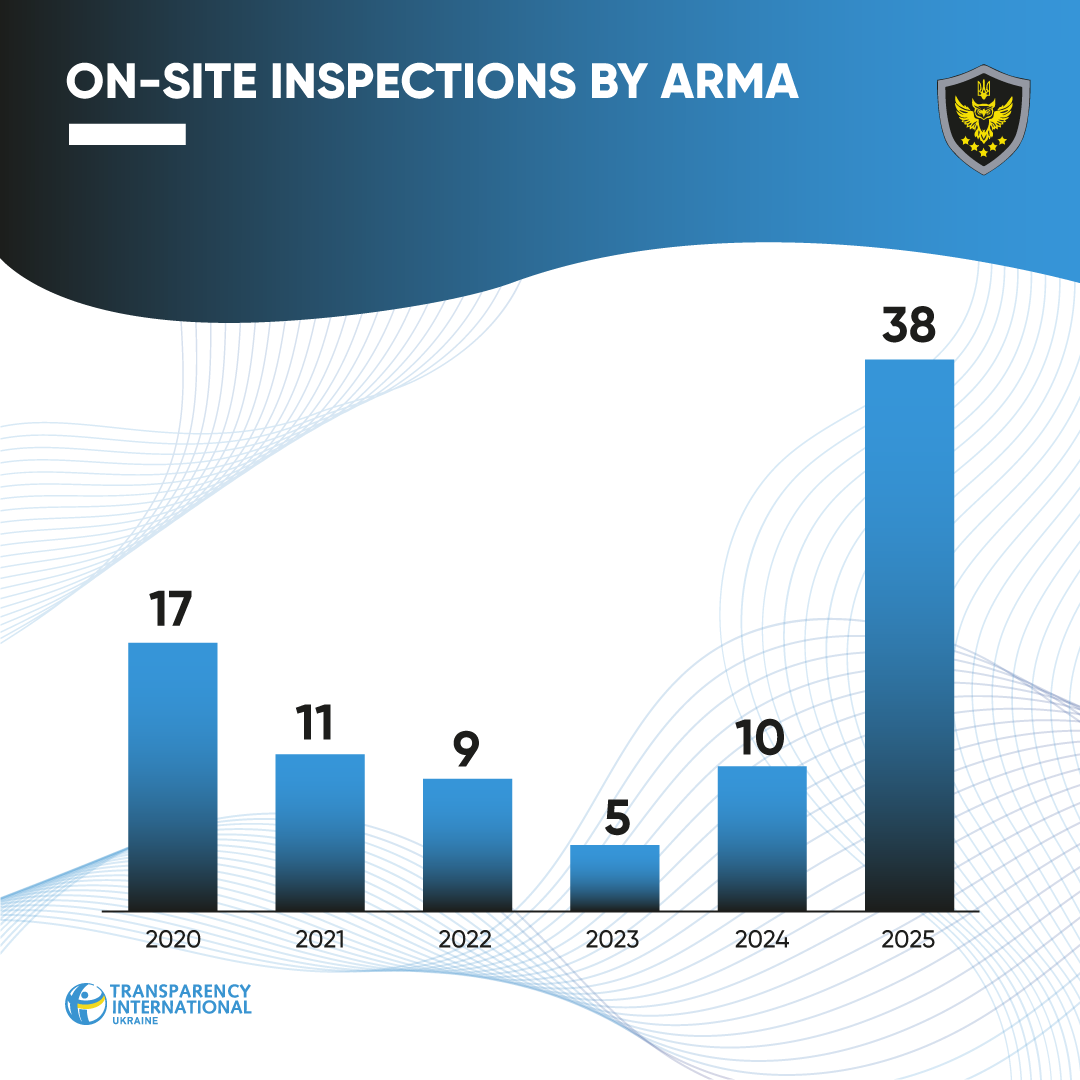
In terms of trend, this is a marked improvement. In absolute terms, though, 38 on-site inspections against the 34,062 assets ARMA has placed under management, worth UAH 10.7 billion, is still a modest figure.
The report also fails to show how the inspection results were interpreted: how many orders led to an actual change in a manager’s conduct, and how many agreements were terminated for ineffectiveness. And the scandalous case of KAMparytet, which subleased shopping centers at prices three times higher than its declared income, is not mentioned in the report at all, even though the case was discussed separately at the parliamentary Anti-Corruption Committee, and in 2026 the Agency confirmed the violations and announced its intention to terminate the agreements with the company.
The report also fails to show how the inspection results were interpreted: how many orders led to an actual change in a manager's conduct, and how many agreements were terminated for ineffectiveness. And the scandalous case of KAMparytet is not mentioned in the report at all,
Pavlo Demchuk
Inventory: ARMA finally has a definitive count of the assets it manages
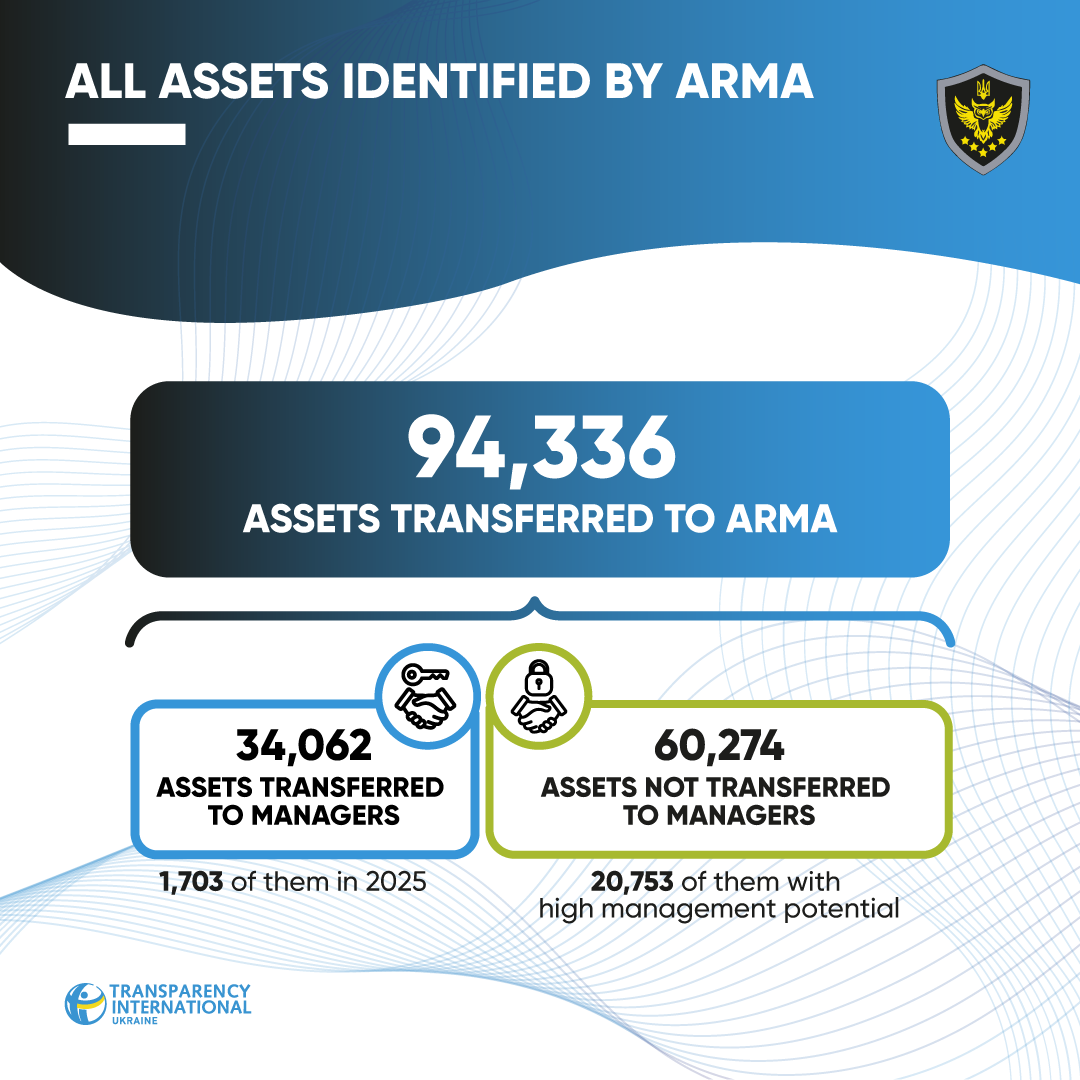
The transitional provisions of the new ARMA law required the body to identify, within six months, all assets placed under its management before the law took effect. The Agency reports that, following a full inventory, its records now cover 60,274 assets, of which 20,753 have high management potential. This figure also includes assets being prepared for competitive procedures or already identified as attractive for management and sale.
Even so, the Agency still does not use the term “asset pool,” which would make it possible to see how many units of property actually form part of an operating business that can be grouped under that concept. In practice, this makes it quite hard to tell from the report how many economically attractive businesses lie behind the figure of 20,753 assets.
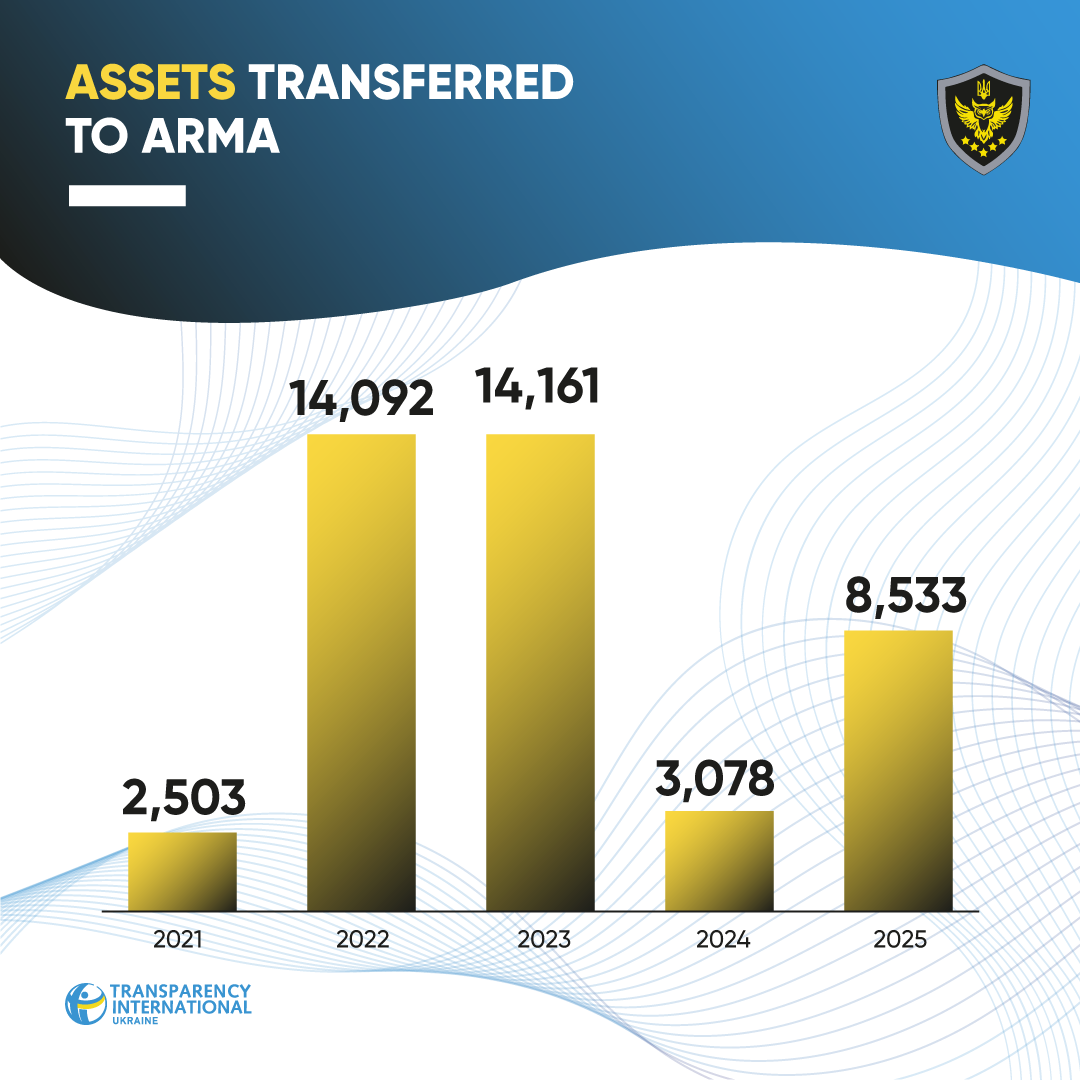
In 2025, 1,703 assets were handed to managers under agreements, while across all years ARMA has transferred 34,062 assets in total. These 1,703 assets are valued at UAH 5,354.31 million, against UAH 10,737.53 million for all assets combined. So nearly 5% of the assets placed under management in 2025 account for roughly 50% of the total value. One hypothesis here is that in earlier years the assets transferred for management were largely low-value.
In all, the body of assets ARMA is empowered to act on amounts to 94,336 units. Of these, 34,062 have already been transferred to managers under agreements (1,703 in 2025), and 60,274 have not (20,753 of them with high management potential).
Handling “complicated” assets proved a separate problem: of 100 appeals ARMA made to prosecutors about its inability to manage such assets effectively, only 32 received a reply, and just 5 of those were resolved favorably. In other words, 95% of the cases where ARMA has already deemed an asset problematic to manage remain unresolved once the prosecution is brought in. And this problem should be resolved by amending the Criminal Procedure Code of Ukraine, as we have stressed before.
The Agency reports that, following a full inventory, its records now cover 60,274 assets, of which 20,753 have high management potential. This figure also includes assets being prepared for competitive procedures or already identified as attractive for management and sale.
Pavlo Demchuk
***
Over the past year, the volume of activity inside ARMA has grown substantially. The Agency is drafting secondary legislation, running asset inventories, tracing assets, and shaping recovery policy. Not every task has been completed, but the progress is visible.
Even so, in watching ARMA’s performance, we would like to see real results in the effectiveness of asset recovery. That can be traced, in particular, by comparing the outcomes of tracing, seizure, effective management, and confiscation. Beyond that, the data available in the report does not make clear how the new system for selecting managers actually works, since not a single auction of that kind has taken place since the law was adopted. And in any case, the management agreements covered in the report were all concluded under the old procedures.
That is why we see the key task for ARMA today as changing the very logic of how it traces and manages property. In our opinion, the next report should demonstrate not just the volume of work done, but concrete achievements across the system as a whole. All the more so since invoking the old rules will no longer make any sense.
We see the key task for ARMA today as changing the very logic of how it traces and manages property.
Pavlo Demchuk
Source: zn.ua


