



March 11, 2026 14:02
How much does a square meter of reconstruction cost in Borodianka?
In April 2023, Ukraine launched a government pilot project on the comprehensive recovery of localities that had suffered the greatest destruction as a result of Russian aggression. Its goal was not merely to rebuild individual buildings, but to rethink the very approach to recovery through integrated planning, infrastructure upgrades, and the transformation of affected towns and villages.
Six localities were included in the pilot project. Among them was the settlement of Borodianka in the Kyiv region, which lay along one of the routes used by Russian troops in the first weeks of the full-scale war. During the second year of the pilot, the government twice revised the list of recovery sites. Their number more than doubled, reaching 77. The updated list additionally included the repair and reconstruction of 32 apartment buildings.
The construction of new housing is the focus of this analysis. Earlier, the DOZORRO team had already examined how much a square meter of reconstruction costs the budget in three regions of the country. DOZORRO also analyzed the case of Zhytomyr and calculated the cost of building social housing there for internally displaced persons with grant funding.
This time, we decided to examine how much a square meter of new housing construction costs within the government’s pilot project on comprehensive recovery. In particular, we wanted to see whether these expenditures appear justified when compared with apartment prices on the commercial market.
Seven buildings from scratch
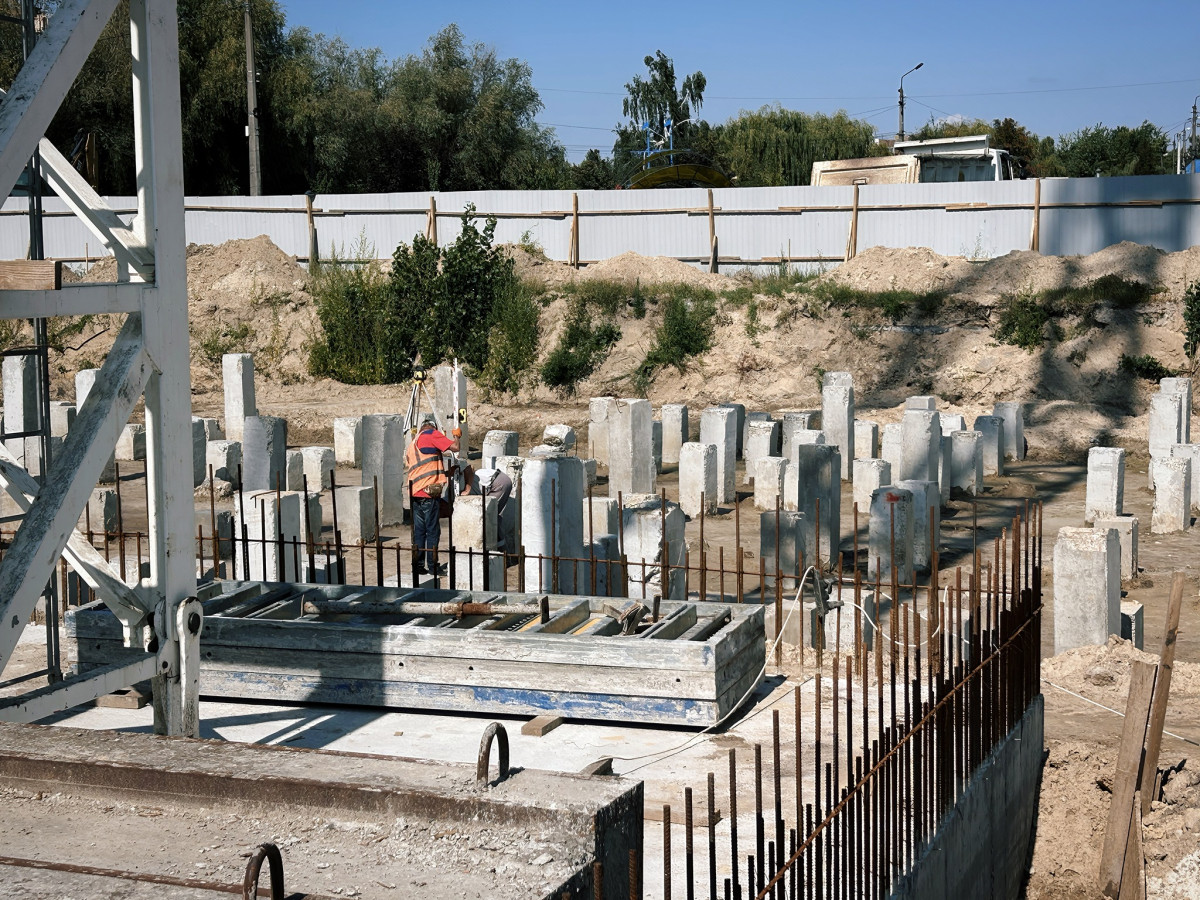
In 2024–2025, seven tenders for the construction of new apartment buildings in Borodianka were announced through the Prozorro system. They are to be built on the sites of residential buildings destroyed by the Russians and completed by the end of 2026. The contracting authorities for these projects are the Recovery and Infrastructure Development Service in Kyiv Region and the Department of Regional Development of the Kyiv Regional State Administration.
Of the seven sites, two are nine-story buildings located at 359 and 353 Tsentralna Street. Another, at 427-A Tsentralna Street, is eight stories high. Three seven-story buildings are being constructed at 371, 326, and 324 Tsentralna Street. The building with the fewest floors is a six-story one at 340 Tsentralna Street.
Together, these buildings are expected to provide housing for 421 families. The largest one, at 359 Tsentralna Street, is designed for 105 apartments, while the smallest, at 340 Tsentralna Street, will contain only 20 apartments.
The apartments are to be handed over to residents with basic finishing. Tile will be laid on the floors and walls in kitchens, hallways, and bathrooms, while living rooms will have laminate flooring and wallpaper. In addition, kitchens will be equipped with stoves and sinks, and bathrooms with toilets, washbasins, and bathtubs. All buildings will also include shelters.
Six of the seven projects include non-residential premises for public utilities and commercial facilities. For example, according to Suspilne, 869 square meters in the eight-story building at 427-A Tsentralna Street will be allocated, at the request of the Borodianka Settlement Council, for a social assistance center and two shops.
Cost per square meter
Why simple division does not work
At first, we planned to calculate the cost per square meter using the approach we normally apply: subtract the cost of the shelter and other project-specific components from the total construction cost, then divide the result by the total apartment area. This is the same methodology we previously used when analyzing the construction of social housing for internally displaced persons in Zhytomyr.
However, we ran into problems almost immediately. The design documentation did not include separate cost estimates for shelter construction. In addition, for one of the buildings—at 427-A Tsentralna Street—the total construction cost also included demolition work. As a result, we could not simply “subtract the extras” and apply that methodology.
To sort out the details, we began sending requests to the contracting authorities. We asked them to explain exactly how much shelter construction cost for each building and, in one case, to provide the demolition costs separately. This process turned out to be lengthy and, frankly, exhausting. Some of the responses were general in nature: the contracting authorities explained that the shelter was part of the building and that its cost had not been itemized separately in the estimate. In other cases, they provided a notional amount calculated as a certain percentage of the total project cost. However, our analysis was based on the actual prices in the signed contracts. That means the cost of shelters could have changed during the procurement process. Because there was no uniform approach in the documentation, we were ultimately unable to obtain equally precise data for all sites.
As a result, it became clear that calculating the cost per square meter using the methodology applied in the Zhytomyr case was simply impossible here. Despite all efforts to clarify figures and match the answers, received data remained too inconsistent.
In addition, almost all the buildings include substantial non-residential space, which directly affects the overall construction cost even though it is not housing. Because of this, the simple ratio of “total cost / residential area” inevitably distorts the real cost per square meter.
| Address | Contract, UAH million | Adjusted contract, UAH million | Additional agreement, UAH million | Additional agreement, UAH million | Total construction cost, UAH million |
| 359 Tseltralna | 285.7 | 285.7 | |||
| 353 Tseltralna | 258.5 | 258.5 | |||
| 427-A Tsentralna | 396.9 | 315.5 | 122.4 | 437.9 | |
| 371 Tseltralna | 280.1 | 277.5 | 23.4 | 300.9 | |
| 326 Tseltralna | 123.2 | 122.7 | 30.4 | 153.1 | |
| 324 Tseltralna | 125.2 | 61.9 | 187.1 | ||
| 340 Tseltralna | 81.9 | 16.8 | 11.9 | 77.2 | 105.9 |
A different formula, different results
That is why, for this analysis, we applied a different formula. It is not perfect, but it allows us to reduce these projects to a common denominator and at least approximately compare them with one another and with market indicators. To do this, we included not only the contracts for the direct construction of the buildings, but also other related agreements from Prozorro—for design, author’s supervision, technical supervision, and connection to utility networks. We combined all of these into one total project cost. We then compared that total with the apartment area to determine what share of the funds effectively went toward housing. After that, we divided the resulting figure by the total apartment area and thus calculated a notional cost per square meter.
Project cost * apartment area / Total area = Apartment cost
| Address | Total project cost, UAH million | Floors | Apartments | Non-residential area, m² | Total area, m² | Apartment area, m² | Apartment cost, UAH million | Notional apartment cost per sq.m, UAH thousand |
| 359 Tseltralna | 290.8 | 9 | 105 | 1331 | 9777 | 6700 | 199 | 30 |
| 353 Tseltralna | 264 | 9 | 103 | 1478 | 10567 | 6591 | 165 | 25 |
| 427-A Tsentralna | 411.7 | 8 | 58 | 3872 | 9607 | 4402 | 189 | 43 |
| 371 Tseltralna | 306.2 | 9 | 58 | 1670 | 7694 | 4243 | 169 | 40 |
| 326 Tseltralna | 157 | 7 | 35 | 36 | 3807 | 2662 | 110 | 41 |
| 324 Tseltralna | 193.5 | 7 | 42 | 0 | 3757 | 2816 | 145 | 51 |
| 340 Tseltralna | 107.8 | 6 | 20 | 149 | 1914 | 1345 | 76 | 56 |
The table analysis shows a clear pattern: the fewer floors and apartments a building has, the more expensive each square meter of housing becomes. The lowest cost per square meter is found in the nine-story buildings. In the building at 353 Tsentralna Street, for example, a square meter costs UAH 25.03 thousand, while at 359 Tsentralna Street it costs UAH 29.77 thousand.
The reasons are purely economic. The costs of design, foundations, utility networks, and site improvement are spread across a much larger residential area. As a result, in buildings with more apartments, the cost of one square meter decreases.
The smallest building, by contrast—the six-story building at 340 Tsentralna Street—shows the opposite pattern. Because it includes only 20 apartments, the notional cost per square meter there is the highest, at UAH 56.38 thousand.
What do the estimates show?
DOZORRO analysts reviewed the cost estimates under the contracts for the construction of seven new buildings. In the case of the apartment building at 353 Tsentralna Street, they identified a likely overpayment of UAH 13.7 million. The biggest concern was the price of 12 mm A-III rebar. The contractor, Ukrainian Construction Company LLC, plans to supply it at UAH 42,026.40 per ton. By contrast, Metinvest sells it at UAH 33,300 per ton, and Metal-Holding at UAH 34,005 per ton. This means the likely overpayment on rebar alone could reach UAH 3.9 million. It is also worth considering that construction materials for large projects are usually procured in bulk, so their price should be even lower than in retail outlets.
Another item with a noticeable markup is Knauf MP-75 plaster. In the estimate, it is priced at UAH 16.51 per kilogram. For comparison, Leroy Merlin Ukraine sells this plaster at UAH 11.96 per kilogram, while Interbudservice offers it at UAH 10.36 per kilogram. This item alone could involve another UAH 1.9 million in overpayment. At the same time, it should be borne in mind that contract prices are dynamic and may be adjusted during contract performance.
DOZORRO analysts also identified a likely overstatement of almost UAH 15 million for the project at 427-A Tsentralna Street. For example, the contractor, Ukrbudengineering, included 200 mm insulation in the estimate at UAH 947.63 per square meter—almost twice the market price. Novatorbud sells this material at UAH 498.36 per square meter, and Cube at UAH 325 per square meter. This line item alone could involve nearly UAH 1 million in overpayment. Later, however, the contracting authority amended the contract price and the list of materials, but never published the updated estimate in the system. It is also worth remembering that the contract price for this project is dynamic. We therefore plan to wait for the completion certificates in order to verify the actual prices of materials.
In two other cases—at 326 and 324 Tsentralna Street—the analysts were unable to objectively assess possible overpricing. The contracting authority also amended the contract prices in those cases, but again failed to publish the updated estimates in the system. In the other buildings, analysts either found no overpricing at all or only minor discrepancies relative to the overall cost of construction materials.
What is the price on the commercial market?
To understand how the cost-per-square-meter figures we obtained compare with the market, it is worth looking at commercial housing prices. According to dom.ria, in December 2025, the average price per square meter in the Kyiv region, excluding Kyiv, stood at $891 (nearly UAH 38,000). It is important to note that the new buildings in Borodianka are designed to be handed over with basic cosmetic finishing already completed.
Since there were no listings for newly built housing in Borodianka at the time of the analysis, we used the secondary market for comparison. This makes it possible to see the full price range depending on the condition of the property—from apartments requiring renovation to fully furnished units.
For example, a two-room apartment at 318 Tsentralna Street is listed at UAH 44,122 per square meter. It has a modern European-style renovation and comes fully furnished with appliances. Another two-room apartment on the same street, also furnished and equipped with appliances, is listed at UAH 48,928 per square meter.
Lower prices are seen in apartments without renovation. At 304 Tsentralna Street, for instance, a four-room apartment is listed at UAH 27,985 per square meter, and a two-room apartment at UAH 26,115 per square meter. Both units are in need of renovation or have no renovation at all, and the building itself is scheduled for repair.
Conclusions
Our analysis shows a direct correlation between a building’s height and the cost per square meter: the taller the building, the lower the average cost per square meter. The nine-story projects appear to be the most economically efficient, as fixed costs—design, foundations, utility networks, and site improvement—are spread across a larger residential area. Overall, the price level in these projects appears market-appropriate and does not indicate systematic overpricing. However, the sites have not yet been completed, so we will only be able to assess their final cost once they are commissioned and we can see all actual expenditures in the completion certificates.
Even where cost indicators appear market-appropriate, the efficiency of such projects depends heavily on how transparently they are implemented. Public access to documentation, the timely publication of updated cost estimates, and proper oversight of construction material prices remain essential conditions for maintaining trust in the reconstruction process and ensuring the rational use of budget funds.
At the same time, the debate over the feasibility of alternative compensation mechanisms, including housing certificates, does not eliminate the problem of destroyed development. Even if such tools may be more beneficial for the state in some cases, destroyed buildings do not simply disappear—they still need to be either restored or demolished and rebuilt. In practice, then, there is currently no real alternative to reconstruction: compensation alone does not solve the problem of destroyed infrastructure.
In this context, Borodianka demonstrates a compromise model of reconstruction, balancing cost savings, social function, and the political need to show results. That is why the key question here is not only how much a square meter costs, but also how consistently, reasonably, and openly the state spends money on recovery.
This material was prepared within the framework of the “Digitalization for Growth, Integrity, and Transparency” (UK DIGIT) project, implemented by the Eurasia Foundation and funded by UK Dev.
The material was produced with the financial support of the UK Government’s International Development Assistance Programme. The contents of this material are the sole responsibility of Transparency International Ukraine; the views expressed do not necessarily reflect the official policy of the Government of the United Kingdom.
Source: rubryka.com


