


December 16, 2025 13:34
The Mindichgate Dead End, or Lessons for Ukraine’s Sanctions Policy
On November 13, the President enacted National Security and Defense Council sanctions against the key figures in the latest high-profile NABU investigation—Tymur Mindich and Oleksandr Tsukerman. Yet it remains unclear how exactly these restrictions will operate in practice with regard to the individuals concerned, and what the NSDC intends to do with their assets.
In practice, the National Security and Defense Council applied more than half of all available sanctions, including measures such as deprivation of state awards—which Mindich and Tsukerman do not hold—and a ban on foreign non-military vessels and warships entering Ukraine’s territorial waters. All sanctions, except for the revocation of state awards, were imposed for a period of three years.
As reported earlier, Mindich and Tsukerman were notified of suspicion by the NABU and the SAPO but left Ukraine shortly before searches began on November 10, 2025. How, then, will the sanctions affect them—and will they have any effect at all?
In practice, the NSDC applied more than half of all available sanctions, including measures such as deprivation of state awards—which Mindich and Tsukerman do not hold—and a ban on foreign non-military vessels and warships entering Ukraine’s territorial waters.
Nataliia Sichevliuk
What comes next?
At first glance, the President’s decision to impose sanctions appears to be a form of compensation for the current inability to detain Mindich and Tsukerman within the framework of criminal proceedings. However, for such compensation to be effective, it is not enough to merely issue a Presidential Decree: the decision must be well substantiated and properly enforced.
Under Ukrainian law, sanctions may be applied to a foreign state, company, or individual that poses real or potential threats to Ukraine’s national interests, national security, sovereignty, and territorial integrity; engages in terrorist activity; causes property damage; or creates obstacles to the state’s sustainable economic development, among other grounds.
We cannot know with certainty what exactly served as the basis for sanctions against Mindich and Tsukerman, as NSDC decisions do not disclose their reasoning. Typically, sanctioned persons receive an explanation only when they challenge the sanctions before the Supreme Court.
Assuming that the grounds for sanctions in this case are duly substantiated, the next stage is implementation. The measures most likely to have a tangible impact are financial sanctions—above all, asset freezes.
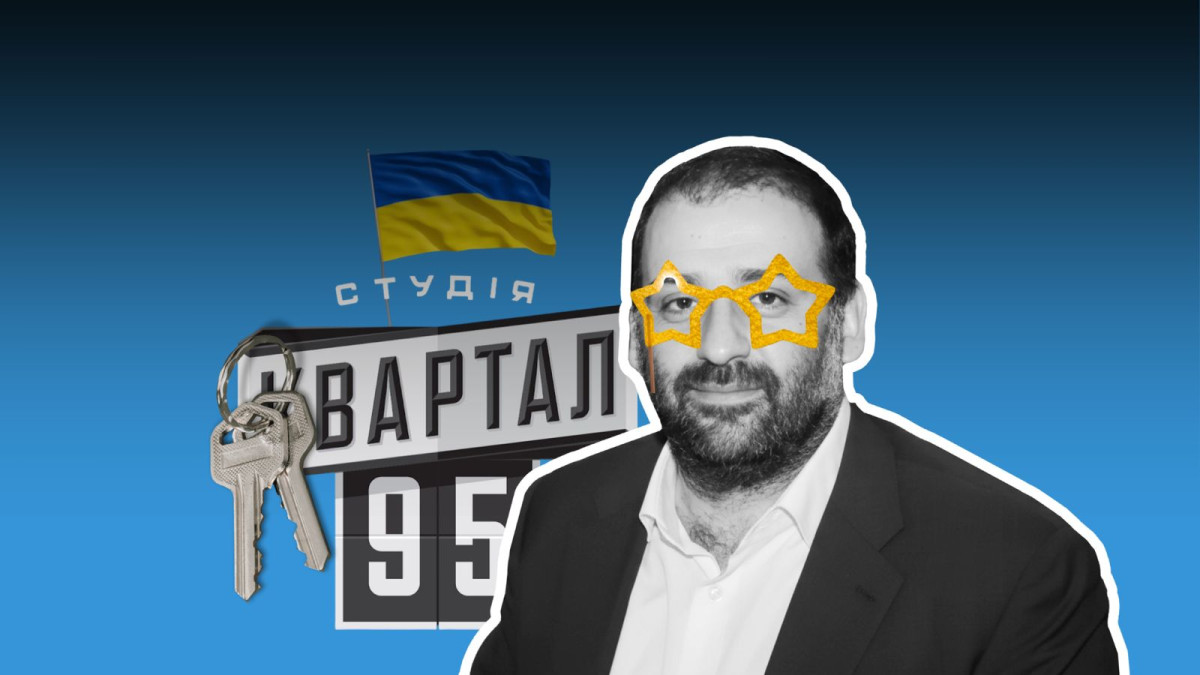
According to YouControl data, Timur Mindich holds corporate rights in 35 Ukrainian companies and is the beneficial owner of several others. In addition to his widely known 50% stake in Kvartal-95 LLC, Mindich is also the beneficial owner of Express-Izumrud LLC, Solutions LLC, Sky Food Services LLC, Coffee Bar Plus LLC, and others. These companies are highly profitable businesses, with annual revenues amounting to tens—or even hundreds—of millions of hryvnias. It was precisely in the interests of Coffee Bar Plus LLC that Yevhen Dykhne, former head of Boryspil Airport and convicted at first instance by the High Anti-Corruption Court, abused his official position. Moreover, Mindich holds corporate rights in jewellery companies registered in the United Kingdom and Luxembourg; however, Ukrainian sanctions do not apply to these entities, as the restrictions are effective only within Ukraine.
As for Oleksandr Tsukerman, he is the director of S/V/M, LTD, a company providing financial services. No other companies owned by Tsukerman have been identified to date.
All of these companies—as well as real estate, vehicles, bank accounts, and other assets—should be frozen pursuant to the NSDC decision. Furthermore, the Law on Sanctions provides that asset freezes apply not only to property directly owned by sanctioned individuals, but also to assets they are able to dispose of. This means that property registered in the names of relatives—such as the three apartments owned by Mindich’s mother, Stella Mindich—may also be subject to freezing.
At the same time, it must be acknowledged that asset-freezing procedures in Ukraine remain insufficiently effective. Oversight of this process falls to the Ministry of Justice, which until recently was headed by another figure implicated in the so-called “Mindich tapes” case, Herman Halushchenko.
Even more critically, Ukraine has yet to criminalize the circumvention of sanctions. Four years into the war, we continue to see cases in which sanctioned individuals have been able to dispose of their assets within Ukraine without hindrance. The most striking example is the case of Serhii Shapran, who facilitated the removal from sanctions of a Russian businessman’s assets worth approximately UAH 1 billion. In other words, there is no guarantee that Mindich’s and Tsukerman’s assets will not simply disappear.
In this context, seizures imposed within criminal proceedings may prove more effective. Such seizures have already been applied to some of Mindich’s and Tsukerman’s assets. However, unlike sanctions, criminal seizures extend only to property directly owned by suspects or explicitly linked to criminal cases. Moreover, Ukraine’s national confiscation regime requires further improvement to more comprehensively cover all cases involving the confiscation of assets belonging to criminal organizations—a topic we have analyzed separately.
Nevertheless, let us assume that the fugitives’ assets are indeed properly frozen. What should the state’s next step be?
We cannot know with certainty what exactly served as the basis for sanctions against Mindich and Tsukerman, as NSDC decisions do not disclose their reasoning. Typically, sanctioned persons receive an explanation only when they challenge the sanctions before the Supreme Court.
Nataliia Sichevliuk
The prospects of sanctions-based confiscation
Since the start of the full-scale invasion, legislators have authorized not only asset freezes and financial restrictions on sanctioned persons, but also the confiscation of such assets into state revenue during martial law, provided certain conditions are met. The law allows for confiscation sanctions against individuals who have caused significant harm to Ukraine’s national security, sovereignty, or territorial integrity—inter alia, by participating in decisions related to armed aggression, financing the Russian state budget, disseminating propaganda, and so forth.
As we can see, the grounds for confiscation are formulated far more narrowly than those for asset freezes and other sanctions. As a result, the creation of a criminal organization by Mindich and Tsukerman, Mindich’s alleged influence over a Cabinet member, and the laundering of proceeds attributed to them in the NABU case cannot, at present, serve as grounds for confiscation of their assets.
To bring a confiscation claim, the Ministry of Justice would need evidence that Mindich and Tsukerman caused harm to Ukraine’s national security, sovereignty, or territorial integrity through cooperation with the Russian Federation.
Accordingly, the prospect of sanctions-based confiscation appears unlikely. The remaining hope is that the assets of the case’s figures will be confiscated within criminal proceedings. At a minimum, the Criminal Code provision on the legalization (laundering) of criminal proceeds provides for such a penalty, and special confiscation mechanisms may allow for the recovery of income obtained in this manner.
The prospect of sanctions-based confiscation appears unlikely. The remaining hope is that the assets of the case’s figures will be confiscated within criminal proceedings.
Nataliia Sichevliuk
Instead of conclusions—hopefully interim ones
The imposition of sanctions on Mindich and Tsukerman vividly illustrates the numerous systemic problems afflicting Ukraine’s sanctions policy. From the practice of using sanctions as a substitute for criminal prosecution to shortcomings in enforcement, the absence of liability for evasion or violations, and beyond, the President’s and the NSDC’s actions may ultimately have little real impact on the individuals concerned.
If persons suspected of corruption are truly to feel the effects of restrictive measures, such measures must be imposed in accordance with the law and best international practice, so that they function effectively and withstand scrutiny in domestic and international courts. Otherwise, these mechanisms will remain ineffective and continue to be used by political leadership to simulate a fight against corruption or other crimes.
Was that the objective of those who moved swiftly to impose sanctions on Mindich and Tsukerman? A rhetorical question.
If persons suspected of corruption are truly to feel the effects of restrictive measures, such measures must be imposed in accordance with the law and best international practice, so that they function effectively and withstand scrutiny in domestic and international courts.
Nataliia Sichevliuk
Source: glavcom.ua


