



Since the High Anti-Corruption Court (HACC) began its work in 2019, Transparency International Ukraine has continuously monitored its activities. Our specialists have attended court hearings, examined the organizational and functional aspects of the HACC’s work, and studied the decisions it has issued.
Systematic and comprehensive observation of the anti-corruption court’s work allows us to identify both positive trends and the challenges it faces.
This report presents the results of the seventh stage of monitoring the HACC’s work — from July 1, 2025, to June 30, 2026 — and continues our series of such monitoring materials. You can read the previous materials on the HACC Decided platform.
In this report, we analyzed trends in the HACC’s adjudication of corruption and corruption-related criminal offenses, and we also examined the implementation of the recommendations made following previous monitoring stages. This time, we separately analyzed in greater detail the grounds for the HACC’s acquittals and the practice of the HACC Appeals Chamber modifying and overturning verdicts — this made it possible to assess not only how promptly judicial decisions are made, but also the reasons that lead to acquittal or to the reversal of verdicts.
Based on these findings, TI Ukraine’s experts determined the level of implementation of the previous recommendations and formulated new ones that can improve the effectiveness of the HACC as a court specializing in anti-corruption justice.
Key takeaways
- The HACC is showing rising productivity and has, for the first time, halted the years-long growth in its backlog of pending cases; single-judge proceedings have proven their effectiveness, cutting case processing times several times over.
- The share of postponed hearings and procedural violations recorded by our monitoring declined across all categories of hearings, and the practice of plea agreements is gradually improving.
- However, the ineffective regulation of limitation periods remains the main challenge and continues to worsen, while the abuse of procedural rights and unresolved procedural issues (replacement of a judge, the point of transition to panel proceedings) undermine the progress achieved.
On November 20, 2025, the assembly of HACC judges approved the High Anti-Corruption Court Strategy for 2026–2028 — the first strategic document of this level adopted by the court itself.
Tellingly, among the two key indicators of achieving its strategic focus by the end of 2028, the court explicitly named reducing the number of criminal proceedings closed due to the expiry of limitation periods — that is, the very problem we have consistently documented since the fourth monitoring period and to which a separate subsection of this report is devoted. The Strategy also provides for a more effective organization of court proceedings and the active use of data for internal monitoring, which includes introducing a case-prioritization mechanism. To this end, the trends in the backlog of pending cases, the duration of their consideration, and other indicators will be assessed.
The fact that the court has institutionally emphasized these matters at the level of its own strategy is a positive signal. Real progress in these areas will be assessed in future reporting periods.
The HACC is showing rising productivity and has, for the first time, halted the years-long growth in its backlog of pending cases; single-judge proceedings have proven their effectiveness, cutting case processing times several times over.
Executive Summary
The seventh HACC monitoring report covers the period from July 1, 2025, to June 30, 2026. During this time, our monitoring lawyers attended 1,067 court hearings and analyzed hundreds of court decisions, continuing to assess the court’s procedural efficiency, its compliance with the standards of criminal proceedings, and the implementation of recommendations from previous monitoring stages.
The results point to a mixed picture: the HACC is showing a gradual rise in productivity and improvements in the internal organization of its work, while problems whose resolution depends on parliament or other state bodies remain without an adequate response.
Key Achievements
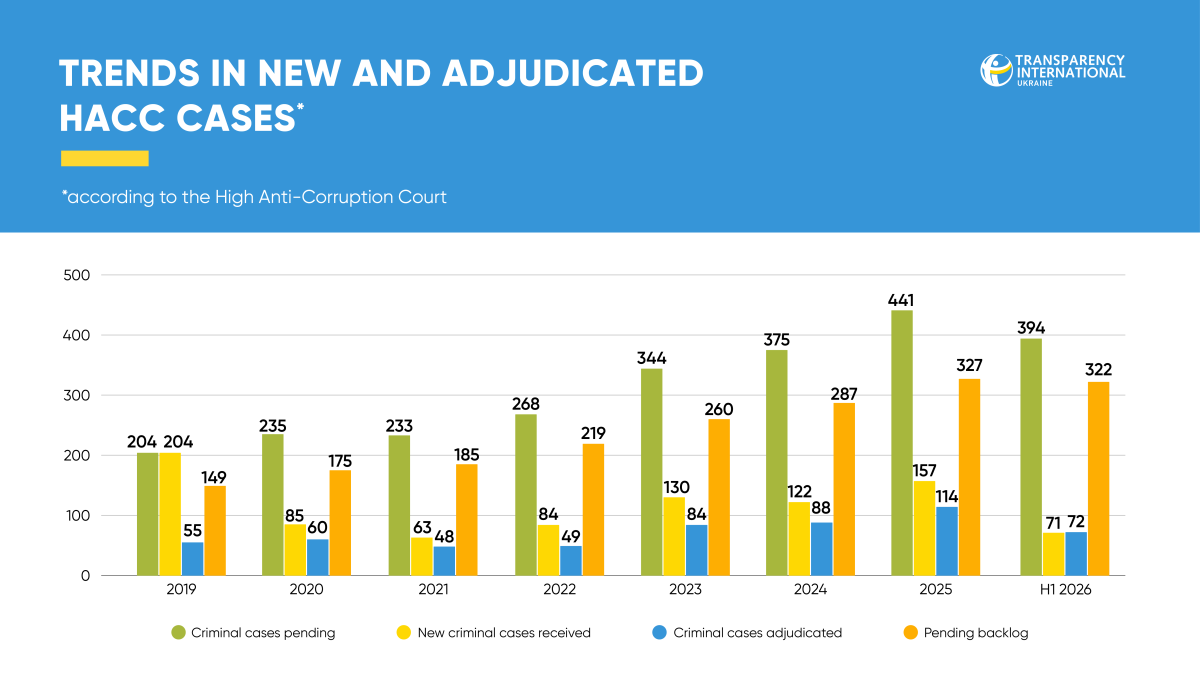
Record productivity and a shift in caseload dynamics. In 2025, the HACC heard 114 criminal cases and convicted 154 persons. In the first half of 2026, the court for the first time heard more cases (72) than the number of new ones it received (71). This made it possible to halt the years-long growth in the backlog of pending proceedings and even to reduce it slightly (from 327 to 322).
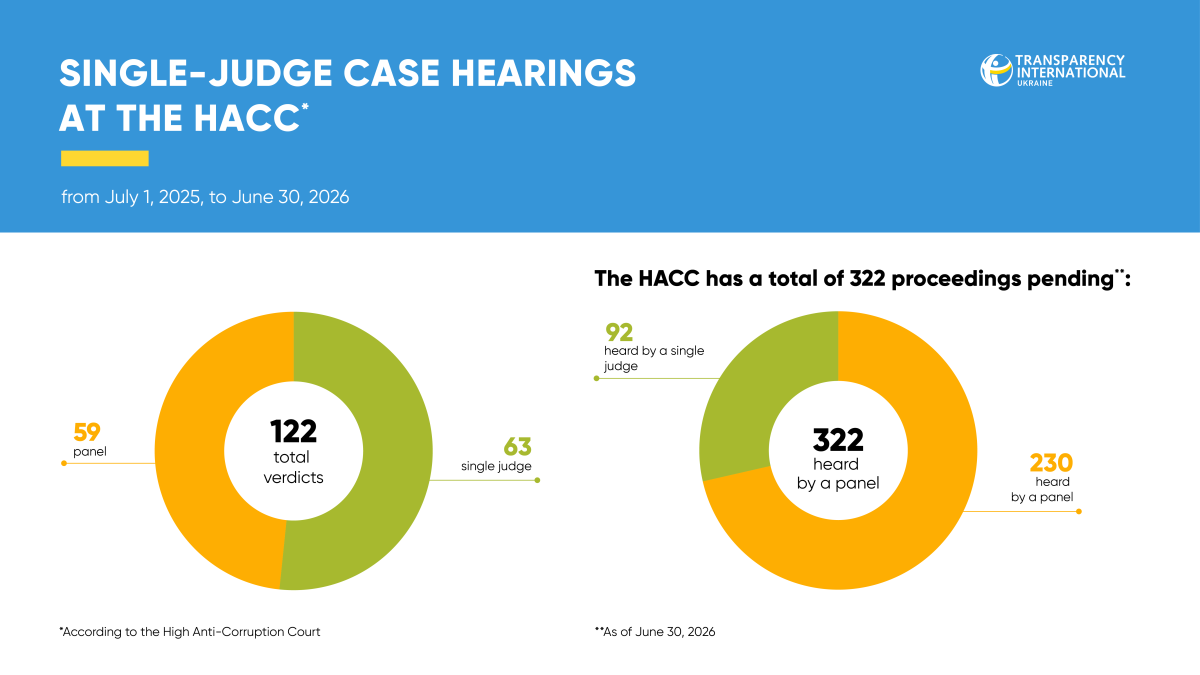
Single-judge proceedings have proven effective. The share of proceedings heard by a single judge rose from 22% to 29% of the entire body of pending cases. The difference in time is quite significant: cases in single-judge proceedings are completed in an average of 342 days (11 months), whereas panel proceedings take four times as long — on average 1,365 days (~3 years and 9 months).
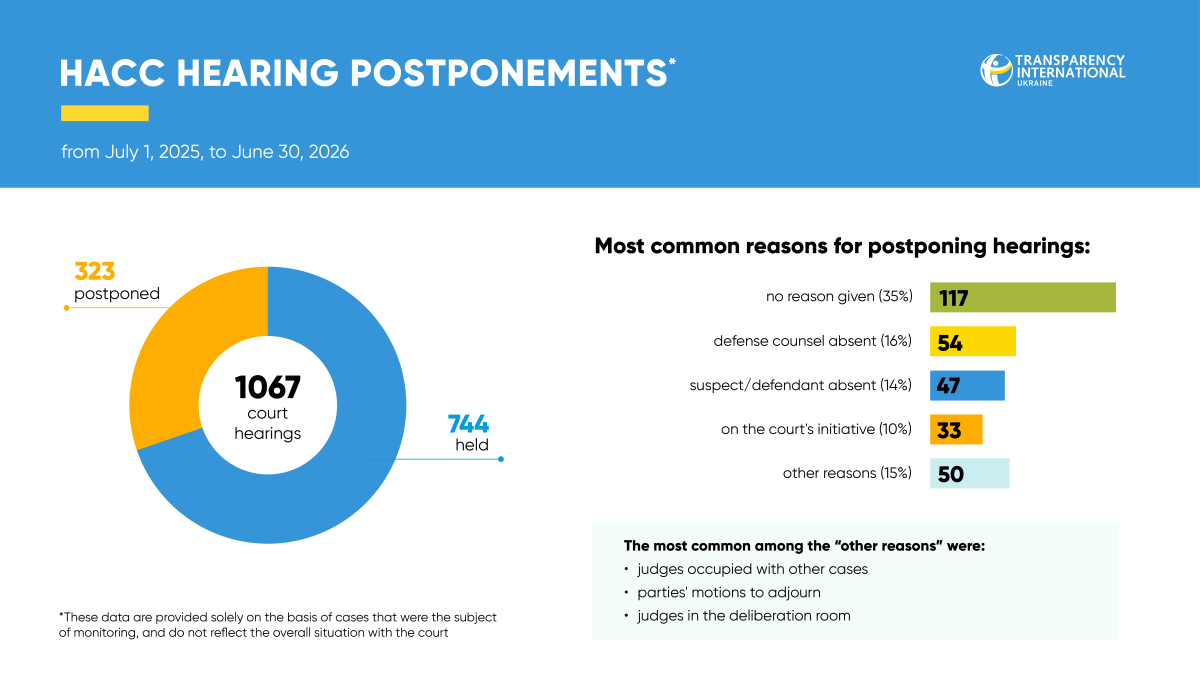
Positive trends across monitoring indicators. The share of postponed hearings fell from 35% to 30%, and the share of procedural violations decreased for all categories of hearings.
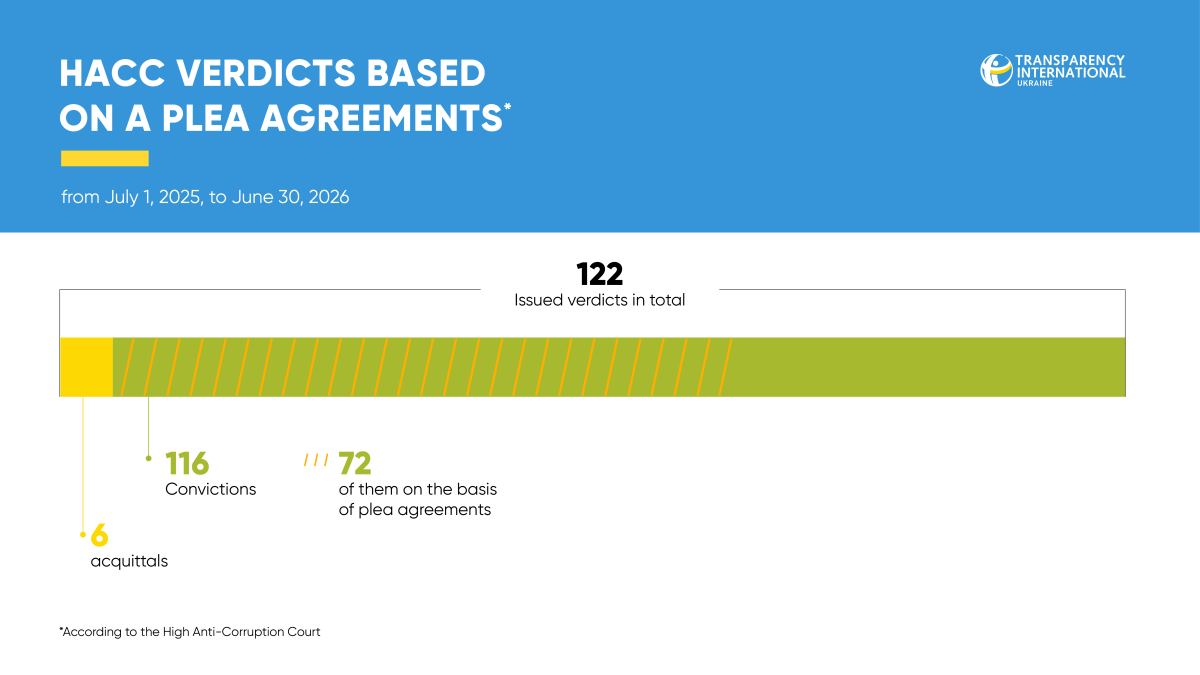
Growth and partial improvement in the practice of plea agreements. The number of verdicts based on plea agreements grew in absolute terms (72 versus 58 last year) but declined slightly in relative terms (62% versus 66% last year). The first publicly confirmed cases of an actual, albeit shorter, sentence under Article 69-2 of the Criminal Code of Ukraine appeared, along with the practice of partially — rather than fully — sealing the texts of verdicts based on agreements.
Personnel and institutional strengthening. Two new judges appointed following the second HACC competition are already presiding over a number of high-profile proceedings, and in August 2026 the President of Ukraine appointed a further 16 winners of the competition. On November 20, 2025, the assembly of HACC judges approved for the first time the court’s Development Strategy for 2026–2028, which institutionally acknowledges a number of the problems raised in our previous reports — in particular, limitation periods and the court’s inadequate premises. After lengthy consultations, the government ultimately resolved the problem of the court’s premises.
Two new judges appointed following the second HACC competition are already presiding over a number of high-profile proceedings, and in August 2026 the President of Ukraine appointed a further 16 winners of the competition.
Critical Challenges
The ineffective regulation of limitation periods remains the biggest problem, and it is worsening. During the reporting period, 22 persons were released from criminal liability due to the expiry of limitation periods (versus 13 last year), and 9 persons were released from punishment (versus only 1 last year). A large share of these closures fall under Articles 364 and 368 of the Criminal Code of Ukraine — that is, serious corruption offenses.
The abuse of procedural rights is taking on new forms. Whereas previously the parties most often resorted to simple failures to appear, now the manipulation of servicemember status, the artificial creation of conflicts of interest, hours-long repetitive speeches, and mass groundless motions are becoming widespread. Judges have begun to apply monetary penalties more actively; however, the court still lacks the power to impose such penalties on defense attorneys, and cooperation with the Bar Qualification and Disciplinary Commissions of the Bar remains ineffective.
The closure of cases due to the expiry of pretrial investigation time limits (the Lozovyi amendments) continues to threaten cases. The number of motions to close cases on this ground rose from 29 to at least 41 over the year, and three cases were closed at first instance. The HACC Appeals Chamber closed two cases on this ground.
Inconsistent approaches to the consequences of replacing a judge have taken on new relevance in connection with the competition for the HACC Appeals Chamber. The transfer of sitting first-instance judges to the appellate level creates the risk that a number of high-profile proceedings will have to be reheard from the beginning.
The problems with single-judge proceedings are procedural in nature: there is no established, consistent practice on when a case should begin to be heard by a panel or by a single judge, which the defense from time to time exploits to delay the process.
The shortage of electronic bracelets available to the police persists, despite an increase in their number. In 5 cases, the court was forced to lift the obligation to wear a bracelet because it was in fact unavailable at the police, applying less reliable alternative preventive measures instead.
Opaque communication around agreements undermines their public perception. The texts of some verdicts remain fully sealed, and there is still no methodology for assessing the public interest, even though improving such approaches is envisaged by the SAPO Development Strategy.
Acquittals and appellate review point to certain areas for improving the quality of pretrial investigation. Of the six acquittals in the reporting period, some are linked to a weak evidentiary base and others to entrapment by the SBI or the SSU. Of the HACC verdicts reviewed on appeal, 43% were modified or overturned, mostly due to the incorrect delineation of related elements of offenses and incomplete justification of the evaluation of evidence.
The ineffective regulation of limitation periods remains the biggest problem, and it is worsening. During the reporting period, 22 persons were released from criminal liability due to the expiry of limitation periods (versus 13 last year), and 9 persons were released from punishment (versus only 1 last year).
Recommendations
To the Verkhovna Rada of Ukraine:
- adopt draft law No. 15354 in the first reading and finalize it for the second reading — providing for the interruption, rather than merely the suspension, of limitation periods from the moment the indictment is sent to the court; extending the grounds for suspension to all corruption articles (not only NABU and SAPO cases); and proportionately strengthening penalties for key corruption articles;
- introduce mechanisms into the Criminal Procedure Code of Ukraine to streamline court proceedings: formalize best practices for conducting hearings and give judges effective tools to respond to the abuse of procedural rights, including the power to impose monetary penalties on defense attorneys;
- abolish the automatic closure of cases due to the expiry of pretrial investigation time limits;
- establish in law that, provided hearings are fully audio- and video-recorded, the consent of the parties to the proceedings is not a mandatory condition for continuing the proceedings after a judge is replaced;
- eliminate the ambiguity in determining the point at which the right to panel proceedings is exercised, and extend single-judge proceedings to cases on the recognition of assets as unjustified and to sanctions-related proceedings;
- establish in law that the application of special confiscation is a mandatory condition for approving a plea agreement where the grounds for its application provided by law exist.
To the High Anti-Corruption Court:
- organize the handling of cases at risk of limitation periods expiring more effectively — coordinating hearing schedules in advance and responding to unjustified failures to appear;
- consistently implement organizational approaches to managing hearings: standardize time limits for speeches, restore the practice of holding parties liable for contempt of court (Article 185-3 of the Code of Ukraine on Administrative Offenses), hear only the parties concerned on motions, and make wider use of state-funded defense attorneys to ensure the continuity of proceedings;
- consolidate and formalize as a standard the existing practice of partially sealing verdicts based on agreements.
To the Cabinet of Ministers of Ukraine:
- ensure stable funding for the procurement of electronic monitoring devices, in particular by identifying funding sources for 2027.
To the Specialized Anti-Corruption Prosecutor’s Office:
- accelerate the implementation of the measures in the 2026–2028 Development Strategy on establishing consistent approaches to concluding plea agreements.
Implementing these recommendations will contribute to further strengthening the HACC’s institutional capacity and will increase the effectiveness of holding perpetrators accountable for top-level corruption offenses in Ukraine.
When assessing the implementation of the recommendations, we found that most of those left unimplemented depend largely on parliament rather than on the HACC as a judicial body.
This report was prepared by Transparency International Ukraine with the financial support of Sweden.
Implementing these recommendations will contribute to further strengthening the HACC's institutional capacity and will increase the effectiveness of holding perpetrators accountable for top-level corruption offenses in Ukraine.


