

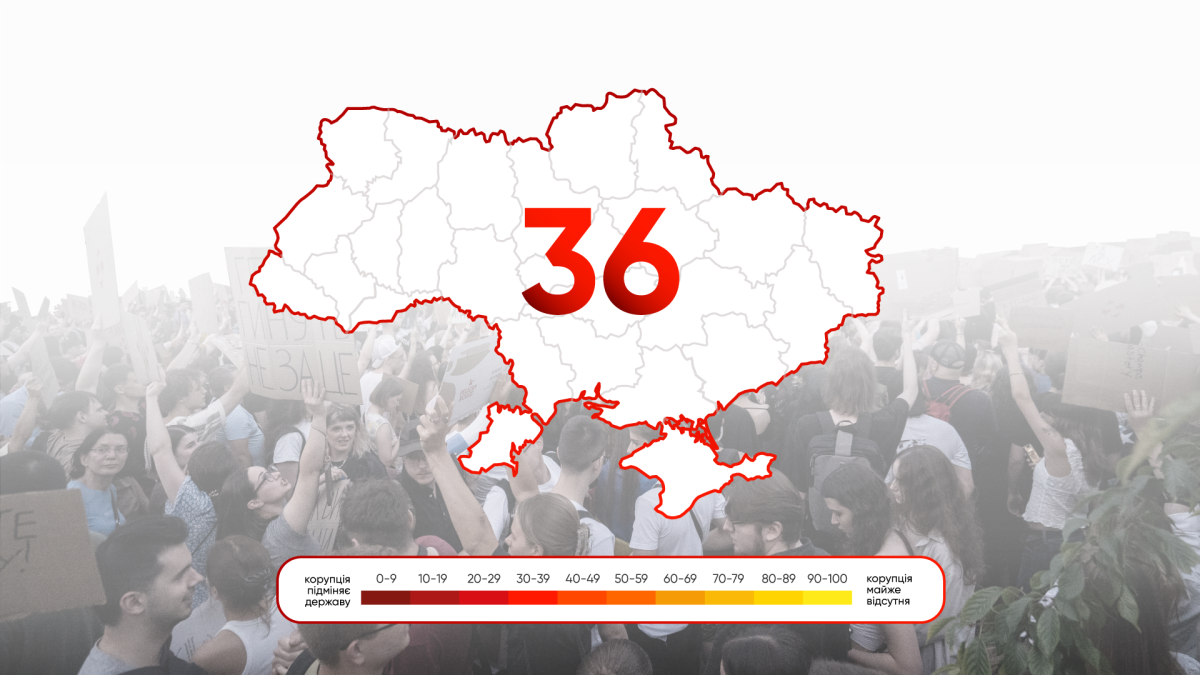
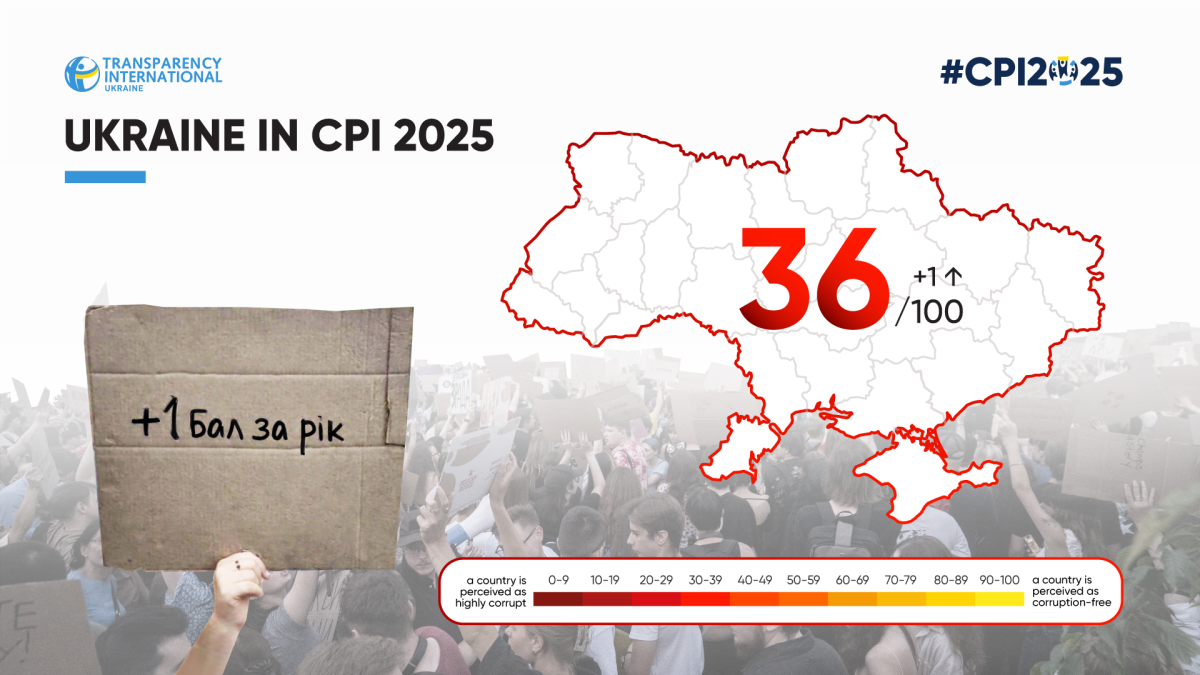
Ukraine scored 36 out of 100 in the Corruption Perceptions Index (CPI) for 2025. In Transparency International’s latest study, Ukraine ranked 104th out of 182 countries.
This year, Argentina and Belize also scored 36 points. Ukraine is one point behind Colombia, Dominican Republic, Gambia, Lesotho, and Zambia, while Brazil and Sri Lanka scored one point less.
In this way, Ukraine matched its CPI 2023 result. However, a more substantial breakthrough was held back by a significant slowdown in EU integration reforms and in fulfilling international commitments—still the main drivers of change in the country.
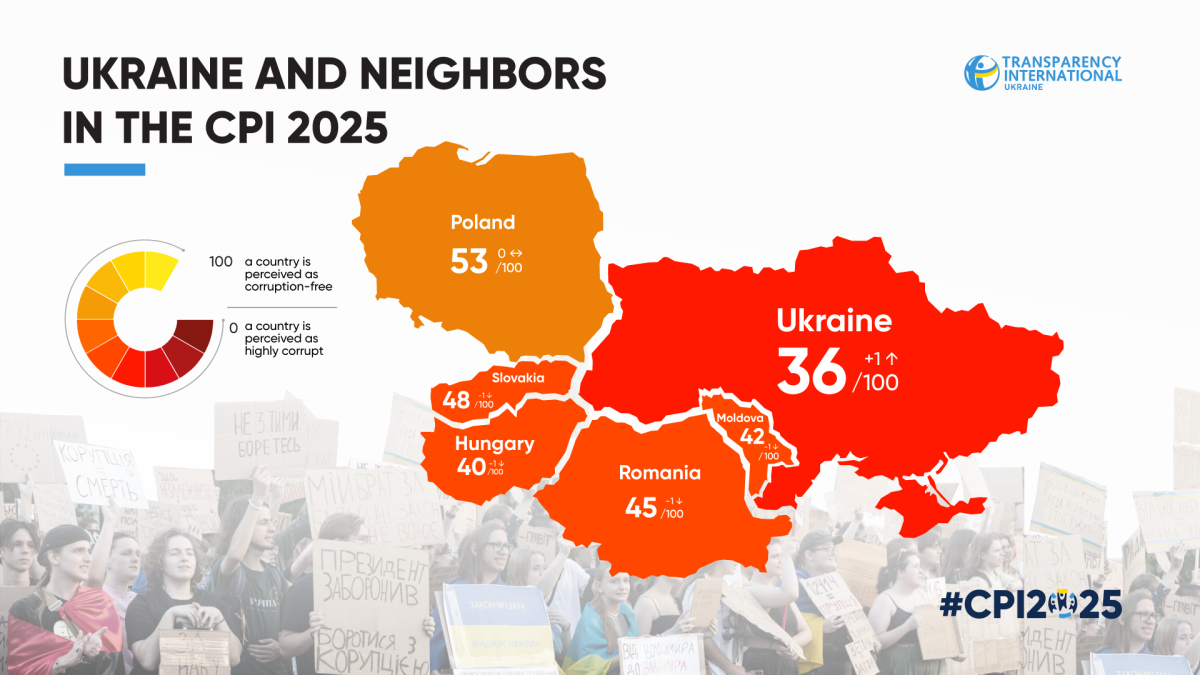
Among Ukraine’s western neighbors, only Poland’s score remained unchanged—53 points and 52nd place in the Corruption Perceptions Index 2025. By contrast, Slovakia (48 points, 61st place), Romania (45 points, 70th place), Moldova (42 points, 80th place), and Hungary (40 points, 84th place) each lost 1 point. As a result, none of Ukraine’s neighboring countries managed to improve their CPI scores, while Ukraine was the only country in the region that succeeded in slightly strengthening its standing in the study.
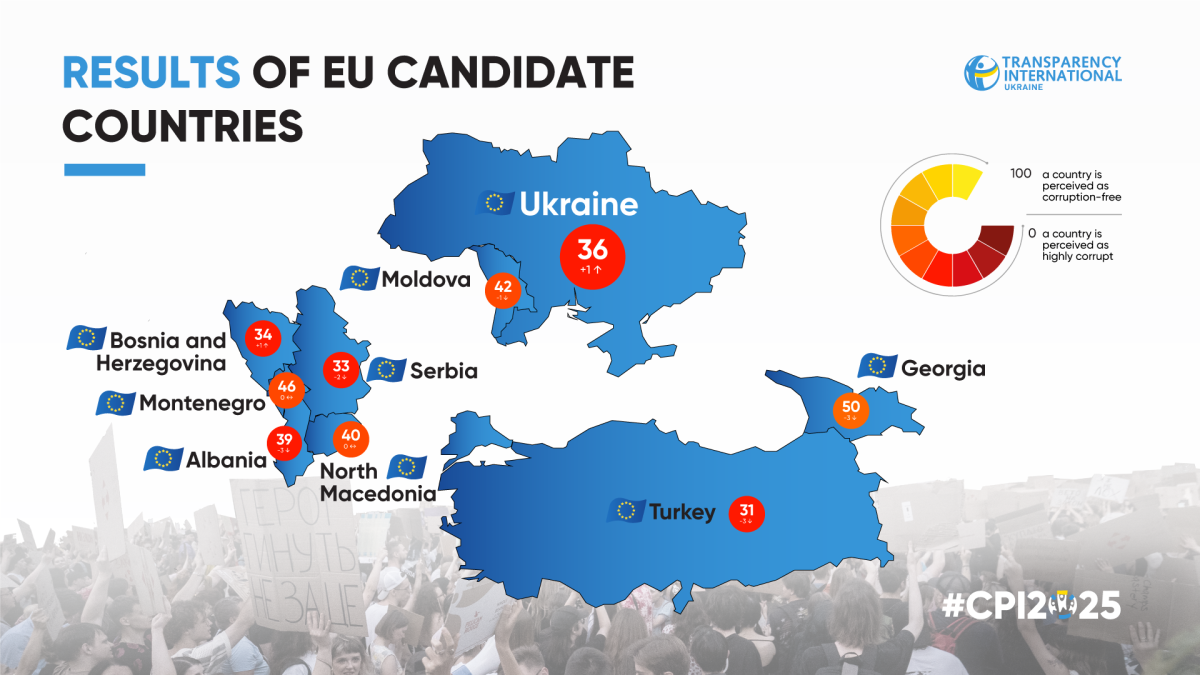
As for EU candidate countries, the average score is 39 (down from 40 last year), which is 3 points higher than Ukraine’s current score.
Over the year, the scores for Montenegro (46 points, 65th place) and North Macedonia (40 points, 84th place) did not change. Moldova (42 points, 80th place) lost 1 point. Serbia (33 points, 116th place) dropped by 2 points. Georgia (50 points, 56th place), Albania (39 points, 91st place), and Turkey (31 points, 124th place) each lost 3 points. Meanwhile, Bosnia and Herzegovina improved by 1 point—34 points, 109th place. Thus, in 2025, among all EU candidate countries, only Ukraine and Bosnia and Herzegovina showed progress.
Montenegro, North Macedonia, Moldova, Georgia, and Albania are ahead of Ukraine, while Serbia, Turkey, and Bosnia and Herzegovina scored fewer points than Ukraine.
Overall, based on CPI 2025 results, the global average score decreased for the first time in more than 10 years—from 43 to 42. This shows not only a broad stagnation in anti-corruption efforts worldwide, but also to a degree of rollback, driven by a global crisis of democracy and the security order.
Negative trends are also visible across the European Union and Western Europe: while the average score for these countries was 66 in 2022, it has dropped to 64 this year. This, too, suggests an inadequate response to the challenges of the moment, especially given the controversial, drawn-out process of drafting, and the debated substance of, the EU’s general anti-corruption directive.
Ukraine matched its CPI 2023 result. However, a more substantial breakthrough was held back by a significant slowdown in EU integration reforms and in fulfilling international commitments—still the main drivers of change in the country.
What components make up Ukraine’s CPI 2025 indicator?
The Corruption Perceptions Index is not only one of the largest thematic studies in its field but also a marker of how things stand inside a country. That is why Ukraine’s CPI score and its progress in fighting corruption are used as reference points by international partners and donors, as well as by potential investors.
In recent years, Ukraine has shown very restrained progress. After gaining +3 in 2023 and reaching a total of 36 points, the country has essentially remained at that level, alternately losing and then regaining 1 point from year to year.
As in the previous year, Ukraine’s results in the Corruption Perceptions Index 2025 were calculated on the basis of eight assessments covering the period from January 2023 through September 2025, inclusive. Due to methodological limitations, many developments from fall 2025 (for example, the “Midas case”) and early 2026 (for example, NABU’s notice of suspicion to Batkivshchyna party leader Yuliia Tymoshenko) were not reflected in this year’s Index.
In one of the underlying sources, Ukraine’s score increased: the Bertelsmann Transformation Index added 5 points. By contrast, in the World Economic Forum’s Executive Opinion Survey, Ukraine lost 2 points. In the remaining six sources—the Freedom House Nations in Transit report, the Rule of Law Index compiled by the World Justice Project, the country risk ratings by The Economist Intelligence Unit, Varieties of Democracy, S&P Global Insights’ Risk and Business Environment Indicators, and the PRS Group’s International Country Risk Guide—Ukraine’s position did not change.
The 2026 Bertelsmann Transformation Index assessment, in which Ukraine gained 5 points, was conducted from January 2023 to January 2025 and incorporated the views of 280 experts worldwide. Among other factors, they assessed whether officials who abuse their positions are held accountable or punished. In other words, this outcome was driven by the active work of the NABU, the SAPO, and the HACC in investigating and adjudicating top-level corruption cases in 2023–2024.
The World Economic Forum’s Executive Opinion Survey—conducted from March through August 2025, where Ukraine lost 2 points—includes, among other questions: “In your country, to what extent is it common for public funds to be diverted to companies, individuals, or groups due to corruption?” To administer this survey, the World Economic Forum works closely with more than 160 partner institutions. Primarily reputable economics faculties at national universities, independent research institutes, or business organizations. These partners are selected based on their capacity to capture the views of leading business executives and their knowledge of the country’s business environment.
It is also important to note that, in some cases, Ukraine’s score did not change because certain source data were not updated from the previous Corruption Perceptions Index cycle. For example, S&P Global Insights’ Risk and Business Environment Indicators still cover October–December 2023. Likewise, Freedom House’s once-annual Nations in Transit report stopped being published after 2024.
Thus, it was the jump in the Bertelsmann Transformation Index that ultimately drove Ukraine’s overall +1 point in CPI 2025. In this context, a one-point increase may be perceived not as improvement, but as motion without progress that feels especially painful in a country at war. After all, despite having a concrete reform plan, Ukraine did not demonstrate real progress or readiness to implement it. The fulfilment of commitments already undertaken has once again been postponed, while genuinely positive developments in 2025 were relatively few.
During that period, many negative and positive events influenced public perceptions of corruption in our country. On the positive side: the Commission for the External Independent Audit published the results of the first independent assessment of NABU’s effectiveness; parliament voted for ARMA reform; and the Cabinet of Ministers approved Transformation Road Maps in the areas of the rule of law, public governance reform, and the functioning of democratic institutions.
However, the audit of NACP remains blocked; a commission to select candidates for the Accounting Chamber has not been established; and international experts’ participation in the Selection Commission for appointing HQCJ members has ended. And the attempted dismantling of the anti-corruption system in July 2025 jeopardized Ukraine’s future progress in fighting corruption. These and other negative developments prevented Ukraine from achieving a larger increase.
In recent years, Ukraine has shown very restrained progress. After gaining +3 in 2023 and reaching a total of 36 points, the country has essentially remained at that level, alternately losing and then regaining 1 point from year to year.
What further anti-corruption measures should Ukraine implement to improve its CPI performance?
Ukraine’s CPI 2025 score shows that the progress achieved in fighting corruption has largely been made possible by the commitments Ukraine has undertaken with international partners, and by a united society that once again refused to let the country veer off its democratic path.
The following documents currently shape Ukraine’s trajectory:
- Ukraine Facility Plan;
- EU Enlargement Report on Ukraine;
- the IMF program under the Extended Fund Facility (EFF);
- the Rule of Law Road Map;
- the Plan of 10 priority reforms in anti-corruption and the rule of law.
In line with these documents, Transparency International Ukraine emphasizes the need to implement 6 priority steps in 2026:
- Safeguard the independence of anti-corruption institutions.
- Improve outcomes in corruption cases, especially in freezing and confiscating illicit assets.
- Enhance the institutional capacity and focus of the National Agency on Corruption Prevention.
- Update legislation to ensure swift, high-quality justice.
- Expand the involvement of international experts in the selection commission for appointing HQCJ members.
- Adopt an Anti-Corruption Strategy and a State Anti-Corruption Program.
Ukraine’s CPI 2025 score shows that the progress achieved in fighting corruption has largely been made possible by the commitments Ukraine has undertaken with international partners, and by a united society that once again refused to let the country veer off its democratic path.
Global corruption perceptions trends in 2025
As CPI 2025 shows, the global corruption situation is worsening: even established democracies are seeing rising corruption amid weakening leadership. The study indicates that the number of countries scoring above 80 has fallen from 12 ten years ago to just five this year.
At the same time, CPI scores suggest that democracies, which are typically stronger at controlling corruption than autocracies or flawed democracies, are experiencing a worrying decline in performance. This trend includes countries such as the United States (64), Canada (75), and New Zealand (81), as well as parts of Europe, including the United Kingdom (70), France (66), and Sweden (80). Another troubling pattern is that many governments have intensified restrictions on freedom of expression, association, and assembly. Since 2012, 36 of the 50 countries with the most significant score declines have also seen civic space shrink. Based on CPI 2025, the global movement Transparency International concludes that the overwhelming majority of countries are failing to control corruption: more than two-thirds—122 out of 180—score below 50.
The study also shows that, over the past decade, anti-corruption efforts in many European countries have largely stalled. Since 2012, perceptions of corruption have significantly worsened in 13 countries in Western Europe and the EU, while only seven countries have posted notable improvements.
In December 2025, the EU agreed on its first Anti-Corruption Directive to harmonize criminal legislation on corruption. However, provisions in a document that was supposed to establish a zero-tolerance framework were diluted by some member states, including Italy (53), which blocked the criminalization of abuse of office by public officials. As a result, the European Union ended up with a framework that lacks ambition, clarity, and enforceability.
Meanwhile, the United States continued its decline to the lowest CPI score in its history. Although 2025 developments are not yet fully reflected, actions targeting freedom of expression and undermining judicial independence are already a cause for concern. In the past year, the United States saw temporary suspension and weakening of enforcement of the Foreign Corrupt Practices Act of 1977, signaling the current administration’s tolerance of corrupt business practices. At the same time, cuts to U.S. support for civil society abroad weakened global anti-corruption efforts, while political leaders in other countries interpreted this funding rollback as a signal to further restrict the activities of NGOs, journalists, and other independent voices.
More broadly, high CPI scores do not guarantee that top-ranked countries are free from corruption, as several of the Index leaders facilitate corruption in other countries by enabling the laundering and cross-border transfer of corruption proceeds. For example, Switzerland (80) and Singapore (84).
Transparency International warns that the lack of bold leadership in the global fight against corruption is weakening international anti-corruption action and risks reducing pressure for reform worldwide.
In light of these trends, the Transparency International movement calls for:
- renewed political leadership in the fight against corruption, including full enforcement of laws, fulfillment of international commitments, and reforms that strengthen transparency, oversight, and accountability;
- protection of civic space by ending attacks on journalists, NGOs, and whistleblowers, and stopping efforts to restrict the independent work of civil society;
- closing secrecy loopholes that allow corrupt money to move across borders, including by ensuring transparency about who ultimately owns companies, trusts, and assets.
CPI scores suggest that democracies, which are typically stronger at controlling corruption than autocracies or flawed democracies, are experiencing a worrying decline in performance.
CPI study: how it works
Corruption Perceptions Index (CPI) is a ranking calculated by the global organization Transparency International since 1995. The organization does not conduct its own surveys. The Index is calculated based on 13 studies of reputable international institutions and think tanks.
The key indicator of the Index is the score, not the rank. The minimum score (0 points) means that corruption actually replaces the government, while the maximum (100 points) indicates that corruption is almost absent in society. The index assesses corruption only in the public sector.
The CPI incorporates the views of business representatives, investors, market analysts, and others. It reflects private-sector perspectives and how the private sector perceives corruption in the public sector.
It is important to keep in mind that CPI measures perception of corruption, not the actual level of corruption. A higher score for one country compared to another does not necessarily mean that the former has less actual corruption—it simply indicates that it is perceived as less corrupt.
The CPI methodology has been approved by the European Commission for its robust statistical approach.
CPI assesses perceptions of public sector corruption such as bribery, embezzlement of public funds, nepotism in public service, state capture, the government’s ability to implement integrity mechanisms, the effective prosecution of corrupt officials, excessive bureaucracy, and the adequacy of laws on financial disclosure, conflict of interest prevention, and access to information, as well as the protection of whistleblowers, journalists, and investigators.
Why do we need a CPI?
- The CPI covers more countries than any single source.
- The CPI compensates for the error in different sources using the average of the results of at least three different sources.
- The CPI scale of 0 to 100 is more accurate than other sources, as some have a scale of 1 to 5 or 1 to 7, which results in many countries receiving the same results.
- The CPI balances different perspectives on corruption in the public sector and has a neutral approach to different political regimes.
It is important to keep in mind that CPI measures perception of corruption, not the actual level of corruption. A higher score for one country compared to another does not necessarily mean that the former has less actual corruption—it simply indicates that it is perceived as less corrupt.


