


Selecting Judges for the HACC: Interviews in Review
March 24, 2026
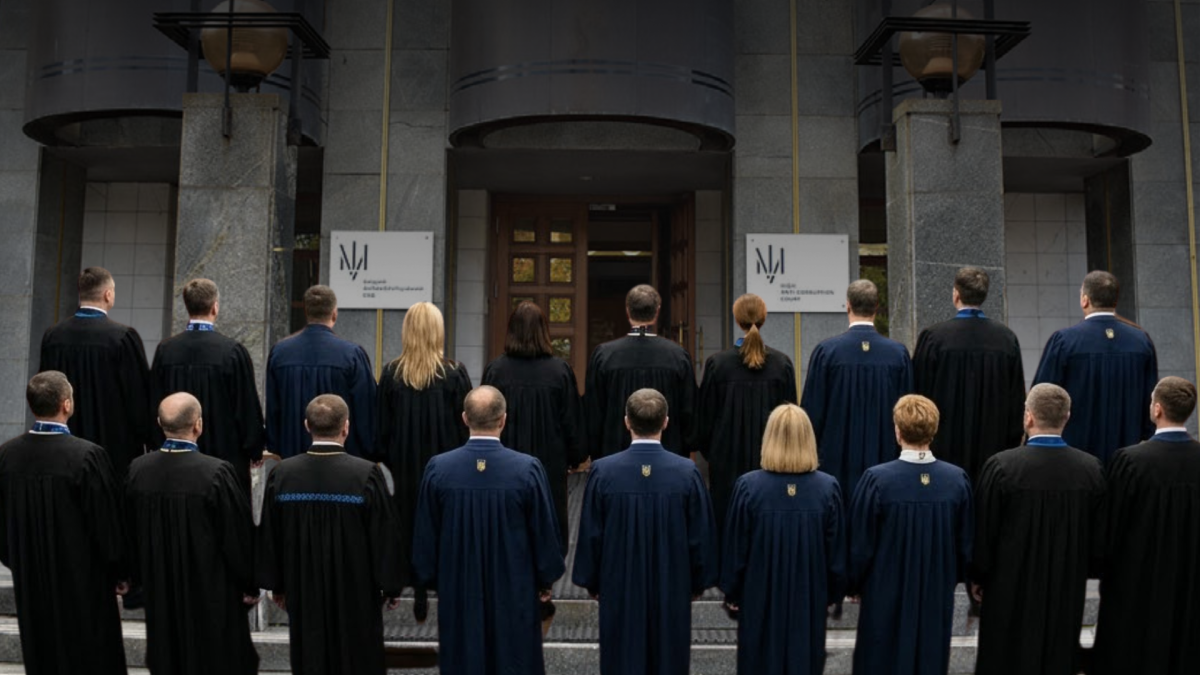
Twenty-two new judges for the HACC — that is the outcome of the candidate interview stage, conducted jointly by international experts and the judicial qualification commission. Here is a closer look at what those aspiring to take a seat on the bench were actually asked.
Twenty-two new judges for the High Anti-Corruption Court — that is the outcome of the candidate interview stage, conducted jointly by international experts and the judicial qualification commission. Here is a closer look at what those aspiring to take a seat on the bench were actually asked.
What is the selection process about?
Before we knew it, the most intensive phase of the competition for HACC judgeships had come to a close: interviews with candidates conducted by the Public Council of International Experts (PCIE) and the High Qualifications Commission of Judges (HQCJ). Over the course of more than four weeks, they held 69 interviews.
Candidates were questioned about their assets, prior rulings, professional accomplishments, their motivation for joining the HACC, any travel to Russia or temporarily occupied territories, plagiarism in academic work, and much more. I covered the key moments from the first two weeks of interviews in an earlier piece.
As a reminder, the competition is being held to fill 23 vacant positions — 13 in the HACC’s court of first instance and 10 in its Appeals Chamber. This is already the second selection round: the process launched in 2023 yielded only two successful candidates out of 25 openings.
It is worth noting that the involvement of international experts provided an additional guarantee of transparency and impartiality. Equally important was the close collaboration between the PCIE and the HQCJ, as well as the active participation of civil society and international partners. The interviews were genuinely grounded in thorough analysis of candidates’ biographies, financial disclosures, and a range of other matters.
It should also be noted that under Ukraine’s obligations within the Ukraine Facility plan, the country must appoint at least 20 judges. The number of candidates who advanced past the interview stage is sufficient for Ukraine to meet that commitment.
It should also be noted that under Ukraine's obligations within the Ukraine Facility plan, the country must appoint at least 20 judges. The number of candidates who advanced past the interview stage is sufficient for Ukraine to meet that commitment.
Andrii Borovyk
What were candidates asked about?
Over the final two and a half weeks, PCIE and HQCJ members conducted 36 interviews. The participation of two candidates — Maksym Hloba and Stanislav Nesterenko — was terminated by the commission. So what were the most notable lines of questioning?
Bitcoin, solar panels, and billion-hryvnia businesses
Assets, business interests, and automobiles dominated the experts’ questions. Ihor Omelian, a lecturer at the International European University, was asked about companies in which he appeared as a co-founder: Podil Agro Invest LLC (with a charter capital of UAH 4.2 billion, of which UAH 1.4 billion belonged to the candidate) and Sea Investment Group LLC (with a charter capital of UAH 560 million, of which UAH 140 million was his share). Omelian claimed he had voluntarily withdrawn from both ventures due to their failure, walking away from his billion-hryvnia stakes without complaint.
Curiously, Omelian appeared to be trying to impress the PCIE and HQCJ with a display of integrity, noting that he could have omitted a property from his declaration since it “wasn’t even in the registry” and no one would have noticed.
Another business arrangement that drew the panel’s attention was the solar panel operation of attorney Volodymyr Bubleinyk. Through the sale of electricity under a green energy tariff, he managed to earn half a million euros — while the seven buildings used to house the panels had been transferred to him free of charge by the local municipal council. He explained that the properties had no market value and that the council’s motivation was to boost budget revenues and promote renewable energy development.
Attorney Olena Roik faced extensive questioning about the origins of her assets — most notably, the lack of documentation for the purchase of two bitcoins she allegedly sold in 2021 for $155,000, without paying taxes. She claimed to have subsequently lent that money to a friend, and had to take legal action to recover it. Also raising eyebrows was the purchase of an Aston Martin for UAH 14 million in 2025 — a sum far exceeding her declared income. Roik described the car as a particular way of “storing cash” accumulated through savings, an inheritance, and a loan. When asked about the ethics of purchasing a luxury vehicle just one month before the competition, she responded with confidence: she was “not ashamed” of her declaration and considered herself “modest.”
Searches in the Court Decisions Registry
The commission also continued probing candidates about searches of restricted personal information — their own or that of close associates — conducted through full-access mode in the Unified State Register of Court Decisions, information they could have exploited for personal gain. The explanations varied. Tetiana Troian, a judge of the Sosnivskyi District Court in Cherkasy, admitted to conducting such searches in order to monitor potential debt collection proceedings initiated by a bank.
Yuliia Retynska, a judge of the Zavodskyi District Court in Zaporizhzhia, attributed the searches to a technical mix-up between browser tabs with different access levels during her work. She separately confirmed that she had shared information about the criminal liability of a friend’s ex-husband, insisting she had only disclosed data from open cases. The commission apparently found these explanations satisfactory — Retynska advanced to the next stage.
Ihor Chaikin, a judge of the Pokrovskyi District Court in Kryvyi Rih, explained that he had searched for himself and close relatives on over 100 occasions while preparing documents for various competitions, to verify information about any potential criminal proceedings or court summons. The PCIE and HQCJ found this sufficient grounds to pass him through as well.
Oleksandr Leonov, a judge of the Khadzhybeiskyi District Court of Odesa, additionally reported that his profile had been accessed without authorization, resulting in nearly 1,000 queries.
The charitable attorneys
During one interview, a PCIE expert could not help but remark that Ukraine, unlike most other countries, appears to have an unusually widespread practice of attorneys providing their services free of charge. The pattern surfaced, for example, during the interview with Oleksandr Zavhorodnii, who — despite having no declared income in 2015–2017 and 2020–2021, and having relocated from occupied territory — continued offering his legal services at no cost.
Ivan Kravchenko, a lecturer at Sumy National Agrarian University, attributed the absence of revenue from the law firm he co-founded to pro bono work.
Anton Baida, an associate professor at the Yaroslav Mudryi National Law University, similarly stated that despite holding an attorney’s license, he handled nearly all cases for free — for acquaintances — citing it as a way to test his theoretical knowledge in practice. He also noted that he lacked the funds to cover the mandatory continuing professional development required of licensed attorneys.
Pardoning drunk drivers
The HQCJ and PCIE also scrutinized candidates’ judicial track records, specifically a pattern of mass case closures involving drunk driving charges on grounds of statutory time limits having lapsed.
Oleh Marchuk, a judge of the Vasylkiv City-District Court in Kyiv Region, explained that procedural notification issues were common in such cases and that his workload had been excessive overall. It also emerged that Marchuk himself had accumulated more than 20 administrative traffic violations — he suggested that some may have been committed by his wife, though he acknowledged that in roughly 15 instances, he was indeed the offender.
Similar concerns were raised with Iryna Tokarska, a judge of the Manevychi District Court, Volyn Region. She justified the mass closures of DUI cases — either on the basis of expired time limits or by imposing fines without license revocation — by pointing to the difficulty of summoning military personnel to court and the fact that some offenders lacked driving licenses. Her decision to close a case involving an intoxicated serviceman, which she explained as a “gesture of leniency” following combat near Bakhmut, drew particular criticism.
I also cannot omit the high-profile moment when NABU and SAPO exposed Ivan Posokhov, a judge of the Siverskodonetsk City Court, Luhansk Region, on charges of soliciting a $30,000 bribe — while he was actively participating in the HACC judicial selection competition. What made it especially striking was his statement during the interview that he was unaware of any misconduct among colleagues or anyone else. On the subject of corruption, he remarked that the phenomenon exists — but that he had never personally encountered it.
I also cannot omit the high-profile moment when NABU and SAPO exposed Ivan Posokhov, a judge of the Siverskodonetsk City Court, Luhansk Region, on charges of soliciting a $30,000 bribe — while he was actively participating in the HACC judicial selection competition.
Andrii Borovyk
On the results
The interview stage, conducted with the participation of international experts and the qualification commission, proved to be an indispensable part of the competition — a moment where candidates could be confronted directly with the most sensitive aspects of their professional histories. It is worth emphasizing that the picture drawn in this article is inevitably incomplete: what matters most is how candidates respond to tough questions when pressed. As we have seen, some answers were deemed sufficient to carry candidates forward.
As for the process itself — we once again have reason to believe in the effectiveness of this selection model, despite the considerable skepticism that has surrounded it. What this round demonstrates is that involving international experts can genuinely ensure transparency, quality, and independence in the appointment of HACC judges — and that this is not merely a box-ticking exercise.
Following this stage, interviews are also conducted by the High Council of Justice (HCJ). If the Council endorses the HQCJ’s decisions, the President appoints the judges upon its recommendation.
The results of this stage are, in my opinion, something of a compromise. Among those who may advance to become judges are four candidates whose interview responses were notably unconvincing.
Vladyslav Kukhta, presiding judge of the Chernihiv District Court, was called out by the PCIE on ethical grounds. He secured a third term as court chair by exploiting a two-month administrative “pause” in his tenure to circumvent a legal two-term limit. That same maneuver also allowed a colleague to secure lifetime financial benefits at a salary inflated by 10% for the administrative role. In addition, in 2020 he recused himself from a prominent espionage case with Belarusian dimensions, for which the HCJ formally reprimanded him.
Another prospective HACC judge is Iryna Teslenko, currently a judge of the Kreminna District Court in Luhansk Region, seconded to the Solomianskyi District Court of Kyiv. She was questioned about failing to declare rented housing in Kreminna, a questionable valuation of an apartment in Kharkiv, and a series of profitable car resales by her family. She explained the absence of a registered address by claiming she stayed in hotels on working days and paid in cash; the car profits she attributed to her husband’s repair work. The HQCJ also flagged a discrepancy between her savings and expenditures during maternity leave, as well as trips to Russia after 2014 — which she justified as an unavoidable necessity in order to purchase medication for her parents.
Yuliia Retynska, mentioned earlier in connection with the registry searches, also had to explain a significant jump in her savings: in 2020 she managed to set aside approximately $15,000, as her net income rose from UAH 300,000 to UAH 700,000. She explained this by deliberately saving for a home purchase and cutting personal expenses sharply following the start of the full-scale invasion.
The final candidate to raise concerns is Olha Pevna, a judge of the Troitske District Court in Luhansk Region. PCIE and HQCJ members found inconsistencies in her asset declarations for 2016–2022. Among the financial red flags: in 2019, after accounting for savings, she was left with just UAH 290 per month. She insists her expenses were covered by her children’s father. The commission noted, however, that this should have been declared. Additional concerns include late submission of financial disclosure reports and suspicious transactions involving the purchase and refund of a defective vehicle bought in the Czech Republic.
The commission was also intrigued by her relationship with her ex-husband: the couple divorced in 2015, yet had a child together in 2020, traveled as a family, and shared property. There is speculation that the divorce may have been fictitious — a means of shielding assets from seizure following a traffic accident in which the husband was involved and victims sustained serious injuries. Pevna denied this, saying contact with her ex-husband was strictly limited to co-parenting.
What remains critically important now is to see the full written reasoning behind the PCIE and HQCJ decisions for each candidate — and to await the High Council of Justice’s review.
What remains critically important now is to see the full written reasoning behind the PCIE and HQCJ decisions for each candidate — and to await the High Council of Justice's review.
Andrii Borovyk
Source: www.liga.net


