


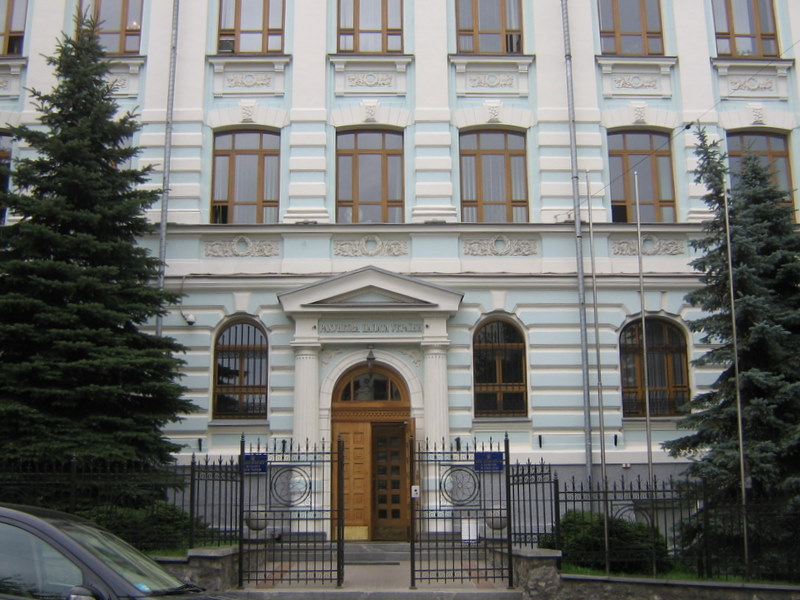

The Accounting Chamber May Lose a Member: Crisis or Catalyst?
May 4, 2026
Staffing tensions at the Accounting Chamber are mounting against the backdrop of a competition that parliament has been unable to launch for nearly a year.
On Wednesday, April 1, the Accounting Chamber published a notice that one of its members, Yelyzaveta Pushko-Tsybuliak, had submitted a resignation letter. Under the law, such a resignation cannot take effect immediately — members of the Accounting Chamber are dismissed by parliament. The Accounting Chamber has already resolved to refer the matter to parliament, where it must first be considered by the relevant budget committee before being put to a plenary vote.
If Pushko-Tsybuliak is dismissed, Ukraine’s supreme financial control body will be left with just four members. Each member is currently responsible for specific areas of work — twelve in total — so yet another departure will mean redistributing her responsibilities among the remaining members, adding to their workload in a way unlikely to improve the institution’s effectiveness.
That said, the Accounting Chamber will not grind to a halt. Under the law, a session is quorate if at least two-thirds of the actually appointed membership is present. After a potential dismissal, decisions could be taken with just three members present and voting.
In practice, this will only deepen what is already a protracted staffing crisis that has persisted for nearly two years.
The last time new members were selected for the Accounting Chamber was in 2023. Those interviews were publicly broadcast, which gave the public a clear view of the problem’s depth. The competition was purely formal — it included neither a proper assessment of candidates’ professional competence nor any integrity screening. Most candidates had a poor grasp of the Accounting Chamber’s mandate and international auditing standards, significantly overstated their foreign language proficiency, and some openly displayed loyalty to the MPs sitting on the interview panel.
The competition launched alongside the new reform law in December 2024 was meant to fix the staffing problem. The remaining vacancies were to be filled through an updated selection procedure, which provides for a special Advisory Group of Experts (AGE) in which international experts hold a majority voice. Internationally nominated candidates, comprising half the AGE, were put forward as early as spring 2024. The remaining three AGE members were to be nominated by parliamentary factions or groups. MPs have attempted several times to agree on that list, but have failed to hold a vote and formally establish the AGE in nearly a year.
The potential dismissal could further complicate the process of filling vacancies at the Accounting Chamber. Under the law, a competition for a vacated seat must open the day after the member’s term ends. This means that if Pushko-Tsybuliak is dismissed, two competitions would run simultaneously: the first — for the six vacancies opened in December 2024 — and a second for the newly vacated seat. Parliament would then have several options for managing this:
- The straightforward approach — establish a single AGE to select candidates for all vacant positions. This carries procedural risks, however. The law requires the AGE formation process to restart after a new competition opens. Failing to comply could provide grounds to challenge the results — in the best case, of the second competition alone; in the worst case, of both. The simple option may thus prove the riskiest.
- The complex approach — run two separate competitions. This would require finally establishing an AGE for the first competition and launching a separate process for the additional vacancy. The timeline could stretch indefinitely, but it would comply fully with the law.
- The compromise approach — swiftly amend the legislation to allow competition procedures to be consolidated across all Accounting Chamber vacancies, provided they have not yet reached a certain stage — such as AGE formation. This would avoid procedural violations while streamlining and accelerating the appointment of the missing members.
There is also the option of simply refusing to approve the resignation — but this would only delay the inevitable. In practice, someone who wants to leave is unlikely to perform their duties effectively, and the institution is already chronically short-staffed.
It is also important to recognize that filling the Accounting Chamber’s vacancies is not merely a question of the supreme audit institution’s capacity to effectively oversee public spending during wartime with limited fiscal resources. It also bears on Ukraine’s fulfillment of its EU accession commitments and on the confidence of international partners, which directly determines the scale of continued financial support. Completing the Accounting Chamber’s membership by year-end is one of the structural benchmarks under the IMF’s new 2026 program for Ukraine.
Parliament has every reason to finally resolve the problems of an institution that is, after all, accountable to it. Whether the resignation becomes a deepening of the crisis or a catalyst for resolving it depends entirely on political will.
Source: zn.ua


