



June 11, 2026 10:34
While Klychko stays silent: what the Kyiv City State Administration has put nearly UAH 26 billion under contract for since the start of the year
Kyiv Mayor Vitalii Klychko has not reported to the city’s residents in over four years — the last time was back in December 2021. Over that period, plenty of questions have piled up for the city government, from spending on repairs and transport to reconstruction and energy. In April, Transparency International Ukraine Executive Director Andrii Borovyk registered an electronic petition to the Kyiv City Council demanding that the mayor’s public reports be reinstated. In April, TI Ukraine’s petition demanding the return of public reports gathered the required number of signatures — and a response did come, though not the one expected: the Kyiv authorities pointed to a website with published reports and to the security risks of martial law, but stopped short of promising an open meeting with the community.
While this story plays out, the DOZORRO team decided to look at exactly what contracting authorities controlled by the city government have been directing billions toward since the start of 2026.
According to BI Prozorro, from January through May 24 the KCSA had already contracted UAH 26 billion. That is slightly less than over the same period in 2025, when the figure stood at UAH 26.2 billion. The most funds went to construction and current repairs — UAH 7.1 billion. In second place was fuel and electricity, at UAH 5.8 billion. This category traditionally ranks among the city’s largest expenses, since it covers keeping public transport, municipal enterprises, hospitals, schools, and other city infrastructure running. Moreover, electricity procurements alone make up substantial sums given their high cost. Another UAH 2.6 billion was contracted for medical equipment, medical products, and services. This category includes both procurement of medicines, consumables, and equipment for the capital’s hospitals and the services needed to run the city’s medical system. In particular, the year’s top 5 largest contracts included an agreement between the Kyiv City Center for Emergency Medical Care and Disaster Medicine and the municipal organization Kyivmedspetstrans for transporting ambulance crews in specialized vehicles, worth UAH 436.7 million.
Largest contracting authorities
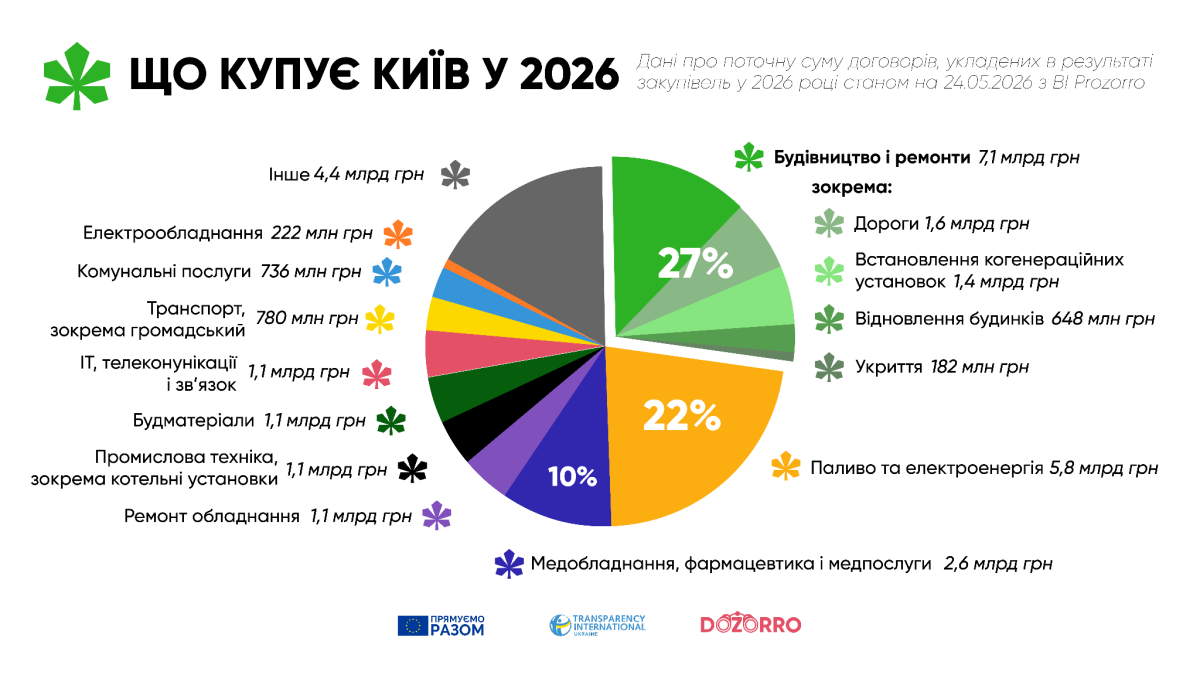
Since the start of the year, the most contracts were signed by the Kyivteploenergo municipal enterprise — UAH 4.6 billion. The company procured boiler houses, the installation of cogeneration units, fuel, and repair services for equipment damaged by Russian attacks.
In second place was the Kyivpastrans municipal enterprise, with over UAH 1.6 billion. The funds went toward procuring new trolleybuses, electricity, fuel, and spare parts for public transport.
Third was Kyivvodokanal — UAH 1.1 billion. The contracts were signed to support the operation of water supply systems, water treatment, and the reconstruction of pumping stations.
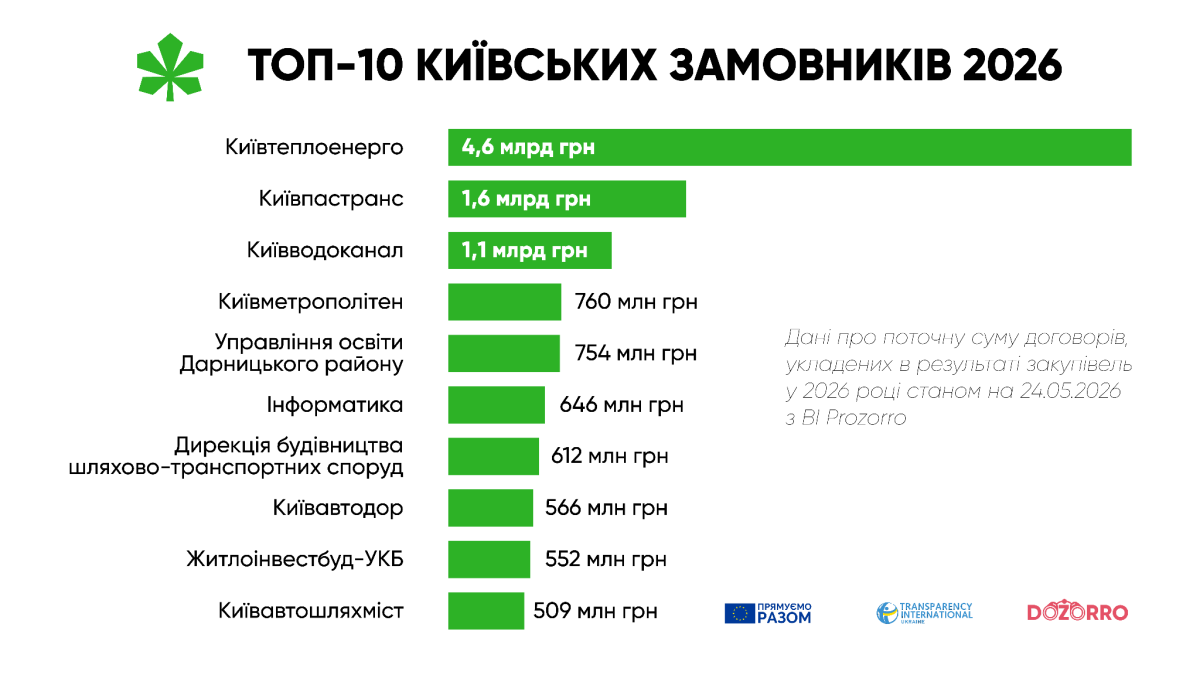
Among the capital’s largest spending areas are road infrastructure, blackout preparedness, housing reconstruction, and public transport. Let’s take a closer look at the most expensive projects.
Road infrastructure
One of the capital’s most expensive infrastructure projects in 2026 is the reconstruction of the traffic interchange at the junction of Beresteiskyi Avenue and Vadyma Hetmana Street. The Directorate for Construction of Road and Transport Facilities of Kyiv municipal enterprise signed a UAH 605 million contract with the Prombud Technology consortium. This concerns finishing the Shuliavka interchange, whose reconstruction has already been underway for several years. The works are scheduled for completion by the end of 2027. The project involves finishing the overpass ramps, road works, relocating utility networks, and improving the surrounding area.
Another UAH 516 million was contracted by the municipal corporation Kyivavtodor for the major overhaul of Myloslavska Street in Kyiv’s Desnianskyi district. The work will be carried out by Avtomahistral-Pivden LLC. The works cover a 1.6 km stretch from Honoré de Balzac Street to Mykoly Zakrevskoho Street. The project involves renewing the road surface, the tram track, sidewalks, bike lanes, and lighting, and improving the surrounding area. The works are to be completed by 2028.
The city is also directing significant funds to repairing bridges and overpasses. In particular, the municipal enterprise Kyivavtoshliakhmist contracted over UAH 174 million for routine repairs to the Pivdennyi Bridge, as well as to two right-bank overpasses. Another UAH 57.2 million will be spent on repairing the overhead pedestrian crossing near Peremoha Park, and UAH 46.5 million on repairing the load-bearing structures of the overpass at the junction of Nauky Avenue and the continuous-flow highway.
Preparing for blackouts and winter
Preparing for possible new attacks on the power system and for outages is another of the capital’s spending areas. In total, over UAH 1.8 billion has already been contracted for backup power, cogeneration, and the protection of critical infrastructure.
The most funds were directed by the Kyivteploenergo municipal enterprise. The company is procuring the installation of cogeneration units — equipment that allows heat and electricity to be generated simultaneously. Such systems are meant to keep the heat-and-power infrastructure running even in the event of new attacks or large-scale outages. The procurements cover not only the installation of the cogeneration units themselves but also the construction of separate infrastructure for their operation — protective structures, gas pipelines, power grids, ventilation, automation, and safety systems. In total, Kyivteploenergo has already contracted approximately UAH 1.4 billion for these projects.
In parallel, backup power is being reinforced at other important infrastructure facilities. Kyivvodokanal, for example, ordered works to introduce backup power at the Bortnychi Aeration Station for UAH 36.8 million and at the Pozniaky sewage pumping station for another UAH 17.4 million.
Funds were also directed separately toward supporting road and social infrastructure during possible outages. The Traffic Management Center municipal enterprise procured backup-power cabinets for over UAH 8.4 million to keep traffic lights and road infrastructure operating during possible power cuts. The Education Department of the Darnytskyi District State Administration ordered diesel generators for UAH 6.6 million to ensure the uninterrupted operation of educational institutions during emergency or load-shedding outages. Earlier this year DOZORRO examined how cities were preparing for blackouts. In 2025, UAH 9.6 billion was contracted through Prozorro for energy resilience in Kyiv Region, though large state-owned companies account for a significant share of it. Without them, the figure is approximately UAH 3.4 billion.
A separate area of preparation concerns the city’s heat supply. Kyivteploenergo procured ten 30 MW hot-water boilers for UAH 752 million. This is the most expensive contract signed by the city since the start of the year. Kyivkotloturboprom LLC is to deliver the equipment by the end of 2026. Such boilers are used in district heating systems to supply heat to residential buildings and infrastructure facilities. The procurement is likely tied to preparing the capital for the new heating season.
Reconstruction after Russian attacks
Some of the KCSA’s large procurements concern restoring housing damaged by Russia. Since the start of the year, over UAH 647 million has already been contracted in the capital for the design and major overhaul of such buildings. The largest contracting authority for such works is the Zhytloinvestbud-UKB municipal enterprise, which commissions major overhauls of apartment blocks in various districts of the city.
The largest contract — UAH 144.5 million — was signed for the reconstruction of a nine-story building at 31 Václav Havel Boulevard. Last June, a Russian missile struck the building, completely destroying one of its entrance sections. The works will be carried out by ASCON Construction Company LLC.
A further UAH 101.6 million will go toward the major overhaul of the building at 5 Ivana Honty Street. During a Russian strike in June 2025, an entire entrance section there collapsed. After inspections and project preparation, it was decided to restore the building. The contract went to Modern City Infrastructure LLC. The same company will also repair the neighboring building at 7 Ivana Honty Street — for another UAH 29.4 million.
UAH 78.8 million has been contracted to restore the building at 87 Václav Havel Boulevard. The building sustained serious damage from a Russian drone attack in June 2025 and is currently in an emergency-hazard condition. The works will be carried out by Renesansbud IBC LLC.
Another UAH 43.2 million was contracted for restoration works at 28B Vidradnyi Avenue. The building was damaged during a Russian shelling overnight on July 31, 2025. The major-overhaul contract went to the InzhBud Alliance consortium.
Shelters
In the fifth year of the war, the construction and repair of shelters still remains a priority. The most such procurements were carried out by Kyiv’s district education departments.
One of the largest contracts was the repair of shelters at Lyceum No. 155 on Sichovykh Striltsiv Street. The Education Department of the Shevchenkivskyi District State Administration contracted UAH 16.7 million with the Spetsservice private enterprise for the works.
Separately, the city is continuing to build new protective structures at educational institutions. For example, UAH 15 million was contracted for the construction of a shelter for Nyvky Gymnasium No. 172 in the Shevchenkivskyi District. The contractor was Ukr Smart Engineering LLC.
Kyiv has begun launching new, larger-scale projects — underground learning spaces at schools. The most expensive such procurement was the construction of an underground school for Pavlo Tychyna Gymnasium No. 191 in the Dniprovskyi District. The estimated value of the works is UAH 343.5 million. Another UAH 326.6 million was earmarked for the construction of a protective structure for Lyceum No. 105 in the Darnytskyi District.
Surface transport
Public transport remains one of the capital’s major spending areas. The largest contracting authority in this field is the Kyivpastrans municipal enterprise. Since the start of the year, the company has signed contracts to procure electricity and fuel for transport operations, as well as to renew its fleet.
In January, Kyivpastrans ordered 16 trolleybuses from Polytechnoservice LLC. One of the company’s owners is former Kyivpastrans chief engineer Yurii Bombandiorov. The contract was initially valued at UAH 306.2 million. The vehicles are to be delivered by the end of 2026. The procurement itself, however, raised many questions. In January, the Nashi Hroshi outlet pointed out that the price of this trolleybus model has risen substantially in recent years. While in 2022 Chernivtsi bought similar PTS T12309 units for $282,000–295,000 apiece, in 2025–2026 the cost had already reached $436,000–444,000. In other words, the model’s price effectively grew one and a half times in three years.
Later, the State Audit Service reviewed this procurement and found that, when calculating the estimated value, Kyivpastrans had relied on the commercial proposal of the eventual winner — Polytechnoservice LLC — with a price of UAH 18.97 million per trolleybus. In the tender bid, however, the price had already risen to UAH 19.14 million. The auditors flagged a possible overpayment of UAH 2.7 million. Following this, the parties reduced the contract amount by that same sum. The current procurement took place after Kyivpastrans, in the fall of 2025, canceled another large tender — worth more than UAH 1 billion — for the procurement of 40 trolleybuses. At the time, the Passengers of Kyiv CSO criticized the tender terms over the short bid submission deadlines, the large advance payment, and the likely inflated cost of the vehicles.
Besides purchasing new trolleybuses, the company directed UAH 6.6 million toward servicing public transport and the e-ticket system. This covers technical support for validators, onboard computers, and driver terminals, the repair of automated fare-collection equipment, and cable networks in vehicles. Kyivpastrans also procured insurance services for passenger transportation — over UAH 14 million; spare parts and components for trolleybuses, buses, and trams — over UAH 109 million; and materials for vehicle repairs — UAH 6.9 million.
Public questions around Kyivpastrans’s operations have lately been mounting. In May, the company’s employees appealed to Vitalii Klychko with a complaint about the enterprise’s management and reported possible abuses in procurement. In particular, this concerns the alleged inflation of spare-parts prices, the creation of obstacles for certain suppliers, and informal influence over tender decisions. In their appeal, the staff called for an independent procurement audit and an internal review of the management’s activities.
Metro procurements
Beyond surface transport, the capital is also directing significant funds toward the metro’s operations in 2026. Since the start of the year, the Kyiv Metro municipal enterprise has already contracted UAH 760 million, including for car repairs and upgrades to safety, power-supply, and station-infrastructure systems.
The most expensive procurement was signaling, centralization, and blocking equipment for UAH 132.6 million. This refers to the signaling, centralization, and blocking systems that control train movement, track switching, and safe intervals between trains. The procurement drew the attention of journalists and auditors, as part of the equipment turned out to be more expensive than in the metro’s previous tenders. Track-circuit receivers, for example, were procured at roughly a quarter more than in 2024.
That said, a higher price does not necessarily mean an inflated cost. It may have been driven by rising delivery and energy costs, a shortage of specialized parts, and the inclusion of additional services in the price — installation, configuration, or technical support of the equipment.
The metro contracted another UAH 59.2 million for uninterruptible power-supply systems for this equipment, so that traffic-control systems keep working even during emergency power outages.
The metro contracted UAH 93.7 million for the repair of wheelsets on car bogies. These are running-gear components that essentially bear the cars and enable their movement along the rails. Such repairs are carried out because of the constant load and wear during operation.
Almost the same amount — UAH 96.3 million — went to electrical equipment for escalator modernization. This refers to upgrading the control and power systems of escalator units at metro stations, some of which have been operating for decades. A further UAH 114.2 million will be spent on rectifiers for the metro’s power-supply systems. This equipment converts electric current and powers part of the infrastructure and train movement.
Another UAH 74.4 million was contracted for the services of the operator of the automated fare-collection system — that is, support for electronic payment and turnstiles in the metro.
Among other large procurements are repairs to the system that checks the technical condition of cars while in motion, the purchase of frames for metro-car bogies, and the reconstruction of fire alarms at several metro stations, including Khreshchatyk, Vokzalna, Palats Sportu, and Zvirynetska.
Parks and greenery
Despite the major spending on transport, preparing for possible new blackouts, building shelters, and restoring damaged buildings, the KCSA continues to invest in improving and greening the city as well.
One of the largest such procurements was the major overhaul of the southwestern part of Natalka Park in the Obolonskyi District. Over UAH 65 million was contracted for the works. The project involves renewing park infrastructure, recreation areas, and surfacing, and improving the surrounding area.
Simultaneously, municipal enterprises procured flowers, trees, and ornamental plants for flowerbeds, parks, and squares. The green-space maintenance enterprise of the Desnianskyi District, for example, bought flowers and plants worth UAH 1.9 million. Among them were marigolds, salvia, begonias, and pelargoniums, as well as ornamental shrubs and perennials.
How the capital’s spending has changed over the war years
Comparing the overall procurement volumes of KCSA-controlled entities in recent years, the capital’s spending rose sharply after 2022. In 2022, procurements totaled UAH 21 billion — almost half the level of pre-war 2021, when UAH 38.4 billion was contracted. As early as 2023, procurement volumes more than doubled, to UAH 43.6 billion. And in 2024, Kyiv set a five-year record: procurements reached UAH 72.5 billion. In 2025, the figure dropped somewhat — to UAH 69.2 billion — though it still remains far above both the pre-war level and the first year of the full-scale war. In total, from 2022 through May 2026, KCSA-controlled entities contracted UAH 232 billion through Prozorro. Contracts on such a scale only heighten the public demand for the city government’s public accountability.
This material is funded by the European Union. Its content is the sole responsibility of Transparency International Ukraine and does not necessarily reflect the views of the European Union.
Source: hmarochos.kiev.ua


