



August 24, 2026 08:15
35 Years. Major Anti-Corruption Wins of Ukraine’s Independence
Today, we celebrate 35 years of Ukraine’s independence and, furthermore, 35 years of the country’s anti-corruption journey. Freedom, the rule of law, and institutional resilience are things that we have been championing as civil society all these years because these are the cornerstones of independence.
In the 90s, however, the Ukrainian society had a very different vision of corruption: it was easily tolerated as an everyday practice. But over the past 35 years, the worldview has drastically changed: corruption is perceived as one of the key problems in Ukraine’s development, and we have been continuously fighting for the independence of anti-corruption institutions.
Throughout these years, we have been fighting for a transparent state, and civil society played a key role in this process. Despite the major support from our international partners, it was the initiative and demands of the public that drove the implementation of key reforms. And without people who want to make a difference, it would definitely be impossible to defend the independence of anti-corruption agencies even after the long, exhausting war.
“Ukrainian civil society has grown, and it is important to recognize this. Particular progress has been made over the past 12 years. In moments of crisis, it was civil society that supported the country, both during the Revolution of Dignity and with the onset of the full-scale invasion. In the future, it will remain the state’s reliable partner. A strong civil society is one of the foundations of our independence,” said Andrii Borovyk, Executive Director of TI Ukraine. Read more in his op-ed for Ukrainska Pravda.
From having no clear definition of corruption in the legislation, Ukraine has progressed to a comprehensive system of anti-corruption institutions and tools of transparency and accountability. Today, we are proud of independent anti-corruption agencies, public registers, electronic procurement, and thousands of people who stand up for these institutions when they face pressure.
Here, we have collected the main anti-corruption wins of Ukraine’s independence so far, broken down into three eras, from the development of Ukraine’s statehood to continued reforms even during the full-scale war. This is not a complete story but a reminder of what has been accomplished and why it’s worth fighting for.
Ukrainian civil society has grown, and it is important to recognize this. Particular progress has been made over the past 12 years. In moments of crisis, it was civil society that supported the country, both during the Revolution of Dignity and with the onset of the full-scale invasion. In the future, it will remain the state’s reliable partner.
Andrii Borovyk
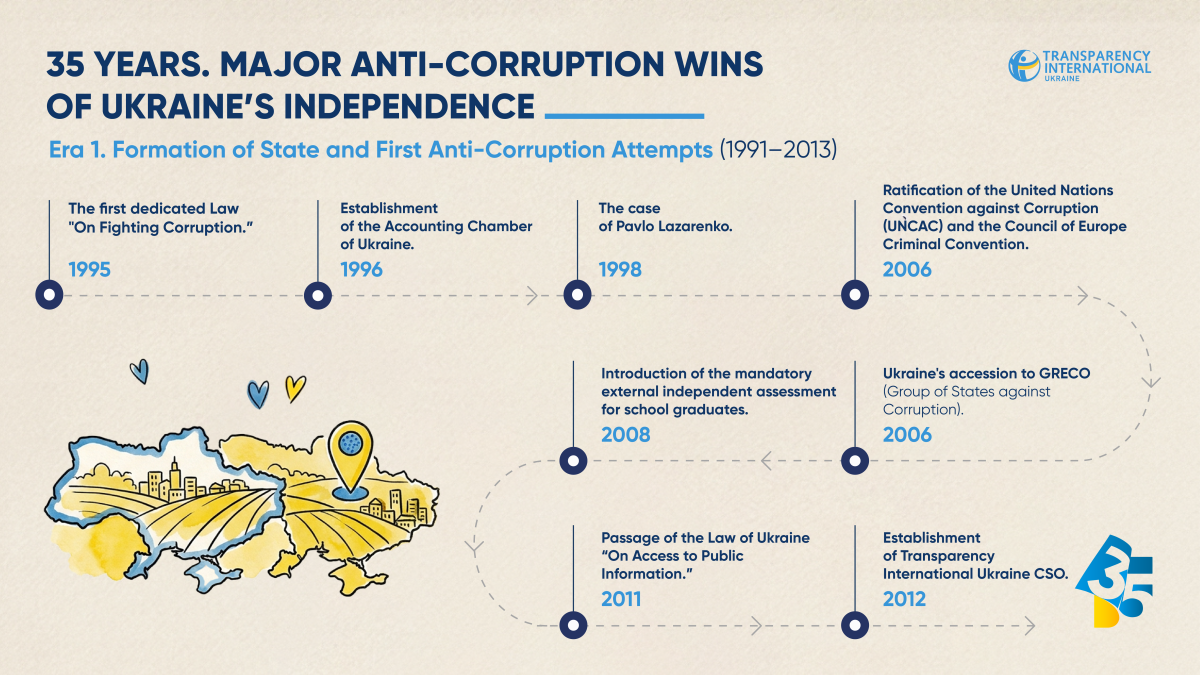
Era 1. Formation of State and First Anti-Corruption Attempts (1991–2013)
This era is marked by the first attempts to describe corruption at the level of law and the first international audit of Ukrainian reforms. It resulted in the emergence of basic tools that made the anti-corruption reform possible, from the right to public information to the foundation of anti-corruption NGOs.
1. 1995 — the first dedicated Law “On Fighting Corruption.” Ukraine was one of the first countries in the post-Soviet space that attempted to legally define the notion of corruption and the associated administrative liability.
2. 1996 — establishment of the Accounting Chamber of Ukraine. This year saw the establishment of the first constitutional agency of external financial oversight over the use of state budget funds.
3. 1998 — the case of Pavlo Lazarenko. Ukraine’s former PM became the first high-ranking official in Ukraine’s history to be accused of corruption.
4. 2006 — ratification of the United Nations Convention against Corruption (UNCAC) and the Council of Europe Criminal Convention. Ukraine officially undertook international obligations to harmonize anti-corruption legislation.
5. 2006 — Ukraine’s accession to GRECO (Group of States against Corruption). Ukraine would now undergo regular international audits of its anti-corruption reforms.
6. 2008 — introduction of the mandatory external independent assessment for school graduates. Taking a test with uniform criteria for all students became a prerequisite to be admitted to any higher educational establishment. This significantly reduced the opportunities for corruption in university admissions and became one of the most successful educational reforms.
7. 2011 — passage of the Law of Ukraine “On Access to Public Information.” Citizens and journalists received a powerful legal tool to scrutinize the actions of officials and the use of public resources.
8. 2012 — establishment of Transparency International Ukraine CSO. In 2014, the organization was officially accredited by Transparency International, becoming the only representative of the global anti-corruption movement in Ukraine.
This era is marked by the first attempts to describe corruption at the level of law and the first international audit of Ukrainian reforms.
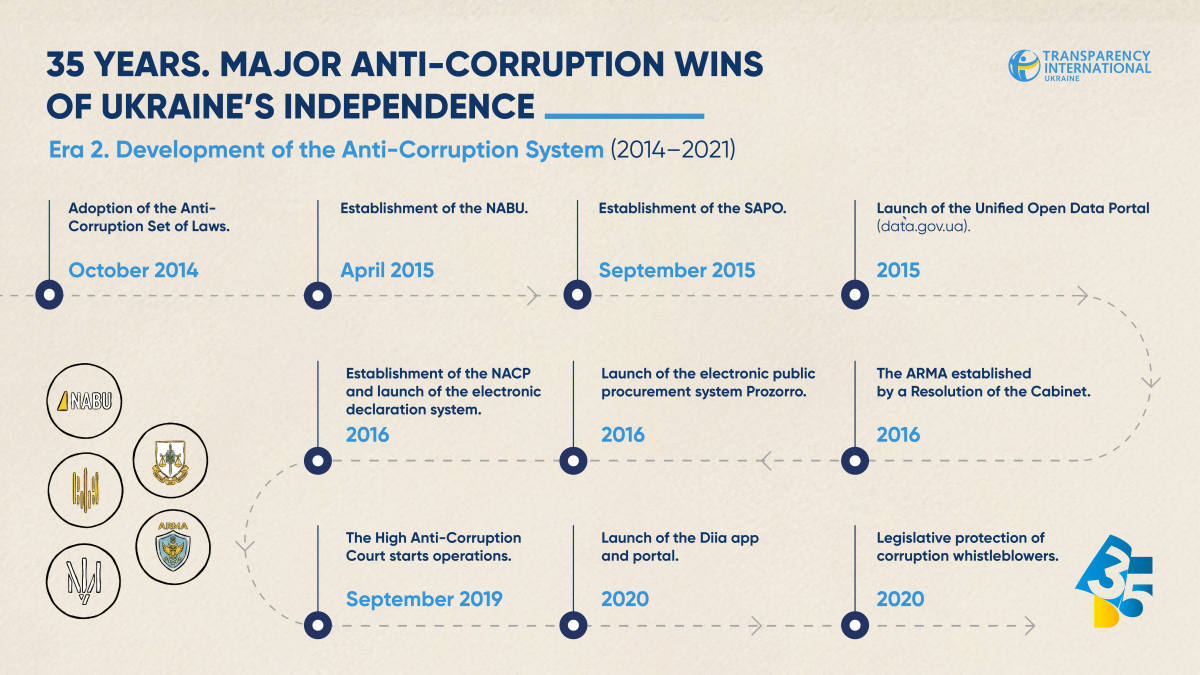
Era 2. Development of the Anti-Corruption System (2014–2021)
Following the Revolution of Dignity, Ukraine quickly established an entire system of anti-corruption institutions: the NABU, the SAPO, the ARMA, the NACP, and the HACC. The public procurement e-system Prozorro became operational alongside electronic declarations, and the Diia service was launched. This was a period when the anti-corruption reform made a breakthrough from intentions to a functional system.
1. October 2014 — adoption of the Anti-Corruption Set of Laws. The main items on the list included the establishment of the NABU, the formation of a corruption prevention system, opening up property registers, and the declaration of officials’ income and expenses.
2. April 2015 — establishment of the NABU. The President signed decrees establishing the Bureau and appointing its director. This was the first independent anti-corruption agency in Ukraine’s history dedicated to investigating grand corruption.
3. September 2015 — establishment of the SAPO. An independent unit of prosecution was established for procedural support of the NABU in courts.
4. 2015 — launch of the Unified Open Data Portal (data.gov.ua). This marked the beginning of the open data era in public administration.
5. 2016 — the ARMA established by a Resolution of the Cabinet. Finally, there was a functioning mechanism for finding, tracing, and management of property derived from criminal activities.
6. 2016 — launch of the electronic public procurement system Prozorro. The transition from paperwork under the table to the principle “everyone sees everything” saved billions for the national budget. Transparency International Ukraine was responsible for the administration of this project.
7. 2016 — establishment of the NACP and launch of the electronic declaration system. The NACP emerged as a body responsible for the verification of declarations and political financing, as well as for the development of anti-corruption strategic documents. Thus, Ukraine implemented one of the most radical and open systems in the world designed to oversee the funds of public officials.
8. September 2019 — the High Anti-Corruption Court starts operations. This was the last specialized agency to be established as part of the anti-corruption reform.
9. 2020 — launch of the Diia app and portal. This event marked the digitalization of public services, which eliminated everyday corruption and the human factor in dozens of areas, from issuing licenses to registrations of sole proprietors.
10. 2020 — legislative protection of corruption whistleblowers. This was the first step in the implementation of this institution: corruption whistleblowers obtained legal guarantees, rewards, and protection against dismissal. But these standards still need to be aligned with the European legislation.
Following the Revolution of Dignity, Ukraine quickly established an entire system of anti-corruption institutions: the NABU, the SAPO, the ARMA, the NACP, and the HACC.
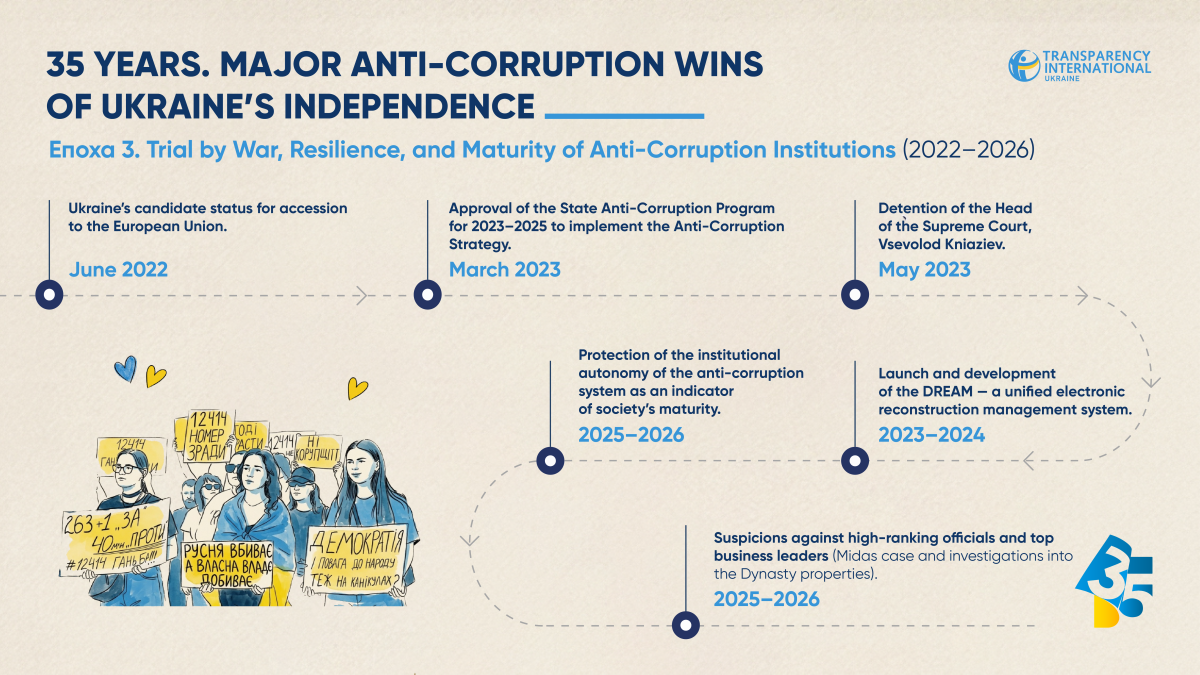
Era 3. Trial by War, Resilience, and Maturity of Anti-Corruption Institutions (2022–2026)
Even during the full-scale war, Ukraine continued its anti-corruption course, formalizing it as a prerequisite for its accession to the EU. Detentions of high-ranking officials, development of the DREAM system for transparent recovery, and, most importantly, people who take to the streets to defend institutional resilience and reforms are the best proof that the anti-corruption system has become part of Ukraine’s social contract.
1. June 2022 — Ukraine’s candidate status for accession to the European Union. Anti-corruption reforms were officially enshrined as a basic condition for joining the European Union.
2. March 2023 — approval of the State Anti-Corruption Program for 2023–2025 to implement the Anti-Corruption Strategy. A step-by-step action plan with clear indicators for dozens of government agencies. In 2024, the Program was adjusted, adding items that would take into account the wartime context.
3. May 2023 — detention of the Head of the Supreme Court, Vsevolod Kniaziev. He became the highest-ranking suspect accused of grand corruption. This is proof that there are no “untouchables” for the anti-corruption system.
4. 2023–2024 — launch and development of the DREAM ecosystem — a unified electronic reconstruction management system. Transparency International Ukraine advocated for the establishment of this platform as part of the RISE Ukraine coalition and then joined the launch of the system.
5. 2025–2026 — protection of the institutional autonomy of the anti-corruption system as an indicator of society’s maturity. In July 2025, people with cardboard posters stood up for the independence of the NABU and the SAPO, and in July 2026, they protested against increased pressure and the rollback of reforms. Ukrainian civil society showed that it can defend anti-corruption institutions from political pressure, demanding unavoidability of punishment and continuity of Ukraine’s European integration progress.
6. 2025–2026 — suspicions against high-ranking officials and top business leaders (the Midas case and investigations into the Dynasty properties). The NABU and the SAPO served suspicions to former Vice Prime Minister Oleksii Chernyshov, businessman Timur Mindich, former Minister of Energy Herman Halushchenko, former Head of the Office of the President Andrii Yermak, and others on charges of participation in criminal enterprises, money laundering, and abuse of power.
Even during the full-scale war, Ukraine continued its anti-corruption course, formalizing it as a prerequisite for its accession to the EU.
Gaining independence was Ukrainian society’s first step towards major change. Independence was won by the struggles of those who had no fear, and we are honored to continue this fight. Together with those who defend Ukraine on the frontlines, we are developing and upholding a state based on the rule of law and strong institutions.
New challenges lie ahead. But the past 35 years have proven that Ukraine knows how to develop and protect its accomplishments.
New challenges lie ahead. But the past 35 years have proven that Ukraine knows how to develop and protect its accomplishments.


