



May 18, 2026 11:18
How the “Dynasty” Mansions Were to Be Shielded from Seizure and Confiscation
In its communication on the notice of suspicion served on former Head of the Office of the President Andrii Yermak, the NABU made public a document setting out a step-by-step plan for shielding the Dynasty mansions from seizure and confiscation. We are convinced that the elements of this plan should be used to strengthen the national confiscation regime — so that, in the future, no one can use such methods to preserve criminally acquired property.
On May 11, six months after the public phase of Operation Midas began, the NABU and the SAPO served former Head of the Office of the President Andrii Yermak with a notice of suspicion for laundering property derived from crime (under Article 209(3) of the Criminal Code of Ukraine).
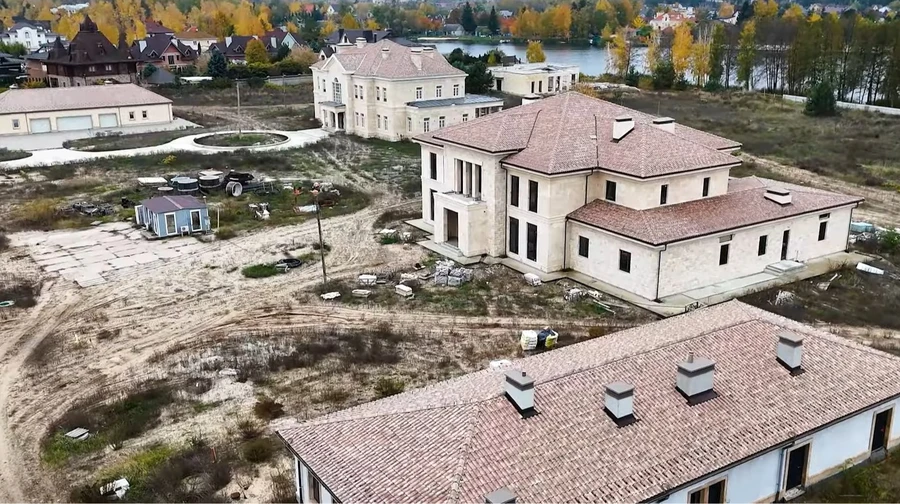
The episode concerns the construction of a gated cottage development code-named “Dynasty” in Kozyn, Kyiv Region. According to the investigation, the total amount of funds laundered exceeds UAH 460 million, obtained, among other sources, from corruption schemes at the state company Energoatom.
In this piece, we propose to examine in greater detail one specific document mentioned in the NABU’s official communication — namely, an analytical brief and a draft action plan for “asset cleansing.” Most likely, it concerns the very same mansions in Kozyn.
We are convinced that the elements of this plan should be used to strengthen the national confiscation regime — so that, in the future, no one can use such methods to preserve criminally acquired property.
Pavlo Demchuk
Background
It should be noted at the outset that the brief plan described here is not the beginning of the Dynasty story but an intermediate stage in it.
According to data made public in the court register, the acquisition of the land plot for the cottage development in 2019 became the subject of a separate NABU investigation — due to indications of probable corrupt actions by local officials. The Kozyn territorial community sold the land — with cadastral number 3223155400:04:006:0028 and an area of 4.2491 hectares — for UAH 9,008,092, based on an expert appraisal of UAH 8,758,275. Yet the investigation estimates the land’s minimum market value at the time at UAH 43,246,120 (i.e., five times higher), and its maximum at UAH 180,193,690 (twenty times higher).
On the level of hypotheses, then, the Dynasty scheme can be traced through three sequential stages:
- the corrupt acquisition of the land plot in 2018–2019 at an undervalued appraisal
- the laundering of criminally obtained funds through real estate construction in 2019–2025
- an attempt in 2025 to “cleanse” the asset of the risk of seizure and confiscation through a series of transactions with unrelated legal entities.
This resembles a complete cycle of obtaining proceeds from crime and removing them beyond the state’s reach. It is precisely this that the modernization of confiscation mechanisms — required by Directive (EU) 2024/1260 — is meant to prevent. As noted in another document important for EU integration — the Rule of Law Roadmap — Ukraine is required to integrate its provisions into national legislation by Q2 2027.
This resembles a complete cycle of obtaining proceeds from crime and removing them beyond the state's reach. It is precisely this that the modernization of confiscation mechanisms — required by Directive (EU) 2024/1260 — is meant to prevent.
Pavlo Demchuk
What happened with the assets
Imagine that you own a house worth $2 million. Formally, however, it isn’t yours — it’s registered to a chain of individuals and companies that, on the surface, appear independent of one another. Something similar was happening with Dynasty, as we can see from materials in the court register.
- 2012. The Sunny recreation facility in Kozyn is purchased through Bloom Development LLC for UAH 2.47 million. The land under the facility is leased from the village council.
- 2018. The Sunny Shore Housing Cooperative is established, ostensibly for the construction of housing. There are three founders: two nominees, with the third becoming chair. Oleksii Chernyshov — recently served with another notice of suspicion by the NABU, which regards him as the organizer of this scheme — does not appear among them. The cooperative obtains the land on sublease.
- 2019. Oleksii Chernyshov briefly appears in documents as a co-founder of Bloom Development LLC, but quickly “exits” — transferring his share to his wife. That same year, the land is purchased outright from the village council by Bloom Development for UAH 9 million.
- 2019. Chernyshov personally extends a loan of UAH 3.6 million to the cooperative (as recorded in an HACC ruling). Formally, then, he is not the owner, but in reality he is financing the project.
- 2020-2025. Active construction of Dynasty. Chernyshov’s wife is effectively running the process. Through nominees and six powers of attorney issued, Chernyshov retains control.
- August 29, 2023. His wife also “exits” the list of Bloom Development’s participants. The sole owner remaining is a nominee.
Accordingly, by the time the NABU starts taking an interest in Oleksii Chernyshov personally, the houses and the land belonged to a company whose registered owner was an individual with no connection to him. Between the actual beneficiary and the asset were a number of legal “layers.”
By the time the NABU starts taking an interest in Oleksii Chernyshov personally, the houses and the land belonged to a company whose registered owner was an individual with no connection to him. Between the actual beneficiary and the asset were a number of legal “layers.”
Pavlo Demchuk
What the “asset cleansing” plan proposes
Owning the unfinished mansions through a chain of legal entities turned out to be insufficient. After the publicity generated by the Bihus.info investigation and the start of the NABU probe, the real owners faced the task of protecting the asset from seizure and subsequent confiscation. The action plan — proposed by specialists who remain unknown — even bears a title that leaves no doubt as to its purpose.
And here is how the plan was to be carried out.
Step 1: “Sell the land to insiders through a loan”
The authors of the brief proposed creating a new company. It is provisionally designated as the “Investor” and is to appear entirely unconnected to Chernyshov (in contrast to the already exposed Bloom Development LLC). This “Investor” buys the land from Bloom Development LLC, but not with its own money — with a loan extended to it by another “friendly” company or bank. And the land is immediately encumbered by a mortgage in favor of the lender.
This structure serves several purposes:
- the purchase for money looks like an ordinary commercial transaction rather than an attempt to conceal property
- the mortgage creates additional obstacles to recovering the asset: if the prosecutor seeks to challenge the sale and reclaim the land, the state will face a “competitor” in the person of the lender.
Step 2: Understate the value of the houses
The plan’s authors do not even hide the fact that there are problems with the real value of the unfinished estate. The document states outright: “bring the real value of the unfinished construction facility closer to the documented financing.” For the actual value of a single house, according to the NABU and the SAPO, is nearly $2 million, while what officially passed through the Sunny Shore Housing Cooperative was far less — approximately 10% of the real costs.
If an independent appraiser writes the real value in the report, the obvious question arises: where did the money come from? That is why a “right” appraiser is needed — one who will record the official value of the house at roughly the level of the documented financing.
Then, if in a year or two someone tries to challenge the sale, they will see contracts in which the price matches the appraisal. Legally, everything is clean.
Step 3: Sell the houses as a pile of materials
If a house is registered in the real estate register, it can be placed under seizure. But if it physically exists yet has not been registered, it is legally almost “invisible” for purposes of reflection in the encumbrance register. The plan envisages this: at the time of the transactions, the Kozyn houses are not formally registered as completed real estate — they exist as construction in progress. This means they can be sold to the “Investor” simply as a set of construction materials — at the reduced value from Step 2 — and the transaction will leave no trace in the state registers.
So, by the time the NABU finally obtains a seizure ruling against the previous owner, there will be nothing left to seize. The houses are not in the register, and the materials have already been recorded in the “Investor’s” books. Additional steps would then be required to locate and identify the new owner and seize their property — which would take additional time.
Step 4: Register the property to the “Investor” as its own
The “Investor” now registers the same houses in its own name in the State Register of Real Property Rights — as a new real estate object. As a legitimate owner who purchased the land under a contract, it has now “built” a house on the land using the purchased materials. Legally, then, this is a different asset from the one that could have been seized earlier, because it was registered after these transactions were carried out. The owner is a company with no connection to Chernyshov. Its origin is documented through a chain of contracts.
Step 5: Sell again — this time openly
The final step: the “Investor” sells the entire complex (the land and the registered real estate) through an electronic trading platform (such as SETAM) to yet another company, provisionally named the “Developer.” This company, too, has no connection to Chernyshov.
Why an auction? Because it creates a presumption of market price and of good-faith acquisition. Bought at an open auction through a transparent procedure — therefore, a bona fide acquirer. And under the requirements of Article 96-2 of the Criminal Code of Ukraine, special confiscation does not apply to a bona fide acquirer. Period.
From there, the “Developer” calmly finishes the mansions, commissions them, and sells them to end buyers. The end buyers will hold completely clean title. Even if, several years later, a verdict is reached against the suspects in the case, there will be nothing left to confiscate.
The plan envisages this: at the time of the transactions, the Kozyn houses are not formally registered as completed real estate — they exist as construction in progress. This means they can be sold to the “Investor” simply as a set of construction materials.
Pavlo Demchuk
In lieu of conclusions: which vulnerabilities of the confiscation regime this plan exploits
As we can see, the “asset cleansing” plan is built on a detailed knowledge of current legislation, and each of its steps targets a specific loophole. A mortgage in favor of a “friendly” lender, an undervalued appraisal, the sale of the mansions as construction materials, the resale through an electronic auction — together, all of this aims to create a legal status in which confiscation becomes impossible even when a verdict exists. Article 96-2 of the Criminal Code of Ukraine permits the confiscation of property from a third party only when it is proven that the party “knew or could have known” about its criminal origin. Yet the plan is specifically constructed so that this awareness cannot be proven.
It is precisely against such a model that Directive (EU) 2024/1260, mentioned at the outset, is directed. It permits courts to confiscate property based on its disproportion to lawful income and the absence of a plausible lawful source. Consequently, there is no longer a need to prove a third party’s subjective awareness in every case. Protection for the bona fide acquirer is preserved through procedural safeguards — the right to counsel, access to case materials, the right to be heard in court, and the right to appeal the confiscation decision, as provided in Article 24 of the Directive.
In the Rule of Law Roadmap, Ukraine has committed to implementing the Directive by Q2 2027. The case of the Dynasty mansions is the best illustration of why this commitment must be fulfilled in substance, not just in form.
As for the fate of these mansions, if it can be proven that they were built with funds of criminal origin, that will be decided by the courts. But without legislative improvements, there remain many ways to shield assets from the “line of fire.”
A mortgage in favor of a “friendly” lender, an undervalued appraisal, the sale of the mansions as construction materials, the resale through an electronic auction — together, all of this aims to create a legal status in which confiscation becomes impossible even when a verdict exists.
Pavlo Demchuk
Source: zn.ua


