



September 14, 2026 11:07
Kravchenko’s “Notice of Suspicion” Against the NABU Director Continues the Pressure on NABU and SAPO
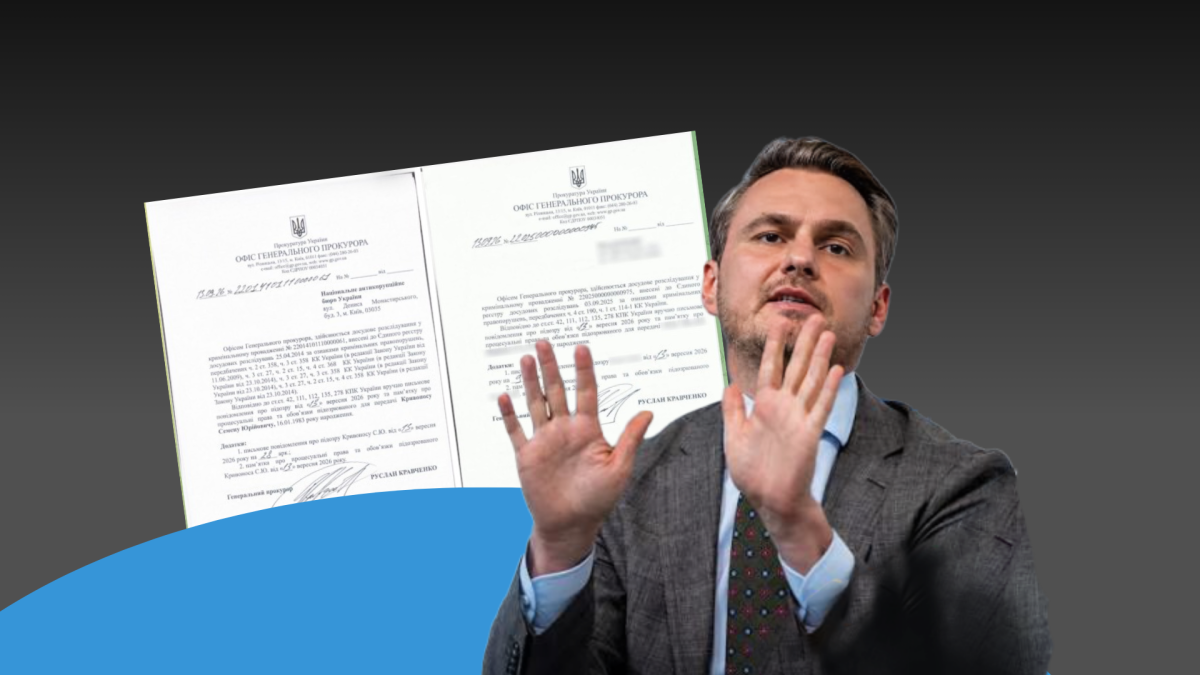
On September 14, Ruslan Kravchenko — still Prosecutor General, for now — publicly announced that he had signed two notices of suspicion at once: one against NABU Director Semion Kryvonos, and one against a person “close to” SAPO Head Oleksandr Klymenko. We at Transparency International Ukraine are convinced that this is not the Prosecutor General discharging his official duties, but a purely political move.
Kravchenko released a video address in which he claims to have sufficient evidence, yet offers no specifics about the crimes he is alleging.
The NABU, for its part, reported that as of now no notice of suspicion has been formally served on Kryvonos, and that the Bureau has not taken over any of the criminal proceedings referred to in the Prosecutor General’s statements. The cover letters Kravchenko himself made public bear out NABU’s account.
The purported suspicion against Kryvonos has nothing to do with his work at the NABU. The criminal proceedings were opened back on April 25, 2014, and Kryvonos’s alleged conduct — forgery of documents and bribery — was classified under the Criminal Code as it stood in 2009 and 2014. In other words, these are acts said to have occurred long before Kryvonos headed the NABU, in proceedings that lay dormant for twelve years. It looks like the revival of an old story already familiar from the tabloids.
The suspicion against Klymenko’s “close associate” is nothing like what Kravchenko described. The official document states that the criminal proceedings were opened on September 3, 2025, for fraud and obstruction of the lawful activities of the Armed Forces of Ukraine and other military formations. The formal text of the published letters contains no article that would indicate any influence over HACC judges or any offer of unlawful benefit to them. The public rhetoric and the procedural document plainly diverge.
The manner of service raises questions of its own. The notice to Kryvonos was mailed to NABU’s address rather than handed over in person. That mechanism would make sense if Kryvonos were outside Kyiv, but he is not — and Kravchenko could have assigned a prosecutor to serve the notices personally.
Taken together, these elements indicate that the notices of suspicion are not the product of a long and thorough investigation intended to bring a case to trial, but a symbolic, demonstrative gesture calculated above all for media effect.
This is consistent with the broader pattern of sustained pressure on independent anti-corruption institutions. Kravchenko himself played an active and direct part in last year’s attacks on the NABU and the SAPO.
Following Kravchenko’s statement, President Zelenskyi called on the Verkhovna Rada to dismiss him as Prosecutor General. Kravchenko wrote that he is currently abroad on a business trip.
All of this demonstrates once again that the Prosecutor General must be as independent of political influence as possible — and that this can only be achieved through a transparent, competitive selection process.
Taken together, these elements indicate that the notices of suspicion are not the product of a long and thorough investigation intended to bring a case to trial, but a symbolic, demonstrative gesture calculated above all for media effect.


