


September 15, 2026 11:57
NABU and SAPO Briefing: Details on Prosecutor General Kravchenko’s Accusations
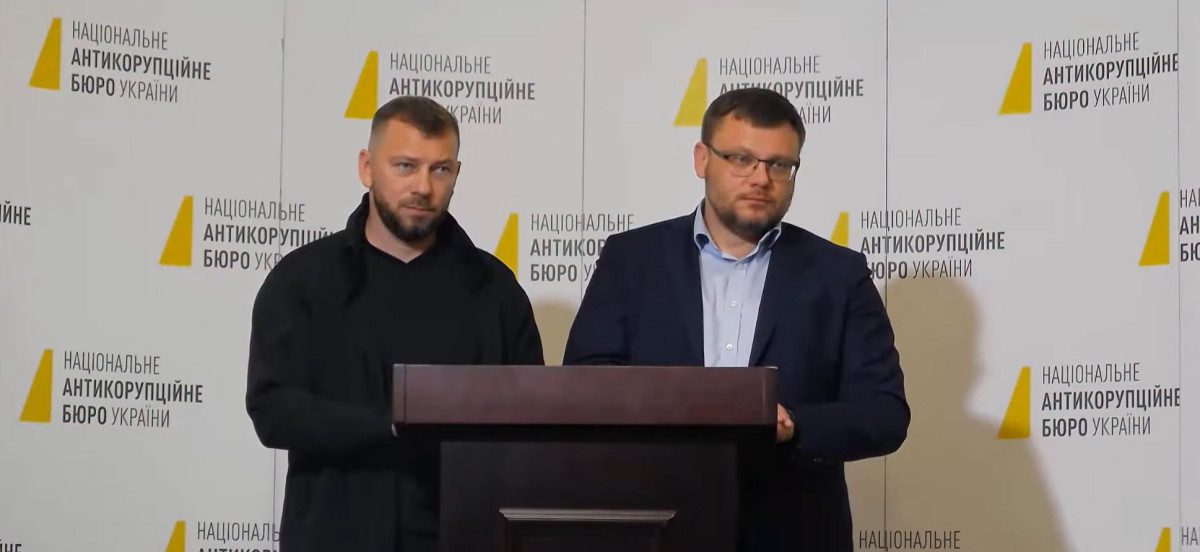
On September 14, NABU Director Semion Kryvonos and SAPO Head Oleksandr Klymenko held a briefing for the media and the public on the suspicions announced by the Prosecutor General.
Opening the briefing, NABU Semion Kryvonos said he still had not been served with any notice of suspicion, despite the Prosecutor General’s public statement that he had signed one. According to Kryvonos, a defense strategy will be built only once the materials are received.
Asked whether NABU had known about the Prosecutor General’s trip abroad, Kryvonos replied that the bureau does not keep track of a business trip Kravchenko approved for himself.
When a journalist asked point-blank whether the President or Servant of the People faction leader Arakhamia was behind the attack, or whether it came down to Kravchenko’s own inability to cope with pressure, Kryvonos said: “The President already responded to these actions this morning. We don’t want to politicize the NABU and the SAPO.” He added that the bureau plays no political games and sees the attack itself as an attempt to politicize the work of the anti-corruption agencies.
SAPO Head Oleksandr Klymenko addressed the claim that a suspicion had been served on “a person close to him”: “If such a close person turns up, then let them say who it is.” He said none of his family members had received a notice of suspicion.
Asked whether there was enough evidence on Kravchenko himself within Carthage Operation, Klymenko kept it short: “We have never announced suspicions and we will not announce them.”
Overall, both heads described the situation as a new genre, “Telegram suspicions”: public claims of suspicion made through video addresses and social media, without documents ever actually being served on the people concerned.
SAPO Head Oleksandr Klymenko spoke to the substance of the complaints over how old the Kryvonos case is: “If you dig up a case that’s 10–15 years old, it doesn’t look very good. Especially after an operation like Carthage.”
When journalists asked whether Kryvonos was aware of any search activities targeting him, the NABU Director shot back: “I don’t comment on nonsense.” He went on to clarify an important detail about the searches at the PGO: according to him, the seizure report itself states that a reference note was seized, not a criminal case file, as the Prosecutor General had claimed.
Klymenko added a detail on the scale of what was seized during Carthage Operation: according to him, the searches at the PGO turned up a list of NABU detectives who face cases and are actively working on current investigations.
Asked about the child Kravchenko had mentioned earlier, Kryvonos was brief: “I’ve already said I’m not going to comment on fabricated nonsense.”
On communication with the Prosecutor General’s Office both before and after the Carthage recordings were made public, Klymenko described the cooperation as “simply working-level, technical,” particularly where suspicions against MPs were concerned. He added that neither the PGO nor the SAPO had sought closer cooperation, apart from some activity in July 2025. Kryvonos confirmed: “Personally, I’ve had no tension whatsoever with any law enforcement agency.” Communication, he said, was conducted in the ordinary course of work.
Asked directly whether there had been pressure from the PGO or from Kravchenko personally, and whether anyone had approached them for a private conversation, Kryvonos said: “Investigative actions are ongoing, and if there is any, it will be assessed through procedural means.”
The NABU Director also rejected Kravchenko’s claim that he had been given guarantees that kept him silent for a week: “It’s nonsense that we guaranteed him anything or didn’t.”
NABU Director Kryvonos shared details of his meeting with the President: “At the meeting with the President, we mostly discussed the call center situation. This may well be linked to Russian aggression… Purely Russian sabotage.” He added that tens of thousands of young people had worked at these call centers, robbing European partners, not Russians.
When journalists asked whether SSU officers were involved in the attack on the anti-corruption agencies and whether this was only the first stage of such pressure, Kryvonos chose his words carefully: “If we announce attacks, we won’t be able to do anything.” He dismissed reports of supposed new operations, such as “Emperor,” as untrue.
Pressed on whether Kravchenko is a subject of the Carthage case, Kryvonos declined to answer on the substance, instead describing the scale of efforts to obstruct the investigation: according to him, the court decisions register is under constant monitoring, and in one set of proceedings those involved knew about an upcoming search in advance. Kryvonos also said the movements of NABU detectives’ vehicles are being tracked through the Safe City system, and queries to the property register and the court decisions register were regularly monitored. And two weeks ago, the SSU tried to gain access to D-3, the HACC’s document management system.
SAPO Head Klymenko added that, according to information available to the SAPO, an information attack was already being prepared and carried out in July 2025, involving not only the Prosecutor General but also a close friend and lawyer of his, whom Klymenko called the “architect” of these attacks.
This material is funded by Norway. Its content is the sole responsibility of Transparency International Ukraine and does not necessarily reflect the views of the Norwegian Government.
Asked whether there was enough evidence on Kravchenko himself within Carthage Operation, Klymenko kept it short: “We have never announced suspicions and we will not announce them.”


