



September 9, 2026 13:17
“Such Discussions Are a Sign of a Mature Democracy”: 7 Years of the HACC
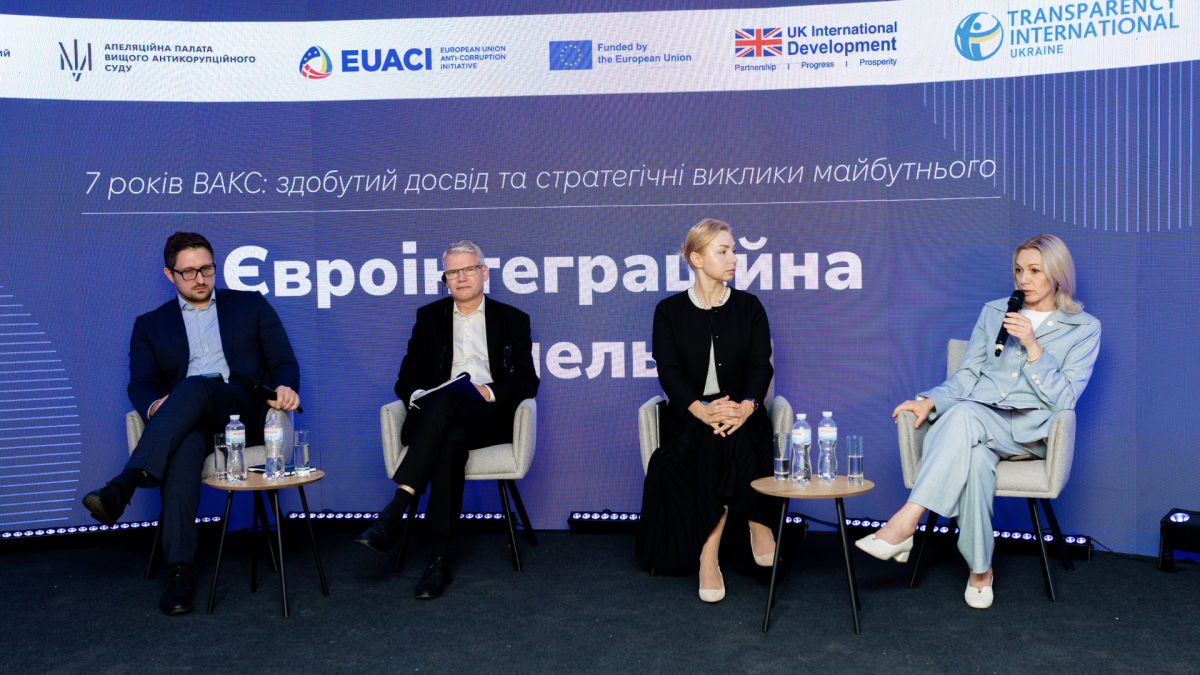
A conference titled “7 Years of the HACC: Lessons Learned and the Strategic Challenges Ahead” took place in Kyiv. For the first time, the event was held in the High Anti-Corruption Court’s new premises. Representatives of the HACC, NABU, SAPO, the Supreme Court, and the Verkhovna Rada, together with experts from civil society, international partners, and the legal profession, discussed the court’s results and the challenges facing the anti-corruption institutions across two panel discussions.
To open, the Chair of the HACC, Ihor Strohyi, summed up the court’s work in figures: over 7 years, the court has handed down 431 verdicts in criminal cases, 54 decisions in civil cases, and 79 in administrative ones. Investigating judges have considered more than 70,000 motions, complaints, and applications.
But behind these figures lies a great deal of work — both by the court itself and by the bodies it cooperates with. That was what the event’s guests turned to next.
Over 7 years, the court has handed down 431 verdicts in criminal cases, 54 decisions in civil cases, and 79 in administrative ones.
Ihor Strohyi
Anti-corruption reform and the path to the EU
The first discussion was devoted to the link between anti-corruption reform and Ukraine’s movement toward the EU. It was moderated by Andrii Borovyk, Executive Director of Transparency International Ukraine.
The panelists discussed whether Ukraine’s anti-corruption system has “worked,” and whether the involvement of international experts in the competitions for anti-corruption bodies has proven its worth — including, in particular, the recent selection of 16 new judges for the HACC and its Appeals Chamber. They also touched separately on the accusations that the anti-corruption institutions are “too independent.”
Andrii Borovyk noted that the two main public demands right now are the fight against corruption and EU membership. He invited each speaker to name a single decision Ukraine should take over the next 12 months to come a few steps closer to the European Union.
Allan Pagh Kristensen, Head of the EU Anti-Corruption Initiative (EUACI), declined to pick a single step and stressed that the EU accession process calls for a comprehensive approach to fighting corruption as well. Among the priorities, he singled out the independence, capacity, and effectiveness of institutions.
Anastasiia Radina, Head of the Verkhovna Rada Committee on Anti-Corruption Policy, likewise did not choose a single decision but named three priorities:
1) access to independent forensic examination for the NABU and the SAPO;
2) reform of the SBI (linked to protecting the NABU from political influence);
3) a draft law to curb procedural abuses by the defense.
Vira Mykhailenko, a HACC judge, agreed with the other participants on the need for comprehensive approaches. For her part, she named as priorities the integrity and transparency of public institutions, as well as safeguarding their independence.
Andrii Borovyk also asked whether the involvement of international experts in selecting HACC judges had truly proven its worth. Vira Mykhailenko answered in the affirmative: it adds a lens that heightens the visibility of possible problems and makes it possible to reach the right decision.
Anastasiia Radina, for her part, emphasized that involving international experts in the competitions for the NABU, the SAPO, the HACC, and others is no panacea, but that with them we can hope for a better outcome. She also explained that the key issue right now remains changing the procedure for selecting the SBI director (one of the requirements under the Ukraine Facility plan), where international experts so far play a rather decorative role in decision-making.
“I don’t think a situation like this is possible in every democratic country — where, at an event marking an institution’s anniversary, there is a discussion carrying a degree of criticism, with restrained optimism or pessimism. We may like some things and dislike others. But the very ability to say so openly is a sign of democracy and of a nation’s maturity,” Andrii Borovyk said, summing up the discussion.
I don't think a situation like this is possible in every democratic country — where, at an event marking an institution's anniversary, there is a discussion carrying a degree of criticism, with restrained optimism or pessimism. We may like some things and dislike others. But the very ability to say so openly is a sign of democracy and of a nation's maturity.
Andrii Borovyk
The HACC in practice: figures and challenges
During the second panel, the moderator, Stanislav Borys — an attorney and head of the Committee on Criminal and Criminal Procedure Law at the Ukrainian Bar Association — noted that the NABU, the SAPO, the HACC, and the Supreme Court are helping to build a strong, independent state governed by the rule of law.
In particular, during this discussion Pavlo Demchuk, Senior Legal Advisor at TI Ukraine, presented the findings of a report studying the HACC’s practice in 2023–2024. Among other things, he highlighted the following key conclusions:
- in 2019–2024, the HACC heard on average almost 24% of its cases per year;
- the concept of agreements works and is improving: a case that ends in a plea agreement is heard 24 times faster than one that goes through the full cycle;
- 7.4% of all proceedings are closed due to the expiry of limitation periods and pretrial investigation time limits. That is, the public receives no answer as to whether a person is guilty or not, even where significant damages were involved.
Pavlo Demchuk also mentioned a finding from this year’s HACC monitoring report: for the first time, the number of cases heard exceeded the number that came in (in the first half of 2026). In other words, the backlog of pending cases has begun to shrink.
Our expert also drew attention to the ineffectiveness of disciplinary liability for the abuse of procedural rights.
“Even a disciplinary referral to the bar’s bodies does not always lead to the expected results. Out of 24 proceedings initiated, an actual disciplinary sanction was imposed in only one case,” Pavlo Demchuk noted.
We at TI Ukraine continue to follow the HACC’s work closely. In particular, we analyze the functional and organizational aspects of the court’s work and cover the handling of cases on the HACC Decided platform.
Watch the full broadcast of the event here:
Even a disciplinary referral to the bar's bodies does not always lead to the expected results. Out of 24 proceedings initiated, an actual disciplinary sanction was imposed in only one case.
Pavlo Demchuk


