




June 10, 2026 11:01
Attempted Murder, Escape from Custody, and Embezzlement: the Twists and Turns of the Rodovid Bank case
The collapse of Rodovid Bank, which forced the government to bail it out with public money, was once considered one of the dirtiest banking schemes of the independence era. Yet the bank kept being looted even after it became state-owned.
This eventually grew into a sprawling network of criminal cases investigated by various agencies. There is a plea agreement, there are verdicts — one still on appeal, another carrying no real punishment — and the episode concerning the main defendant is still being heard. But the central question — whether the hundreds of millions of hryvnias siphoned out of the bank will be returned to the state — remains open.
In April 2026, the High Anti-Corruption Court (HACC) handed down a verdict in a case that dates back to the 2008–2009 crisis: the Rodovid Bank case. Dmytro Yehorenko, the former chairman of the bank’s board, was found guilty of aiding and abetting the misappropriation of more than UAH 18 million in state funds and of forgery in office committed by conspiracy. He was sentenced to 10 years’ imprisonment with confiscation of property, but the same verdict released him from serving the sentence — because the statute of limitations had run out. However, the defense filed an appeal against this verdict.

Dmytro Yehorenko, far left. Photo credit: UNIAN
This was the predictable outcome of an investigation that began fourteen years before the case was sent to trial and that was handled by at least three different bodies. Over that time the investigation was suspended and resumed at least eight times, and it ultimately reached court only after the statute of limitations had expired for one of the charged crimes — forgery in office. Yehorenko himself declined to have the proceedings closed on limitation grounds, so the court considered all the charges together.
The investigation was launched in May 2010 by a unit of the Security Service of Ukraine’s Kyiv directorate, and in October that year the case was handed to the SSU’s Main Investigation Directorate. From 2015 to 2018, the investigation was conducted by a unit of the Main Military Prosecutor’s Office within the Prosecutor General’s Office of Ukraine. Finally, in November 2019, the case materials were handed over to the NABU.
But the UAH 18 million attributed to Yehorenko is small change against the far larger episodes of looting at the bank, in particular the UAH 300 million in “Rodovid money,” proceedings over which are still ongoing.
The UAH 18 million attributed to Yehorenko is small change against the far larger episodes of looting at the bank, in particular the UAH 300 million in “Rodovid money,” proceedings over which are still ongoing.
Oksana Kopiichuk
Background: why Rodovid Bank fell into crisis
Rodovid Bank grew rapidly in 2005–2006 — and fell just as rapidly during the 2008 crisis. As of early 2009, it was the 19th largest Ukrainian bank by assets. But behind that outward scale lay a far less rosy picture: roughly 80% of corporate loans were unrecoverable, and the share of non-performing loans to individuals reached 47%. In other words, the bank had effectively ceased to exist as a functioning financial institution — its fall was only a matter of time.
Investigators never fully established who siphoned off assets in the pre-crisis period, or when. The bank’s owners hid behind a chain of shell companies.
One well-known episode illustrates the logic of what was happening, even though it does not directly relate to this criminal case. In 2008, Firtash’s UkrGazEnergo placed roughly half a billion hryvnias on deposit at 9% per annum. A year later, three days before temporary administration was introduced, the rate was raised to 48% — three times the market rate. Later, once the bank was already state-owned, the Firtash structure received UAH 284 million in accrued interest. A court subsequently declared the agreement void, but no one was ever held criminally liable for this episode.
Behind that outward scale lay a far less rosy picture: roughly 80% of corporate loans were unrecoverable, and the share of non-performing loans to individuals reached 47%. In other words, the bank had effectively ceased to exist as a functioning financial institution — its fall was only a matter of time.
Oksana Kopiichuk
Nationalization and another round of plunder
Rodovid’s bankruptcy was among the most high-profile of all such cases at the time. The government of Yulia Tymoshenko decided to rescue it, recapitalizing the bank with an injection of UAH 8.4 billion — almost $1 billion at the time. As a result of this “rescue” operation, 99.97% of the bank’s shares passed into state ownership. But the plunder continued even after the bank became state-owned, as we describe in more detail below.
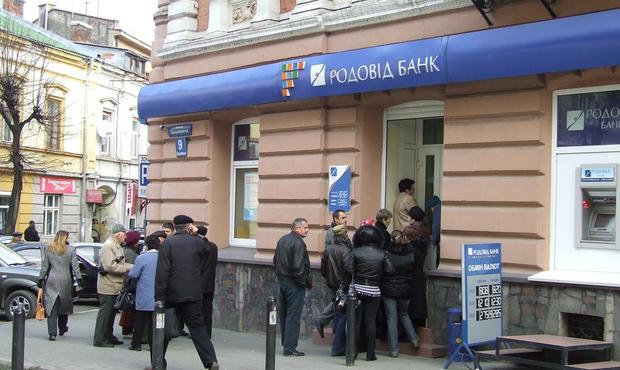
Lines outside Rodovid Bank during its collapse
Formally, the bank was taken over by temporary administrator Serhii Shcherbyna. But in practice, according to investigators, everything was run by Oleksandr Shepelev — a former MP of the fifth and sixth convocations and, in the past, a member of the Yulia Tymoshenko Bloc faction, which he left in 2007 to join the Party of Regions faction. He is the one charged with organizing the embezzlement scheme. Yehorenko was an accessory in it — the man with signing authority who knew the bank’s internal paperwork.

Oleksandr Shepelev
At the time of these events, Shepelev was an MP and held positions on the Verkhovna Rada’s Committee on Finance and Banking, as well as on the privatization commission. According to investigators, he declared himself the bank’s unofficial overseer on behalf of the Cabinet of Ministers, took a separate office at the premises on Sahaidachnoho Street, and began running the institution with no signing authority but through verbal instructions. He installed his own people in key positions.
The fictitious documents were signed by Dmytro Yehorenko, who before temporary administration was introduced had served as acting chairman of the board and, from 2009, as full chairman without the “acting” prefix. He did not organize the scheme or draw up the documents — the papers were simply brought to him ready-made. But he signed them, aware that there were no grounds for transferring the funds. The court qualified his role as aiding and abetting and noted separately that Yehorenko gained no personal financial benefit.
According to the verdict, the scheme was simple. Shepelev’s wife, Halyna, acquired ownership of an administrative building in central Kyiv through a relative linked to the same circle, who had purchased it from EBRF CJSC, a company controlled by that same group. Next came a fictitious lease: the bank supposedly rented this building. Contracts, acceptance certificates, and supplementary agreements were all backdated, marked February 2009 — that is, before temporary administration was introduced — and some documents were dated as far back as 2006. The aim was to disguise the crime as a business relationship that had supposedly existed long before the bank became state-owned.
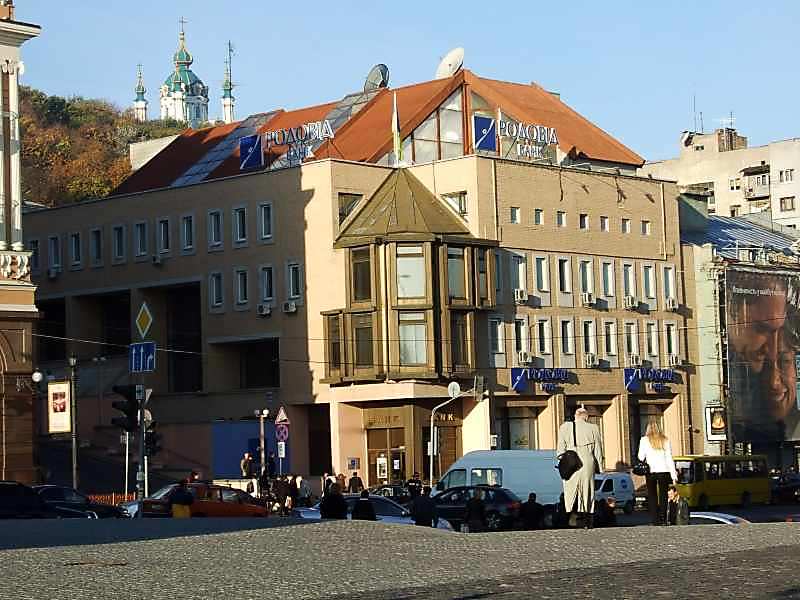
The building on Sahaidachnoho Street near the funicular in Kyiv that once housed Rodovid Bank’s head office
On the basis of these documents, between September 2009 and March 2010 Shcherbyna made nine payments totaling almost UAH 18.5 million to Halyna Shepeleva’s account. More than UAH 17 million of this was withdrawn in cash through the bank’s teller and used by the couple as they saw fit.
The court established that the bank did not actually use the building. No relocation, no furniture, no utility payments — nothing to confirm a genuine tenancy. In April 2010, an audit commission inspected the premises and found only renovation work underway.
In 2014, Ekonomichna Pravda described Rodovid’s collapse as “the dirtiest banking scam of the independence era” and asked: where did the money go, and would anyone be held to account? There are now some answers.
The losses in the Yehorenko case, confirmed by forensic economic examination, amount to almost UAH 18.5 million. No civil claim for compensation was filed, since a separate ruling in a civil case had already ordered UAH 18 million recovered from Halyna Shepeleva in the bank’s favor.
The court established that the bank did not actually use the building. No relocation, no furniture, no utility payments — nothing to confirm a genuine tenancy.
Oksana Kopiichuk
What the court decided in the Yehorenko case
The HACC received the indictment on January 31, 2024, and within a month and a half moved to consideration on the merits, ruling to hold special judicial proceedings in absentia against Yehorenko, who had been wanted since 2018 and, as of February 7, 2019, under arrest in absentia imposed by the Pechersk District Court of Kyiv.
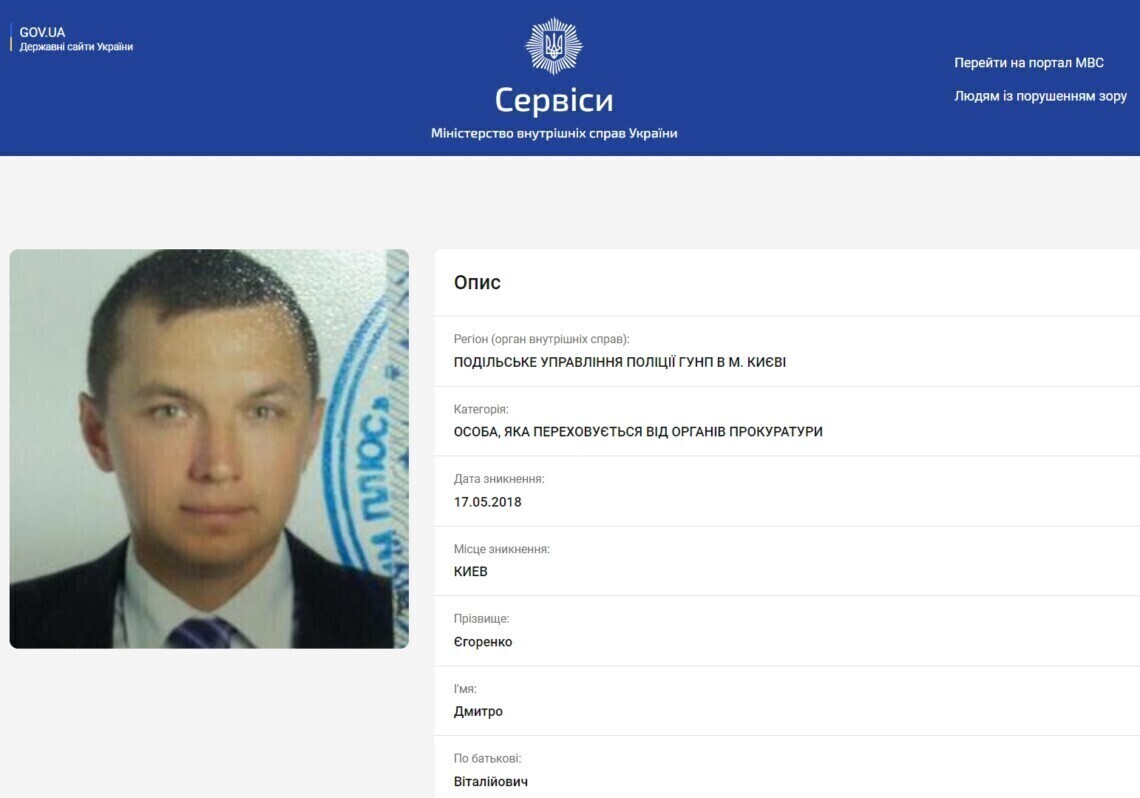
The wanted notice for Dmytro Yehorenko on the Interior Ministry website
Once the case reached trial, however, Yehorenko did express a wish to take part in the hearings remotely.
Over two years, the court examined thousands of pages of documents, questioned witnesses, and ruled on dozens of defense motions. He did not plead guilty. His reasoning ran that, as the owner of 34% of the bank’s authorized capital who had served first as acting chairman of the board and then as chairman, he knew the institution well from the inside. Yehorenko insisted that the building was genuinely leased and that some of the bank’s units had moved in there — security, programmers, and the regional directorate. He denied signing any fictitious documents, claimed the bank had no “overseer” at all, and said Shepelev had no workplace there and only occasionally dropped by to see Shcherbyna. In the end, the court rejected all these arguments.
On April 9, 2026, a panel of HACC judges found Yehorenko guilty under two articles: aiding and abetting the misappropriation of property through abuse of official position (Article 27(5) and Article 191(5) of the Criminal Code of Ukraine) and forgery in office by prior conspiracy (Article 28(2) and Article 366(1) of the Criminal Code of Ukraine). The court sentenced him to 10 years’ imprisonment with confiscation of property and immediately released him from serving it. The reason: the statute of limitations on the more serious offense expired on March 4, 2025, and on the forgery charge back in 2013.
Notably, Yehorenko himself had objected to closing the proceedings on limitation grounds and had insisted on a trial on the merits.
Yehorenko’s defense filed an appeal against the trial court’s verdict. On the basis of these appeals, on May 22, 2026, the HACC Appeals Chamber opened appellate proceedings.
Over two years, the court examined thousands of pages of documents, questioned witnesses, and ruled on dozens of defense motions. He did not plead guilty.
Oksana Kopiichuk
Where the other defendants are now
The Rodovid case is not a single verdict over UAH 18 million siphoned off through a fake lease, but a sprawling network of proceedings moving at different speeds. The total losses inflicted on the bank after nationalization run into the hundreds of millions of hryvnias, and the central episode still awaits resolution.
The bank’s temporary administrator, Serhii Shcherbyna, entered a plea agreement back in 2017 — as the perpetrator of the same crime in which Yehorenko was found to be an accessory. By available accounts, as of 2025 he is in prison.

Halyna Shepeleva
Halyna Shepeleva was convicted by a verdict of the Shevchenkivskyi District Court of Kyiv on December 18, 2024, and sentenced to 7 years’ imprisonment, a 3-year ban on holding certain positions, and confiscation of property. She did not plead guilty, claiming she had signed documents without going into the details because she was busy with the family rather than the bank’s affairs. The verdict has not yet taken legal effect — the defense has filed an appeal.
The main defendant in the case remains Oleksandr Shepelev, a former member of both the Yulia Tymoshenko Bloc and the Party of Regions. Investigators regard him as the architect of the entire scheme, which contains far more episodes than the ones Yehorenko was tried for. The NABU and the SAPO accuse Shepelev of organizing a scheme to misappropriate over UAH 300 million of Rodovid’s funds. According to investigators, this money went to pay for fictitious services from a firm close to Shepelev, and another UAH 40 million, as Shcherbyna stated, went to renovate a building leased from Shepelev himself. Shcherbyna, the bank’s temporary administrator, supposedly had to certify the allocation of this money with his signature under pressure, but on the record he later called those decisions criminal.
The indictment over the UAH 300 million that Shepelev is charged with embezzling reached the HACC in January 2022. Consideration on the merits began that October and continues to this day.
But Shepelev’s record extends far beyond Rodovid. In 2013 he was detained in Budapest: Ukraine suspected him of organizing the murders of an Interior Ministry colonel and a banker, the attempted murder of another banker, and the embezzlement of state funds earmarked for the rescue of the recently nationalized bank. In March 2014 he was extradited to Ukraine and taken into custody. Soon afterward, Shepelev faked an illness and was transferred to an emergency hospital, from which he escaped that July by bribing a guard. He went into hiding in Russia, where he was granted refuge in exchange for testimony against a number of Ukrainian politicians and cooperation with the FSB — which became the basis for opening a high treason case against him. However, after a falling-out with Russian law enforcement over an attempted bribe, he returned to Ukraine, and in February 2018 he was detained near Kyiv carrying the ID of a lieutenant colonel of the “MGB” of the so-called “DPR.”
In 2020, the Desnianskyi District Court of Kyiv sentenced Shepelev to 7 years for escaping custody and bribing a guard. The court established that, while in custody at a Kyiv hospital, Shepelev passed money to the head guard three times — twice UAH 500 and once $100 — so that the guard would ignore his having a phone. On July 6, 2014, he left the hospital through the utility rooms and illegally crossed out of Ukraine. Shepelev did not plead guilty, claiming the entire prosecution was Yanukovych’s personal revenge — supposedly because Shepelev had gone against him. The Court of Appeal upheld the verdict.
In 2022, the Obolonskyi District Court of Kyiv, on top of the earlier verdict, sentenced Shepelev to 15 years for organizing the murder of Serhii Kyrychenko, chairman of the supervisory board of the Donetsk-based AvtoKrAZBank. According to the prosecution, Shepelev eliminated him as a competitor: he hired a hitman for $40,000, who stabbed the victim at least 14 times in the entrance hall of a building in Donetsk. This happened back in January 2003. The court partially granted the civil claim brought by the victim’s daughter for UAH 2.5 million in moral damages. The appeal largely upheld the verdict but credited his prior time in detention. The cassation court, in turn, also counted the sentence for escaping custody toward this term — and found that Shepelev had fully served his sentence for this murder.
Beyond these two convictions, the Solomianskyi District Court of Kyiv is currently hearing another case involving Shepelev — over the contract killing of Roman Yerokhin, a colonel in the Interior Ministry’s organized crime directorate (UBOZ), in 2006.
As of May 2026, the case of the “Rodovid millions” before the HACC is at the stage of examining evidence — the defense is currently presenting its materials. At a hearing on May 4, defense counsel tried to add to the case file the testimony of the bank’s temporary administrator, Serhii Shcherbyna, and other witnesses — testimony they had given in another criminal proceeding. The panel of judges denied the motion: if the defense wants these witnesses’ testimony, it can question them directly in this case. The defense lawyers agreed with the ruling. So, in the near future, the Shepelev case will likely see the questioning of witnesses and defendants from the Rodovid Bank case.
Defense counsel also maintains that much of the evidence he has submitted points, in his view, to the political persecution of his client. The defense argues that the charges against Shepelev were fabricated because of the change of power after the Revolution of Dignity and his client’s political ties to the Yanukovych regime, against which he had supposedly turned. In effect, the defense is trying to portray Shepelev as a victim of political reprisals — despite the fact that he has several convictions for crimes unrelated to this case.
Shepelev himself is currently in a pretrial detention facility. He takes part in hearings by videoconference. In the proceedings he communicates exclusively in Russian.
Although the case has dragged on for years, Shepelev himself has done everything to give the court a chance to get through it in time — inadvertently extending the limitation periods through his own crimes.
The Criminal Code of Ukraine provides that the statute of limitations is suspended if a person evades the investigation or the court. Shepelev fled Ukrainian law enforcement twice: first to Hungary and then, after he was handed over to Ukraine, once more — this time to Russia, and with yet another crime to his name. There he cooperated with hostile intelligence services, as well as with Russian gauleiters in the so-called “DPR.”
The main defendant in the case remains Oleksandr Shepelev, a former member of both the Yulia Tymoshenko Bloc and the Party of Regions. Investigators regard him as the architect of the entire scheme, which contains far more episodes than the ones Yehorenko was tried for.
Oksana Kopiichuk
***
The running of the limitation period can also be interrupted if the defendant commits a new crime before the previous period expires. In that case, the period starts over from the commission of the latest crime.
Shepelev “made use” of this too: after the Rodovid case began, he committed new serious crimes — escaping custody and bribing a guard. It is from the date of the escape, July 6, 2014, that the 15-year limitation period begins to run, expiring in July 2029.
If a verdict in the case over the embezzlement of Rodovid’s funds is not handed down before that date, the case may be closed on limitation grounds. So Yehorenko’s fate — convicted, but walking free — is not yet what threatens Shepelev. But that depends on the court finishing the trial in time.
The Rodovid case vividly illustrates the systemic problem of complex cases being investigated too slowly. Yehorenko received a verdict but served no punishment. Only a small fraction of the losses has been recovered for the state. Another defendant is still waiting for the court to rule on his case. Whether society’s demand for justice in this case will be satisfied remains an open question.
If a verdict in the case over the embezzlement of Rodovid's funds is not handed down before that date, the case may be closed on limitation grounds.
Oksana Kopiichuk
Source: epravda.com.ua


