



June 30, 2026 15:47
How an Attempt to Remove a Case from the HACC Ended in a Warning for Anti-Corruption Judges
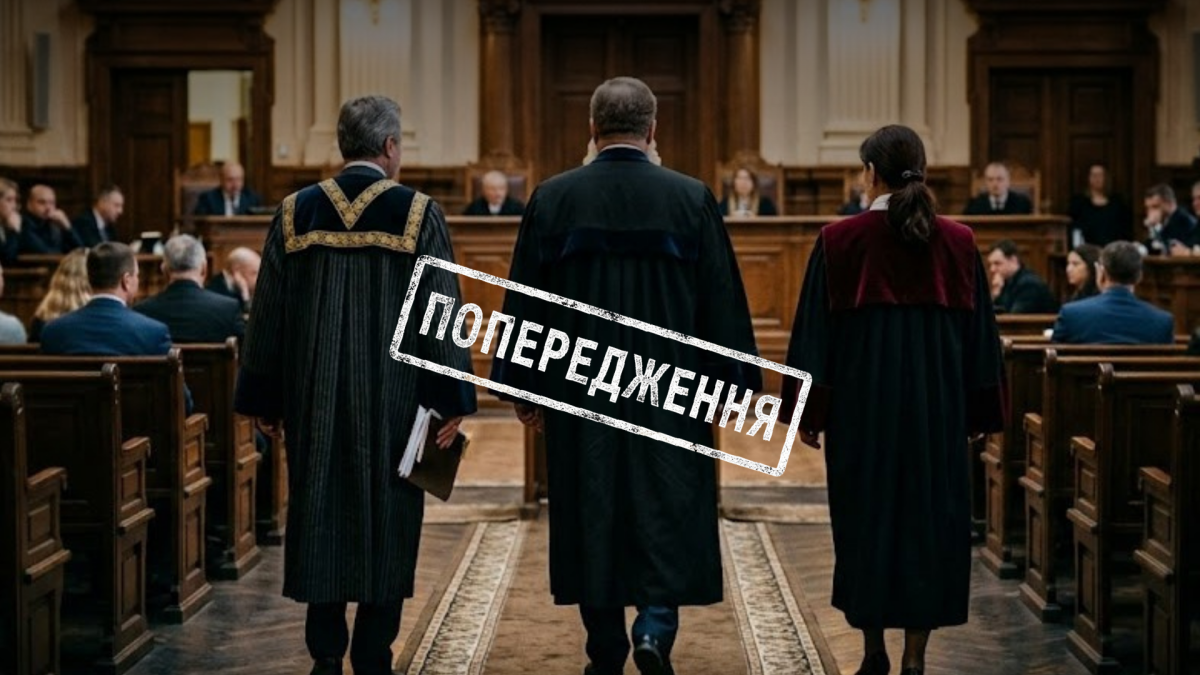
Three judges of the HACC Appeals Chamber received warnings from the High Council of Justice for reviewing an unlawful ruling issued by the Pecherskyi District Court in a NABU case back in 2021. The practice of reviewing decisions by district courts (rather than by the HACC) was supported by both the Kyiv Court of Appeal and the Supreme Court itself—before and after this ruling. TI Ukraine has analyzed the HCJ decision and explains why it raises serious questions.
On May 5, 2026, the High Council of Justice issued warnings to three judges of the HACC’s Appeals Chamber. The full text of the decision appeared only in early June, and it raises serious concerns.
The warning concerned a case in which HACC Appeals Chamber judges reviewed a Pecherskyi District Court order canceling the suspicion against former Deputy Minister of Justice Olena Lukash and closed proceedings because the suspicion could not be challenged before an investigating judge under the applicable law. The HACC Appeals Chamber followed the rules of subject-matter jurisdiction set out in Ukraine’s Criminal Procedure Code. The judges’ legal position drew support from both prior Supreme Court practice and subsequent court decisions in similar cases.
Yet something went wrong in this very case, and the judges received a warning.
What we found in the HCJ decision and what problems it reveals are the subject of this analysis.
The practice of reviewing decisions by district courts (rather than by the HACC) was supported by both the Kyiv Court of Appeal and the Supreme Court itself—before and after this ruling.
Pavlo Demchuk
What happened: a timeline of events
At the center of events is a criminal proceeding against Olena Lukash, former Minister of Justice of Ukraine, charged with misappropriation of budget funds and official forgery. Here is how the HCJ decision regarding HACC Appeals Chamber judges came about.
2014 — Proceeding entered into the Unified Register of Pre-Trial Investigations; investigation conducted by the Prosecutor General’s Office.
October 17, 2019 — Deputy Prosecutor General Chumak serves Lukash with a revised notice of suspicion.
October 21, 2019 — Prosecutor General Riaboshapka transfers the investigation to the NABU; the HACC was henceforth to exercise judicial oversight in the case.
March 2020 — Lukash’s defense counsel files a complaint against the notice of suspicion with the Pecherskyi District Court; the SAPO prosecutor requests the Supreme Court transfer the case to the HACC.
October 12, 2020 — The Supreme Court declines: because the notice was not signed by the SAPO prosecutor, the case supposedly falls outside the HACC’s jurisdiction; the investigating judge of the Pecherskyi District Court grants the defense counsel’s complaint and cancels the suspicion.
November 2020 — The Kyiv Court of Appeal leaves the defense counsel’s complaint against the Pecherskyi District Court’s decision without granting it.
January 2021 — The HACC Appeals Chamber, following the SAPO prosecutor’s complaint, cancels the Pecherskyi District Court’s ruling and closes the proceeding on the complaint.
January 22 and 25, 2021 — Olena Lukash files complaints with the HCJ against the actions of the HACC Appeals Chamber judges. In her complaint, she argued that the HACC Appeals Chamber judges had no authority to review the case.
November 2025 — The Third Disciplinary Chamber of the HCJ refuses to hold the HACC Appeals Chamber judges liable.
May 2026 — The HCJ sitting in plenary session sets aside this decision and issues warnings to judges Kaluhina, Semennykov, and Mykhailenko.
The complaint against the disciplinary chamber’s decision was filed by attorney Ivashchenko—Lukash’s defense counsel, who is himself a defendant in the same criminal proceeding. It is also worth noting that the Supreme Court’s October 2020 decision, on which the HCJ relies, was based on a specific criterion—who signed the notice of suspicion—a criterion that does not actually appear in the Criminal Procedure Code’s provisions on HACC jurisdiction.
It is also worth noting that the Supreme Court's October 2020 decision, on which the HCJ relies, was based on a specific criterion—who signed the notice of suspicion—a criterion that does not actually appear in the Criminal Procedure Code's provisions on HACC jurisdiction.
Pavlo Demchuk
The “case dumping” scheme through the Pecherskyi District Court
From 2020 onward, subjects of NABU investigations began exploiting investigating judges, predominantly from the Pecherskyi District Court in Kyiv, as a tool to remove their cases from anti-corruption proceedings.
The scheme is straightforward: a complaint is filed with the Pecherskyi District Court alleging inaction by the Prosecutor General’s Office concerning the Prosecutor General’s failure to review a defense motion within a NABU criminal proceeding—despite the fact that formally such a court lacks authority to review complaints in NABU cases. Yet the complainants argue that because the Prosecutor General’s Office is located within the territorial jurisdiction of the Pecherskyi District Court, that court is authorized to hear such complaints. The court then issues a ruling favorable to the suspect—for example, ordering the transfer of the case to another investigative body or canceling the suspicion. Subsequently, the Prosecutor General’s Office complies with this ruling, and the case is effectively removed from the system.
This is precisely what happened in the Ukrbud case, involving Oleh Tatarov, then Deputy Head of the Presidential Office. There, the Pecherskyi District Court unlawfully ordered the removal of the case from NABU’s investigative authority. The Prosecutor General’s Office complied, and later Office prosecutors blocked all efforts to return the proceeding to the Bureau by withdrawing an appeal filed with the HACC Appeals Chamber. Similar situations arose in the cases of Zlochevskyi, VAB Bank, and the Dubnevych thermal power plant—matters we will discuss further.
The response to this was as follows: SAPO prosecutors, and sometimes PGO prosecutors, filed appellate complaints with the HACC Appeals Chamber. That court repeatedly reviewed and cancelled rulings issued by the Pecherskyi and other district courts, consistently holding: appellate review of any decisions in cases falling within the HACC’s jurisdiction may be conducted exclusively by the HACC’s Appeal Chamber.
Yet the Supreme Court, in several decisions concerning the Zlochevskyi case in March 2021 and August 2021, as well as in the case of DACK judges from August 2020, held that when a decision was formally issued by a court of general jurisdiction, it must be appealed to the appellate court of general jurisdiction, not the HACC Appeals Chamber. Interestingly, this position conflicted to some degree with other similar situations.
In light of this, the HACC Appeals Chamber was sometimes compelled to dismiss appeals of district court rulings. This occurred in the Zlochevskyi case and in the VAB Bank case.
The problem of jurisdiction over NABU cases in courts of general jurisdiction was so serious that it appeared in the National Anti-Corruption Strategy for 2023–2025 as a separate priority. This means that the state, at the level of a government document, acknowledged that judicial review of NABU cases by other courts represents a systemic problem that must be addressed. The state should therefore adopt specific legislation to prevent such practices. Yet by holding accountable the judges who resisted this practice, the HCJ is moving in the opposite direction.
Against this backdrop, the disciplinary case concerning three HACC Appeals Chamber judges developed—judges whom the High Council of Justice warned in May 2026.
Yet by holding accountable the judges who resisted this practice, the HCJ is moving in the opposite direction.
Pavlo Demchuk
Why HACC Appeals Chamber judges had grounds to act as they did
The January 12, 2021 ruling of the HACC Appeals Chamber in the case of Lukash’s complaint against the notice of suspicion contains detailed and coherent legal reasoning.
The judges proceeded from the premise that Article 33-1 of the Criminal Procedure Code establishes subject-matter jurisdiction of the HACC, which takes priority over territorial jurisdiction. This means: if a criminal proceeding, by its characteristics, falls within the HACC’s jurisdiction, no other court—neither at the trial level nor at the appellate level—may hear it. Jurisdiction is determined by the properties of the proceeding itself, not by which court actually issued a particular decision.
At the time of appellate review, investigative authority in this case had been assigned to the NABU, and the case materials had been transferred to that agency. Thus, the condition set out in Section 20-2 of the Transitional Provisions of Ukraine’s Criminal Procedure Code—that pre-trial investigation is conducted by NABU—was satisfied. Consequently, subject-matter jurisdiction of the HACC applied, meaning that appellate review fell within the competence of the HACC Appeals Chamber.
Regarding the Supreme Court’s October 12, 2020 ruling, which denied the prosecutor’s request to transfer the case from the Pecherskyi District Court to the HACC, the HACC Appeals Chamber judges offered a clear explanation: the Supreme Court was deciding only the question of transfer of the proceeding from one trial court to another—and only within the scope of arguments the prosecutor had raised in the motion. The Supreme Court neither decided nor could have decided the question of appellate jurisdiction for the prosecutor’s later filed appeal.
Beyond this, the HACC Appeals Chamber judges’ position on jurisdiction was neither novel nor isolated—it reflected established practice that had developed both before and after the January 12, 2021 ruling.
The HACC Appeals Chamber had repeatedly reviewed rulings of investigating judges of the Pecherskyi District Court in NABU cases, and the Supreme Court did not challenge this:
- In the VAB Bank case, the HACC Appeals Chamber in July 2020 cancelled a Pecherskyi District Court ruling and closed the proceeding on the complaint. The Cassation Criminal Court within the Supreme Court three times—in September, October, and November 2020—refused to open cassation proceedings on appeals challenging this HACC ruling, finding arguments about unlawful action by the anti-corruption court to be unsubstantiated.
- In the Dubnevych thermal power plant case, in March 2021, the HACC Appeals Chamber cancelled a Pecherskyi District Court ruling, and the Supreme Court twice—in April and May 2021—refused cassation review, stating that the HACC ruling was not subject to appeal.
Moreover, judges of the Kyiv Court of Appeal themselves directed appeals from district court decisions to the HACC Appeals Chamber:
- In the case of the former head of the Chernihiv RSA, in December 2020, the Kyiv Court of Appeal independently transferred an appeal to the HACC Appeals Chamber, determining that the anti-corruption court was the proper appellate court in proceedings falling within the HACC’s jurisdiction—regardless of which trial court issued the challenged decision.
- In the Dubnevych thermal power plant case mentioned above, the Kyiv Court of Appeal in March 2021 transferred the case for review by the HACC Appeals Chamber.
Furthermore, in September 2023, the Supreme Court confirmed the lawfulness of the HACC Appeals Chamber’s actions in another instructive episode: the head of the Pecherskyi District Court for more than two years ignored fourteen requests from the HACC Appeals Chamber for case materials relating to an appeal filed in the Zlochevskyi case, claiming that the anti-corruption court supposedly was not the proper appellate court. The HACC Appeals Chamber submitted a separate ruling to the HCJ concerning the head of court’s violation of Criminal Procedure Code requirements. In September 2023, the Supreme Court left the Pecherskyi District Court head’s cassation appeal without granting it, confirming that determining the question of jurisdiction does not fall within the authority of a trial court head and cannot serve as grounds for refusing to comply with lawful requests from an appellate court.
And in December 2024, the Supreme Court itself granted a motion and transferred an appeal from the Kyiv Court of Appeal to the HACC Appeals Chamber, citing a violation of jurisdictional rules.
Thus, the legal position for which the judges received a warning was not a departure from practice but part of it—consistently supported by both the Kyiv Court of Appeal and the Supreme Court itself, albeit with certain exceptions in specific proceedings.
The HACC Appeals Chamber judges' position on jurisdiction was neither novel nor isolated—it reflected established practice that had developed both before and after the January 12, 2021 ruling.
Pavlo Demchuk
What is wrong with the HCJ decision
In May 2026, the High Council of Justice characterized as “obvious” a violation of what, by July 2021, had already been established as settled practice.
The HACC Appeals Chamber had been reviewing Pecherskyi District Court rulings in NABU cases since 2020—and the Supreme Court did not recognize this as unlawful. Conversely, in refusing to open cassation proceedings, the Supreme Court effectively confirmed the lawfulness of the HACC’s actions. Under such circumstances, the HCJ’s assertion about the “obviousness” of the violation is at best unconvincing.
Moreover, the HCJ overlooked the fact that the Supreme Court in December 2024 did precisely what the judges did in 2021.
The judges, both in their decision and during HCJ proceedings, consistently explained that the Supreme Court in October 2020 was addressing only the transfer of proceedings from one trial court to another. In our view, that same Supreme Court decision contained rather peculiar reasoning regarding the determination of jurisdiction based on who served the notice of suspicion—conditions for such a criterion do not exist in Ukraine’s Criminal Procedure Code.
The HCJ further contends that two conflicting appellate court decisions arose concerning the same ruling. This does not correspond to what actually occurred. The Kyiv Court of Appeal reviewed a complaint filed by the defense counsel of the suspected person, counsel who presented no substantive arguments about any illegality or lack of evidentiary basis for the ruling in their favor. The court emphasized this point in its decision. By contrast, the HACC Appeals Chamber reviewed a complaint filed by the prosecutor, who sought to set aside the same ruling and close the proceeding for substantive violations. Different appellants, different legal requests, different legal positions on review. The HACC Appeals Chamber did not review the Kyiv Court of Appeal’s decision and raised no challenge to it.
Furthermore, at HCJ proceedings, the HACC Appeals Chamber judges pointed out that the HCJ had already declined to open disciplinary proceedings in instances where a HACC Appeals Chamber judge had suspended execution of a Pecherskyi District Court ruling, and subsequently a panel of judges cancelled the corresponding district court ruling.
Under these circumstances, to speak of intentional violation means to contend that the judges acted unlawfully while possessing genuine legal grounds for their position. We found no basis for such a conclusion.
In May 2026, the High Council of Justice characterized as “obvious” a violation of what, by July 2021, had already been established as settled practice.
Pavlo Demchuk
Conclusions and open questions
Following this analysis, several questions remain.
Will the legislature close this gap? The Criminal Procedure Code’s provisions governing jurisdiction over NABU cases in courts of general jurisdiction still contain no clear answer to a situation where a local court, contrary to law, issues a decision in a NABU case.
What does this mean for NABU and SAPO cases in practice? The problem arose because, during a period when the SAPO leadership post was vacant, certain of its powers were exercised by the Prosecutor General. Attorneys, disregarding rules of subject-matter jurisdiction, challenged actions or inaction of the Prosecutor General before the Pecherskyi District Court. The judges of that court ruled on such complaints. If the term of the SAPO leadership ends and stable leadership of the specialized prosecution service is not ensured by then, the problems will return.
Why did the HCJ not notice contradictions in its own practice? During HCJ proceedings, the HACC Appeals Chamber judges pointed out that the HCJ had previously declined to open disciplinary cases in similar circumstances. How can the same actions in one case constitute no disciplinary breach, while in another they do? The HCJ decision offers no answer.
The Criminal Procedure Code's provisions governing jurisdiction over NABU cases in courts of general jurisdiction still contain no clear answer to a situation where a local court, contrary to law, issues a decision in a NABU case.
Pavlo Demchuk
Source: www.pravda.com.ua


