




September 9, 2026 09:40
The Court’s Successes Amid the Authorities’ Passivity: How the HACC’s Practice Changed Over the Year
The High Anti-Corruption Court is showing a steady rise in productivity and improvements in its internal processes. This is borne out by the findings set out in the seventh HACC monitoring report by Transparency International Ukraine.
However, the other state bodies involved, which are supposed to make the decisions needed in this area, are stalling and postponing the resolution of problems. The greatest delays are on the part of the Verkhovna Rada.
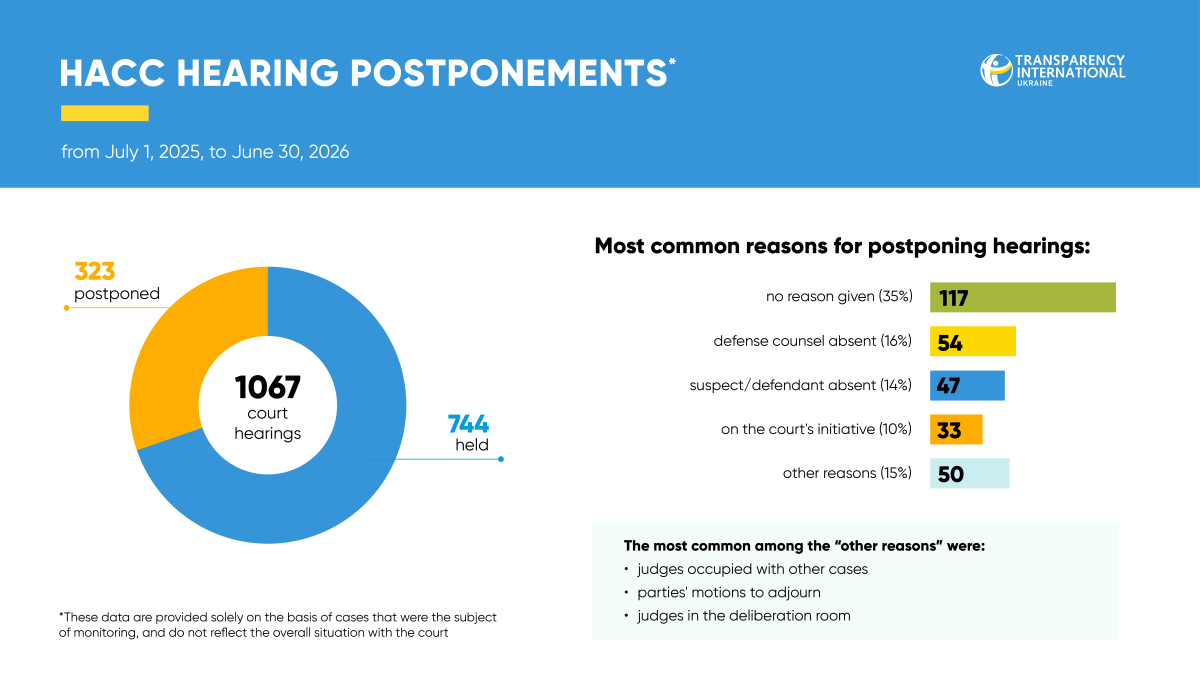
The seventh monitoring stage ran from July 1, 2025, to June 30, 2026, and continues our series of materials on the work of the High Anti-Corruption Court. During this time, our experts attended 1,067 court hearings and analyzed hundreds of court decisions.
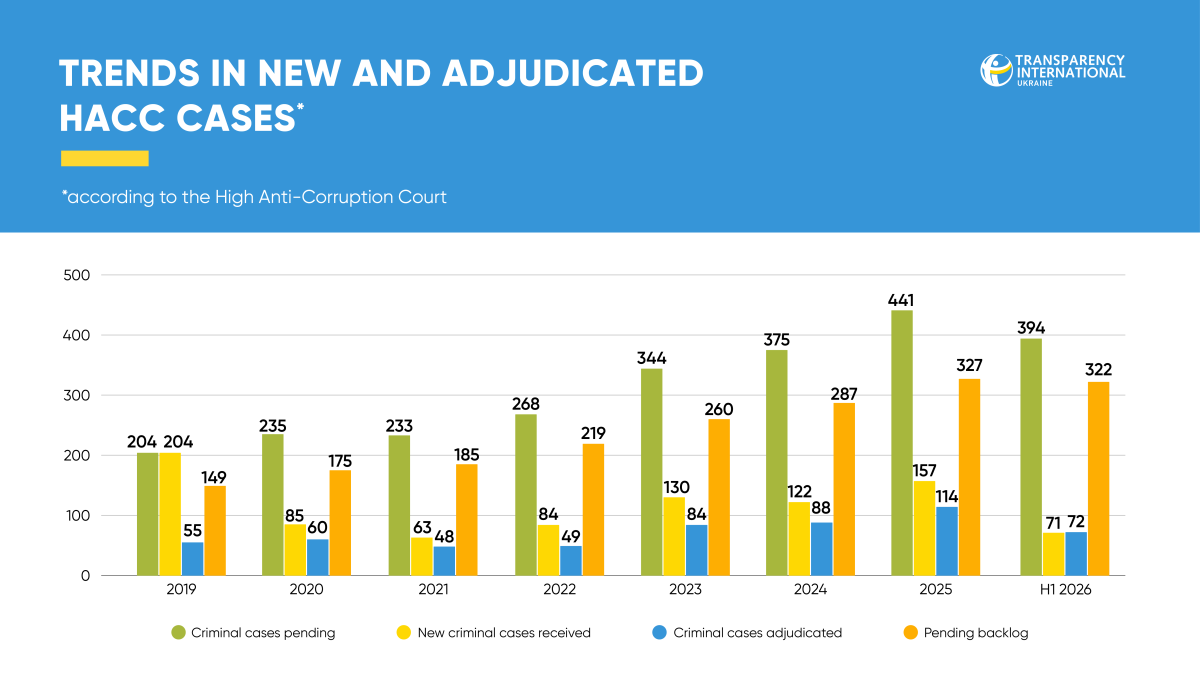
The greatest achievement of this reporting period can be considered the court’s productivity, which was a record over the monitoring period. In 2025, the HACC heard 114 criminal cases and convicted 154 persons, and for the first time it heard more cases (72) than the number of new ones it received (71). This positive trend is based primarily on organizational updates and changes at the institutional level.
As TI Ukraine’s experts found, the reasons for these positive changes included growth and partial improvement in the practice of plea agreements, personnel and institutional strengthening, and single-judge proceedings. Also, over the seventh monitoring period, the share of postponed hearings fell from 35% to 30%, and the share of procedural violations likewise decreased.
“The High Anti-Corruption Court has not merely adapted to working in stable conditions — we are seeing a real result from the legislative changes adopted earlier. The tools that civil society fought for over the years are increasingly being implemented in practice to positive effect. This proves that active advocacy and the determination of parliament yield measurable fruit. That is precisely why we must carry this work further — not because of failures, but, on the contrary, having become convinced of how substantially such steps affect the effectiveness of adjudicating top-level corruption cases,” notes Kateryna Ryzhenko, Deputy Executive Director of Transparency International Ukraine for Legal Affairs.
The biggest problem for the HACC remains the ineffective regulation of limitation periods. Over the year under review, 22 persons were released from criminal liability because those periods had expired (versus 13 last year), and 9 persons from punishment on the same ground (versus only 1 last year). No less of a problem remains the abuse of procedural rights (manipulation of servicemember status, abuse of the recusal mechanism, replacement of defense attorneys, excessively long and repetitive speeches, systematic groundless motions, pressure on the court, and disruption of hearings), and unresolved procedural issues (replacement of a judge, the point of transition to panel proceedings, and the shortage of electronic bracelets) likewise have a negative effect on the handling of cases.
Also, despite the generally positive trend in the use of agreements, we found that there is still a practice of sealing the full text of a verdict, which makes it impossible to learn what exactly the state received as a plea result. The inconsistent practice of partially sealing verdicts based on agreements creates risks for transparency and public trust in the anti-corruption system.
Since the HACC’s creation, TI Ukraine has systematically and consistently tracked its work. Our experts have attended hearings and comprehensively examined various aspects of its work and the decisions it has made.
As usual, TI Ukraine has provided a list of recommendations and necessary changes that should be introduced to improve the effectiveness of the anti-corruption justice system. In particular, we believe, parliament above all should:
- adopt amendments to Article 49 of the Criminal Code that genuinely interrupt, rather than merely suspend, the running of limitation periods in top-level corruption cases;
- give the court effective tools against the abuse of procedural rights — in particular, the power to impose monetary penalties on defense attorneys;
- abolish the automatic closure of cases due to the formal expiry of pretrial investigation time limits;
- eliminate the ambiguity in determining the point of transition to panel proceedings and remove the unjustified exceptions to single-judge proceedings.
TI Ukraine emphasizes: the trust of citizens and international partners, and the prospects for Ukraine’s further integration into the EU, depend on the coordinated work of the entire anti-corruption sphere. That is precisely why the Verkhovna Rada and other state institutions must, as soon as possible, adopt the necessary changes that will improve the HACC’s work.
The full text of the monitoring report on the seventh stage of the HACC’s work is available below.
This report was prepared by Transparency International Ukraine with the financial support of Sweden.
The tools that civil society fought for over the years are increasingly being implemented in practice to positive effect. This proves that active advocacy and the determination of parliament yield measurable fruit. That is precisely why we must carry this work further.
Kateryna Ryzhenko


