



The Experiment Is Over, the Reconstruction Is Not: What More Than Two Years of Comprehensive Restoration Have Shown
October 13, 2026
Evaluating two years of governmental experimental project for the comprehensive restoration of six localities damaged by Russian aggression
In April 2023, the government launched an experimental project for the comprehensive restoration of six localities damaged by Russian aggression. Its ambition was high: not just to repair individual houses or roads, but to comprehensively restore and transform the affected towns and villages by the end of 2025.
The experiment has formally ended. Comprehensive restoration has not.
In two and a half years, not one of the selected localities has been fully rebuilt. Of hundreds of facilities, 80 were completed, just over a tenth of the current need. One village effectively dropped out of the project early on, and in another, construction never began.
What kept the experiment from reaching its goal, and what will happen to the unfinished reconstruction? We present the findings of TI Ukraine’s study of the government’s comprehensive reconstruction experiment.
Experiment over, reconstruction unfinished
At launch in 2023, the experiment covered 295 facilities in six localities:
- the settlement of Borodianka and the village of Moshchun (which dropped out in the first year) in Kyiv Region;
- the town of Trostianets in Sumy Region;
- the village of Posad-Pokrovske, on the border of Kherson and Mykolaiv Regions;
- the village of Tsyrkuny in Kharkiv Region;
- the village of Yahidne in Chernihiv Region.
The list of facilities was later revised several times, and the project’s scale effectively doubled. But the pace of work could not keep up with the growing plans.
As of late May 2026, Yahidne had the most completed facilities (36 of 119), followed by Borodianka (33 of 77). Posad-Pokrovske, home to almost 400 facilities, had finished only 10. In Trostianets, one of four major infrastructure facilities can be considered fully complete; in Tsyrkuny, none.
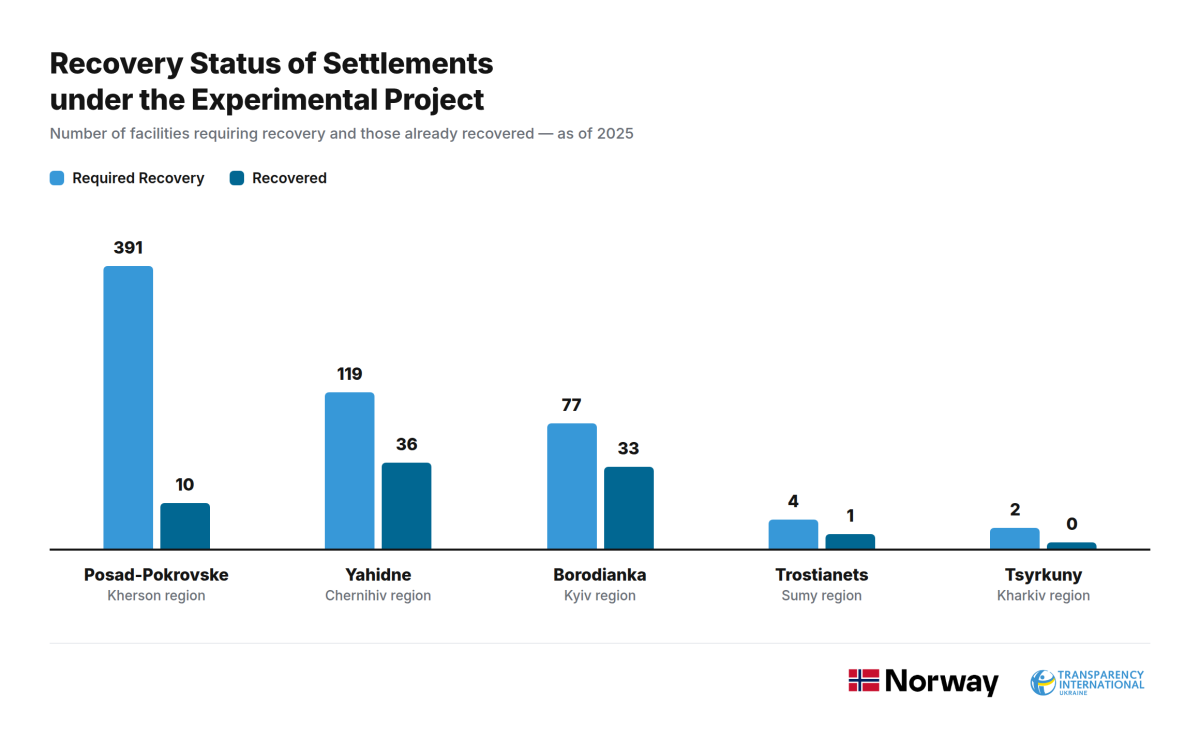
Yet a low share of completed facilities does not always mean that no work is being done. In Posad-Pokrovske, for example, construction was under way at more than 300 facilities, including housing, social infrastructure, roads, and utility networks. The village has entered a large-scale construction phase, but given the volume of reconstruction, completion is still far off.
Borodianka has made more visible progress, with over 40% of its facilities restored. Even here, though, the pace varied considerably depending on the contracting authority, and funding for some contracts remained unresolved.
So the experiment produced some visible results but missed its main goal: the comprehensive restoration of the selected localities within the set time frame.
Money that never came on time
The decisive cause of delays was funding: not just its amount, but above all its unpredictability.
In 2023 and 2024, the government made funding decisions only in August, and the money actually reached contracting authorities even later. This delayed procurement and payments for completed work; some construction was suspended, and some contracts were terminated.
In total, UAH 3.99 billion was actually spent on comprehensive restoration in 2023–2025, roughly a third of the project’s estimated value. Of this, UAH 2.93 billion, or 73% of all expenditures, came in 2025 alone. In other words, the experiment received most of its funding when there was practically no time left to finish it.
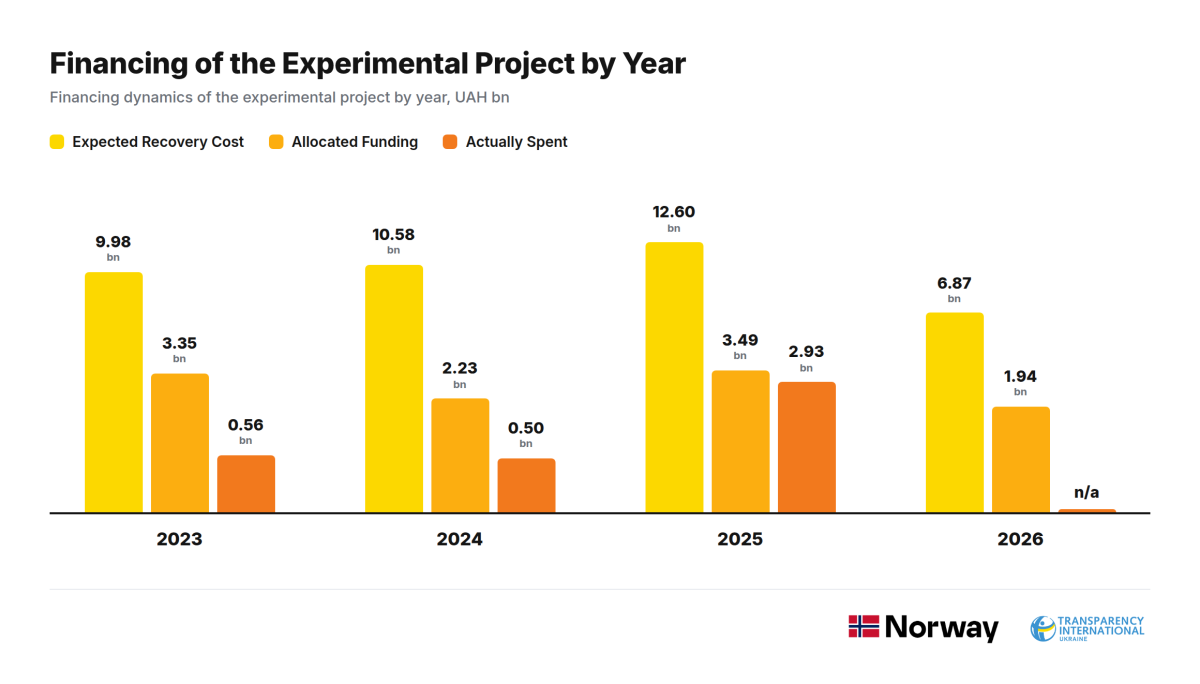
The end of the experiment did not solve the problem. Another UAH 1.94 billion was earmarked to continue the work in 2026, but as of late May, the funds had again not reached spending units. This delayed contract payments and, in Sumy Region, led to contract terminations.
The funding was finally allocated by August. Still, the Agency for Restoration estimates that about UAH 4.92 billion more will be needed to complete all facilities in the coming years.
Conditions for contractors
The drawn-out project also affected procurement. In its final year, contracting authorities signed contracts worth over UAH 2 billion.
The share of direct contracts grew. However, 93% of them by value involved additional works by contractors already performing the main contract. For long-term construction, where design documentation needs adjusting, this is a predictable scenario.
Competition trends were more telling. In the experiment’s first year, open tendering attracted an average of 3.6 bidders; in the second, 2.25; and in the final stage, just 1.5.
Notional savings shrank along with competition, from 21% in the first year to 7.5% in the second and 2.37% in the final phase.
The fate of contracts already signed shows how difficult implementation was. As of July 2026, about 9.5% of contracts from the first two years’ procurement had been terminated, against 3.66% for comparable procurement in Prozorro. Contract terms were extended in almost 43% of cases, roughly twice as often as the average for comparable procurement.
This says more about the environment contractors had to work in: funding delays, design revisions, additional works, and constant rescheduling. Year after year, these systemic problems made the experimental project less attractive to businesses.
Why restoration never became truly comprehensive
Funding was the most tangible problem, but not the only one. The experiment’s design itself had major gaps. It did not require comprehensive restoration plans, set uniform criteria for selecting localities, or define what the “build back better” principle meant in practice.
As a result, the scope of work varied widely: from hundreds of facilities in Posad-Pokrovske to two in Tsyrkuny. Moshchun dropped out of the project at the outset. Comprehensive restoration largely turned into the parallel implementation of hundreds of separate construction projects.
On top of that came problems with transferring contracting authority functions for private housing, numerous revisions to design documentation, and the limited experience of regional Restoration Services in building housing and social infrastructure.
Some delays had objective causes: shelling, repeated damage to facilities, air raid alerts, power outages, labor shortages, and logistical problems. In Tsyrkuny, the security situation never allowed the project to move from design to construction.
But many of the problems could have been avoided with better planning, timely funding, and a clearer division of responsibilities.
The experiment is over. What next?
The end of the experiment does not mean the end of reconstruction. Unfinished work has been transferred to a four-year public investment project covering five localities and 591 facilities.
This format potentially fits the real scale of the task better. Comprehensive restoration is hard to squeeze into a short experiment with annual funding approvals. Design, expert reviews, procurement, construction, and commissioning require a longer horizon.
A public investment project also aligns better with medium-term budget planning, and information about it is to be published in DREAM. This will make it possible to track every stage of implementation, from technical solutions and contracts to actual progress on the ground.
For a project that lacked complete and timely public information for several years, this is a step forward. But a new management framework will not finish any construction by itself. If funding again arrives late, deadlines keep slipping, and priorities among facilities remain unclear, the four-year project risks inheriting the same problems. The government therefore needs to ensure predictable funding, set a realistic completion schedule, and prioritize the facilities together with communities.
Evaluating the experiment and learning from mistakes
There is also the question of evaluating the experiment itself. Back in spring 2025, the government initiated an analysis involving international experts. However, no information on the results of this evaluation is publicly available, and the Agency for Restoration did not respond to our request about it. The promised analysis should be published, or carried out if it has not been yet.
The Accounting Chamber recently conducted the first official audit of the experiment. It found that the project had failed to achieve its objectives: it was implemented without a proper strategic, organizational, and financial basis, amid inconsistent regulation and a mismatch between the powers and responsibilities of its coordinators.
Still, it would be wrong to call the experiment a complete failure.
In Borodianka and Yahidne, dozens of residential and infrastructure facilities were restored. In Posad-Pokrovske, work got under way at hundreds of facilities. In Trostianets, some infrastructure was restored, while other projects now have a foundation to build on. In other words, the experiment launched a reconstruction that can now continue. But as an experiment in comprehensive restoration, it fell short of its stated goal.
Perhaps this experience is the experiment’s main outcome. It showed that comprehensive reconstruction cannot be organized as a set of hundreds of separate facilities with unpredictable annual funding. It requires integrated spatial planning, community participation, shovel-ready projects, stable funding, and clear accountability for the final result.
This does not make the idea of comprehensive restoration any less relevant. On the contrary, the past three years have shown exactly which prerequisites were missing for the concept to work. The key now is not to carry the experiment’s old problems into the new four-year project along with the unfinished facilities.
This material is funded by Norway. Its content is the sole responsibility of Transparency International Ukraine and does not necessarily reflect the views of the Norwegian Government.
Source: zn.ua


