


This research is made possible with the support of the MATRA Programme of the Embassy of the Kingdom of the Netherlands in Ukraine, and with the financial support of Sweden within the framework of the program on institutional development of Transparency International Ukraine. Content reflects the views of the author(s) and does not necessarily correspond with the position of the Embassy of the Kingdom of the Netherlands in Ukraine or the Government of Sweden.

The Transparent Cities program of Transparency International Ukraine has published the results of an assessment of the electronic services ecosystem in cities. The findings show that digital solutions are often limited to isolated services, while integrated service systems for residents and businesses largely remain underdeveloped.
As part of the new study — the European Cities Index, which aims to assess the readiness of Ukrainian communities for EU integration — program experts analyzed 11 cities: Dnipro, Zaporizhzhia, Kyiv, Kropyvnytskyi, Lutsk, Lviv, Odesa, Poltava, Kharkiv, Khmelnytskyi, and Chernihiv. Each city was evaluated against 40 criteria reflecting how user-friendly and mature the digital service infrastructure for citizens and businesses is. A municipality could score a maximum of 100 points for meeting all indicators.
On average, cities met 49.8% of the criteria. Kyiv achieved the highest score — 70 out of 100 possible points. Lviv ranked second with 63 points, followed by Kharkiv with 58 points. The lowest scores were recorded for Poltava (27 points), Chernihiv (32 points), and Lutsk (43 points). As a result, the gap between the leader and the lowest-performing city in this block amounted to 43 points, which is significantly wider than in the assessment of city council openness.
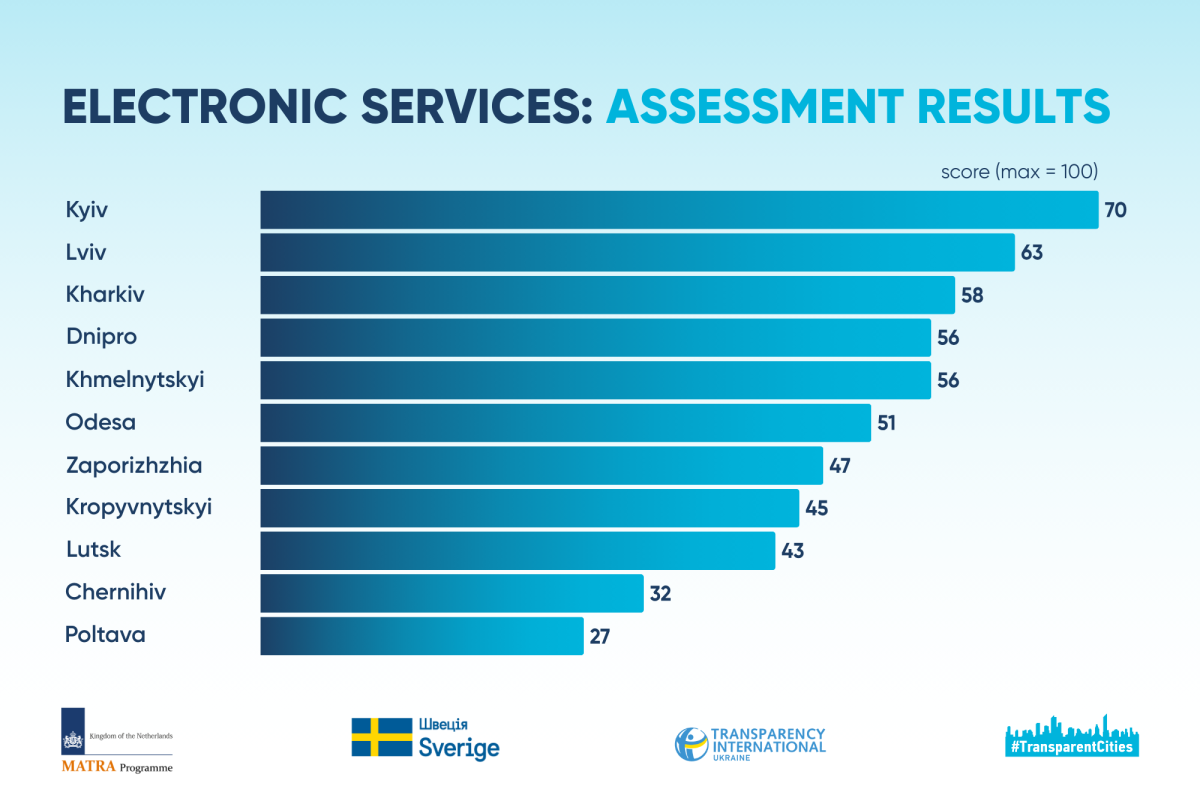
The leadership of Kyiv and Lviv was predictable, as these cities have consistently received recognition in international digital city rankings for several years. However, even they failed to achieve the maximum possible score. In particular, Lviv lost points due to the absence of a comprehensive city mobile application. At the same time, Kharkiv, despite a significant outflow of IT professionals and challenging security conditions, managed not only to maintain services developed before the full-scale invasion but also to launch new ones, including the Open Kharkiv mobile application.
Another city with the status of a territory of potential hostilities included in the study was Zaporizhzhia. Despite its proximity to active hostilities, the city demonstrated the capacity to develop its own information technologies. In 2025, Zaporizhzhia launched the Digital Zaporizhzhia online platform, which is intended to serve as a single window for accessing the city’s digital services.
Among the positive findings: all 11 cities provide access to a real-time public transport tracking service, an electronic local petitions platform, and online kindergarten enrollment with the ability to track waiting lists remotely. In addition, all cities except Kropyvnytskyi have introduced cashless fare payment in municipal transport and enabled online pre-booking of appointments with Administrative Service Centers. Only Kropyvnytskyi and Poltava failed to ensure communication with residents through electronic contact centers. All of these digital solutions bring communities closer to European standards and align with the reforms envisaged under the Ukraine Facility Plan.
At the same time, no city council has published a separate list of social services available to residents online. Similar issues were identified in healthcare and energy efficiency: most communities do not provide access to services for searching medical equipment or medicines, and only Kyiv offers up-to-date data on energy resilience. The situation with shelter maps is particularly alarming: in seven cities, such maps are either absent or do not contain verified up-to-date data. In addition, only five municipalities — Dnipro, Zaporizhzhia, Kropyvnytskyi, Lutsk, and Khmelnytskyi — have created a single point of entry to all services on their official websites. None of the leaders — Kyiv, Lviv, or Kharkiv — have established dedicated sections where users could easily find up-to-date links to the electronic services developed by these cities in recent years.
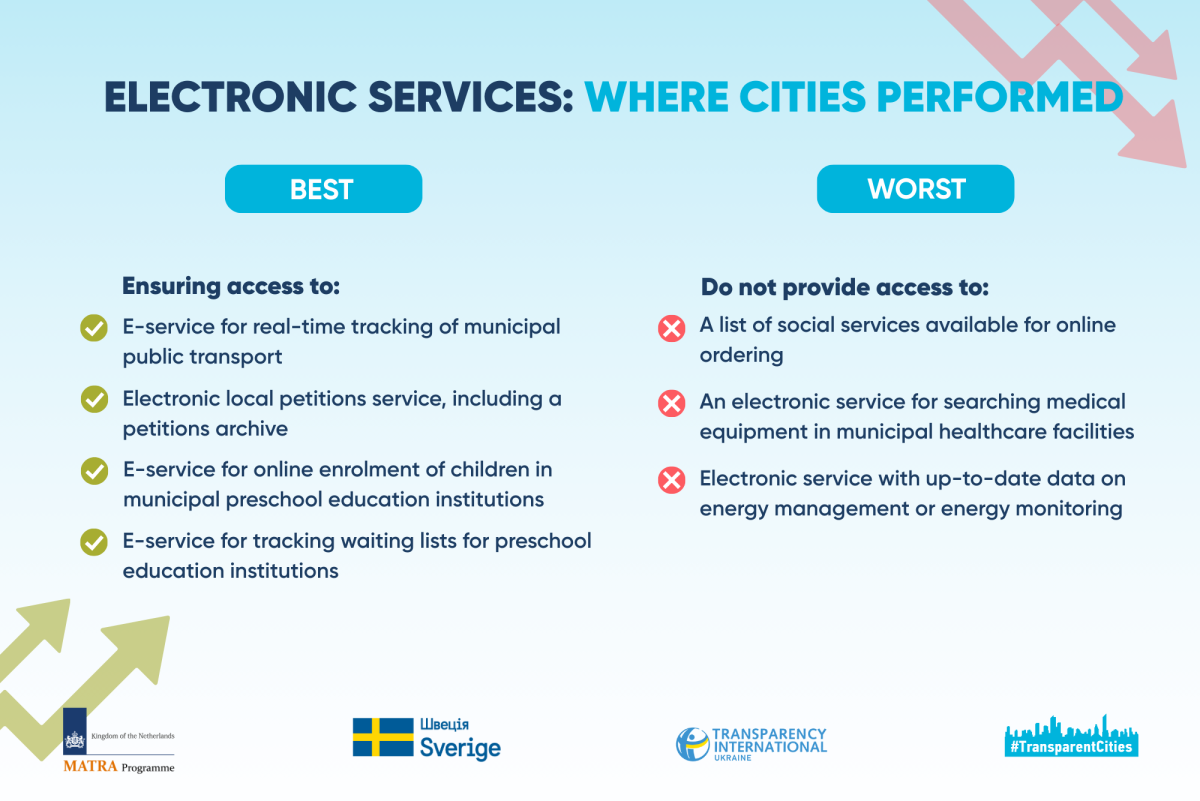
The results indicate uneven development. The greatest progress is observed in areas where digital services have become part of everyday life — transport, education, participation tools, and administrative services. Meanwhile, areas that are critically important during wartime and for post-war recovery — social services, healthcare, energy efficiency, and local statistics — remain underdeveloped and require systematic planning, investment, and stronger managerial focus.
In addition to electronic services, analysts examined whether cities have approved and up-to-date informatization programs. Only three regional centers — Poltava, Chernihiv, and Lutsk — lack such programs. These cities also demonstrate fragmented digital development and a lack of continuity: individual services created with donor support are no longer updated over time or disappear from public access altogether.
“During the war, electronic services are no longer about convenience. For people who have lost documents or property, been forced to relocate, live with disabilities, or remain under constant shelling, the ability to access services online is often a matter of safety and basic access to rights. How digital services function at the city level directly affects quality of life and human dignity in the community. Our task is not merely to record gaps or leadership, but to help cities identify concrete growth points and prepare for European integration not in words, but through real services that make people’s lives easier,” — said Olesia Koval.
Experts from the Transparent Cities program recommend that all municipalities use the study results as a starting point for systemic change. In particular, cities should strengthen strategic digital planning, conduct an inventory of all existing digital services, and consolidate links to them in one place on the official website. Attention should also be paid to developing local digital statistics services and extending digital transformation to the social services sector, following the example of administrative services.
For city council representatives, the analysts have developed a dedicated self-assessment tool that helps evaluate how well a city meets electronic services standards and highlights areas requiring improvement.
In November, the program presented the results of the first block of the European Cities Index, which assessed how Ukrainian cities comply with European standards of openness and identified key areas for improvement at the local level.
This research was prepared within the framework of the program on institutional development of Transparency International Ukraine, which is carried out with the financial support of Sweden, as well as with the support of the MATRA program of the Embassy of the Kingdom of the Netherlands in Ukraine.
Transparency International Ukraine is an accredited representative of Global Transparency International. Since 2012, TI Ukraine has been helping Ukraine grow stronger. The organization takes a comprehensive approach to the development and implementation of changes for reduction of corruption levels in certain areas.
TI Ukraine launched the Transparent Cities program in 2017. Its goal is to foster constructive and meaningful dialogue between citizens, local authorities, and the government to promote high-quality municipal governance, urban development, and effective reconstruction. In 2017–2022, the program annually compiled the Transparency Ranking of the 100 largest cities in Ukraine. After the full-scale invasion, the program conducted two adapted assessments on the state of municipal transparency during wartime. In 2024, the program compiled the Transparency Ranking of 100 Cities, and in 2025, it launched an updated format for assessing city councils — the European City Index.
During the war, electronic services are no longer about convenience. For people who have lost documents or property, been forced to relocate, live with disabilities, or remain under constant shelling, the ability to access services online is often a matter of safety and basic access to rights. How digital services function at the city level directly affects quality of life and human dignity in the community.
Olesia Koval


