



Cities have no single standard for accountability to their communities. Some city councils try to communicate regularly about the work of the mayor, departments, divisions, or municipal enterprises. Most, however, barely communicate their results or do so only episodically.
This emerges from a study of public reporting by local self-government bodies in 11 Ukrainian cities, conducted by the Center for Content Analysis on commission from the Transparent Cities program at Transparency International Ukraine. Analysts examined how city authorities communicated about their reporting between December 1, 2025, and March 15, 2026. They analyzed news sections on official city council websites, local government and official social media accounts, four local online media outlets for each city, regional offices of Suspilne, and content on Facebook, X, Instagram, TikTok, YouTube, and Telegram.
The analysis showed that in 4 of the 11 cities, it is virtually impossible to find any mention of reports on the council’s own platforms. Those cities are Kropyvnytskyi, Odesa, Kharkiv, and Chernihiv. In Kharkiv, analysts found no mention of reports at all on the city council’s or the mayor’s website or social media accounts during the period studied. In Kyiv, communications focused mostly on the aftermath of snowfall and Russian attacks on city infrastructure — which clearly does not cover most of the important issues facing the city. Of the 1,161 messages analyzed, 70%, or more than 800 posts, were devoted to annual reports. Most of the discussion of these reports took place not on the official resources of local self-government bodies, but on external platforms — in local media and on social networks.
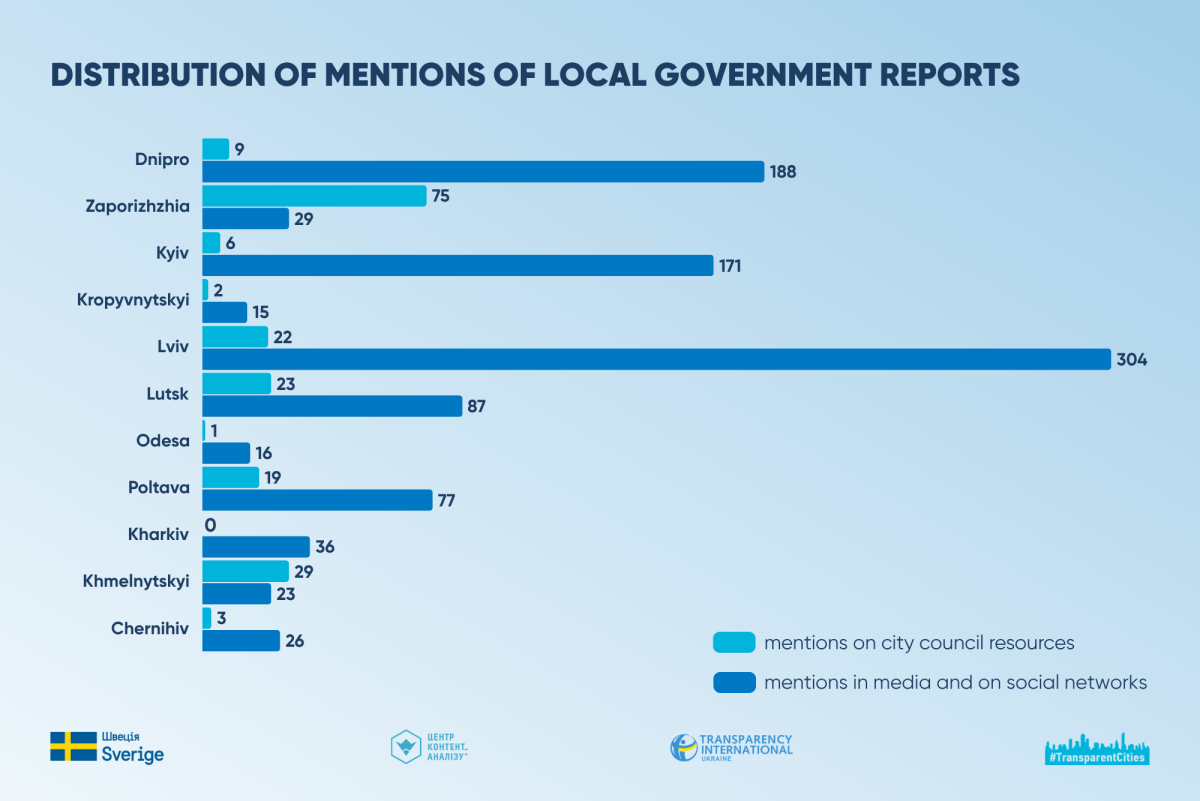
The analysis showed that in 4 of the 11 cities, it is virtually impossible to find any mention of reports on the council's own platforms.
Even where news about reports is published on city council websites, it does not always function as a tool of accountability. The materials are hard to find, written in bureaucratic language, and lack a short summary for residents or an explanation of how the authorities’ decisions affect community life in practice. The messaging often boils down to “the report has taken place” and fails to answer the questions residents actually care about: what was accomplished, what problems remain unresolved, how much money was spent, and what the authorities plan to do next.
The analysis of city council communications on official websites and social media also showed that on their own platforms, local authorities tend to report more on “everyday” matters, while systemic change goes unmentioned. The largest share of posts concerned repairs, improvements, or crisis response — for example, the aftermath of attacks. The most active reporting of this kind was in Zaporizhzhia and Khmelnytskyi. This approach helps residents stay informed about the city’s day-to-day affairs, but it does not give a full picture of what the authorities have achieved. Alongside coverage of current events, local self-government bodies should pay more attention to communicating strategic decisions, long-term projects, and how these shape the community’s development.
City councils also rarely include direct quotes from officials in their own communications (apart from the mayor’s major annual reports). For example, of more than 80 posts about the work of municipal enterprises across all cities in the sample, only two contained direct quotes. As a result, reporting often comes across as impersonal — residents cannot see who makes decisions and who is accountable for the results.
Among the good practices in how city councils communicate reports, analysts noted Lviv and Zaporizhzhia, where the mayors’ major annual reports were broken down by topic and published by area — culture, education, international cooperation, healthcare, and so on — as well as Khmelnytskyi, where posts about the substance of the report outnumbered those simply noting that it had happened.
Overall, mayors’ reports to their communities have considerable untapped potential. Also, local self-government bodies should broaden their pool of in-house spokespeople responsible for specific areas — people who can regularly and substantively explain their decisions and results to the community. This applies not only to the heads of departments, divisions, and municipal enterprises, but also to the council members to whom residents have delegated their votes.
Public discussion of reports took place mainly in local media, on Telegram channels, and in Facebook groups. Media outlets were generally more active in covering reporting than the local authorities were in communicating it, and a significant share of communication was passive. The fewest mentions of reporting by local self-government bodies in local media were recorded in Khmelnytskyi and Kropyvnytskyi. In those two cities, however, the authorities did initiate coverage in the media — whereas in Odesa, every mention of reporting identified was passive: information appeared not through the city council’s efforts, but through discussion by residents and journalists.
On social media, the most active discussion of reporting was in Lviv. There, of more than 260 posts analyzed, nearly 90% related to Andrii Sadovyi’s report. In this case, however, there were certain signs of artificially boosted negative messaging. Reporting by Odesa’s authorities, by contrast, generated only three social media posts — two of which were questions from engaged residents about whether the Mobilization Training Department had reported, or planned to report, on its work.
“The impression is that city councils treat reporting as a formality and have no systematic approach to communicating with the community. But a public report is an opportunity to win support: to explain to the community what has been done, what resources were used, which decisions were difficult, what didn’t work, and how the authorities plan to fix it. Trust isn’t built by a single report — it is earned through systematic, honest, and clear communication,” notes Olesia Koval, Transparent Cities Program Manager at Transparency International Ukraine.
The Transparent Cities program recommends that city councils introduce an internal standard for communicating reports — so that every important report comes not just with documents, but with short explanations for residents.
City councils should also make reporting easy to find on their websites, with dedicated pages for the reports of the mayor, departments, divisions, municipal enterprises, council members, and budget and program reports. Documents should be available for download, search, and reuse.
Reporting should not end the moment the mayor stops speaking. It should be supported by quality communication before, during, and after the event: announcements, live broadcasts, clear summaries, visualization of key results, answers to residents’ questions, engagement with the media, and explanation of the authorities’ next decisions.
Particular attention should go to difficult topics. If a report includes unfinished tasks, criticism, delays, or hard decisions, it is better to explain them openly. Silence creates space for distrust and negative interpretation.
Accountability in a European city means publishing reports, holding meetings with the community, and proactively communicating the results delivered by city officials and structural divisions. Above all, it is the best way to show the community that the authorities remember: decisions are made on behalf of the people, with public money, and with direct effect on the life of the city.
The impression is that city councils treat reporting as a formality and have no systematic approach to communicating with the community. But a public report is an opportunity to win support: to explain to the community what has been done, what resources were used, which decisions were difficult, what didn't work, and how the authorities plan to fix it. Trust isn't built by a single report — it is earned through systematic, honest, and clear communication
Olesia Koval
This research was prepared within the framework of the program on institutional development of Transparency International Ukraine, which is carried out with the financial support of Sweden.Views, conclusions or recommendations belong to the authors and compilers of this publication and do not necessarily reflect the official position of the Government of Sweden. The responsibility over the content lies solely with authors and compilers of this publication.
About
Transparency International Ukraine is an accredited chapter of Global Transparency International. Since 2012, TI Ukraine has been helping Ukraine grow stronger. The organization takes a comprehensive approach to the development and implementation of changes for reduction of corruption levels in certain areas.
TI Ukraine launched the Transparent Cities program in 2017. Its goal is to foster constructive and meaningful dialogue between citizens, local authorities, and the government to promote high-quality municipal governance, urban development, and effective reconstruction. In 2017–2022, the program annually compiled the Transparency Ranking of the 100 largest cities in Ukraine. After the full-scale invasion, the program conducted two adapted assessments on the state of municipal transparency during wartime. In 2024, the program compiled the Transparency Ranking of 100 Cities, and in 2025, it launched an updated format for assessing city councils — the European City Index.


