


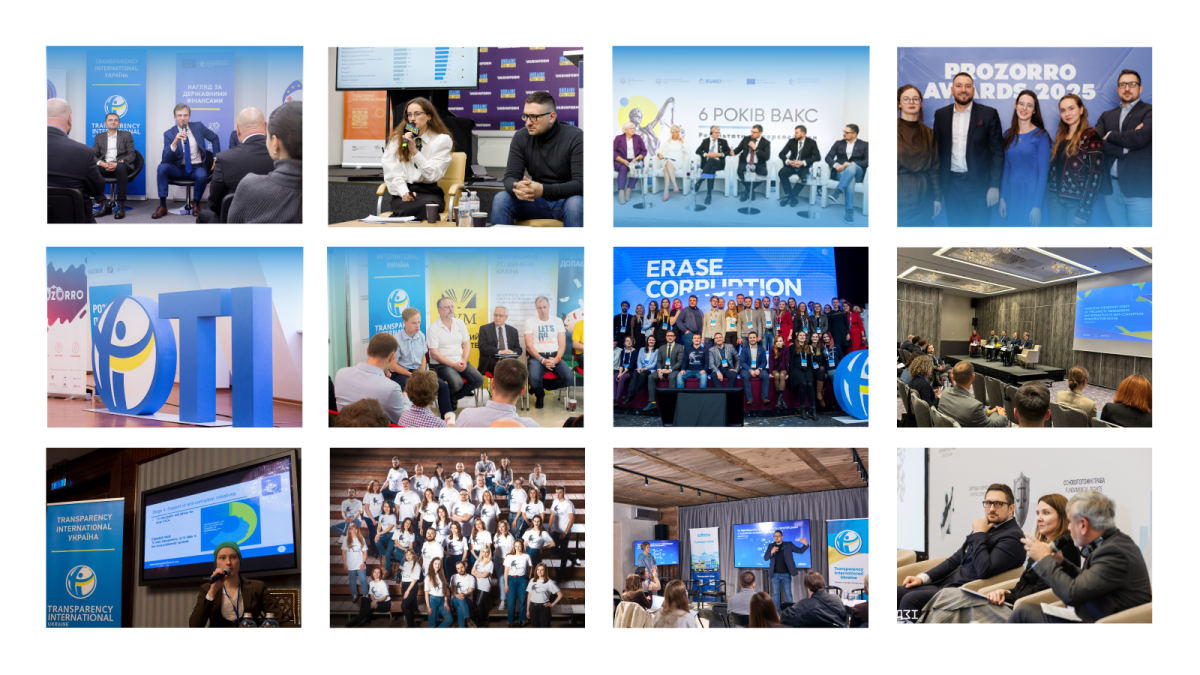

Today, November 1, Transparency International Ukraine marks 12 years since receiving full accreditation from the global Transparency International movement.
To mark the occasion, we have gathered the most important achievements of these years, the ones worth remembering and talking about. We share them in chronological order, from 2014 to today, and set them against what the country itself was going through.
Transparency International Ukraine marks 12 years since receiving full accreditation from the global Transparency International movement.
2014
What was happening in the country? After the Revolution of Dignity, Parliament passed a major package of anti-corruption laws in October. It provided for the creation of the NABU, a corruption prevention system, open property registers, and declarations of officials’ income and expenditures.
And at TI Ukraine?
On November 1, our organization received full accreditation from Transparency International. That year, TI Ukraine helped found the Reanimation Package of Reforms platform, and together with our partners we drafted the bills on which the anti-corruption reform was later built.
2015
What was happening in the country? This was the year the NABU and the SAPO began their work and the open data portal data.gov.ua went live. The Prozorro pilot launched in February, and in December Parliament passed the new Law on Public Procurement.
And at TI Ukraine?
TI Ukraine has been part of public procurement reform from the very start. Throughout the year, we administered the development of the Prozorro e-procurement system, built by volunteers from civil society and businesses.
2016
What was happening in the country? The NACP and the e-declaration system began operating, and the ARMA was established. From August, all public procurement went through Prozorro. And in November, the state sold assets of failed banks at transparent electronic auctions for the first time.
And at TI Ukraine?
Together with the Deposit Guarantee Fund, we created the Prozorro.Sale system, which has brought at least UAH 121 billion into the budget.
That same year, we launched the DOZORRO project for civic monitoring of procurement. And TI Ukraine’s head office moved from Kropyvnytskyi to Kyiv.
2017
What was happening in the country? The Association Agreement with the European Union entered into force, and visa-free travel began.
And at TI Ukraine?
To support and strengthen the regions, TI Ukraine launched the Transparent Cities program and released the first City Transparency Ranking.
2018
What was happening in the country? On June 7, the Verkhovna Rada passed the Law on the High Anti-Corruption Court, setting in motion the development of an anti-corruption justice system. In July, Kherson activist Kateryna Handziuk was doused with acid. She died in November.
And at TI Ukraine?
From day one, TI Ukraine actively supported the work of the future HACC. Our experts analyzed all 1,925 amendments to the HACC law. We traveled to cities across Ukraine, urging lawyers to apply to the court. And during the selection itself, together with colleagues from civil society, we analyzed the 113 candidates admitted to the interview stage and identified 55 questionable contenders.
2019
What was happening in the country? In February, Bihus.Info released one of the most resonant anti-corruption investigations of the year, exposing corruption schemes in the defense sector involving Ihor Hladkovskyi. The HACC began its work that same year.
Once the ninth-convocation Verkhovna Rada took office, MPs launched a genuine legislative “turbo mode” that brought a comprehensive overhaul of the entire anti-corruption system. In particular, the NACP and the public procurement system were rebooted, and transparent privatization was launched.
And at TI Ukraine?
From the day the HACC opened on September 5, we began monitoring hearings in top-level corruption cases. We tracked the first competition to select the head of the NACP. We handed Prozorro.Sale over to the state. And we celebrated our fifth anniversary with a major anti-corruption conference.
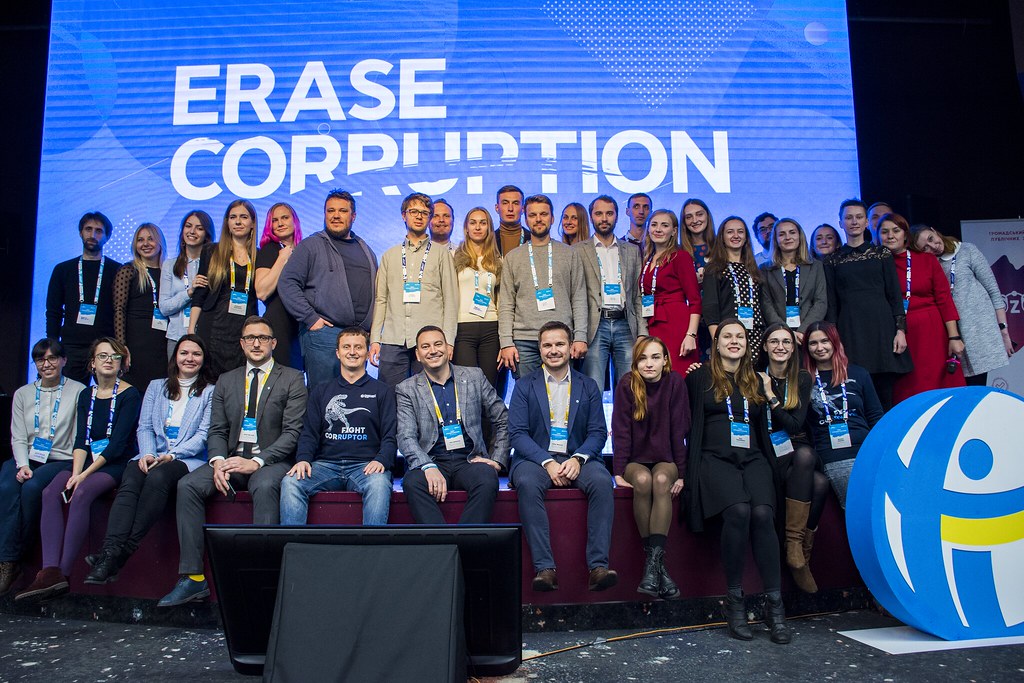 TI Ukraine 5 years
2020
What was happening in the country? The COVID-19 pandemic began, and the new government made its first significant rollbacks in the fight against corruption. This backsliding culminated in October, when the Constitutional Court struck down criminal liability for knowingly false declarations and willful failure to file a declaration, which very nearly derailed the entire anti-corruption reform. Yet there were also high-profile cases: an attempt to give NABU and SAPO leadership a “super bribe,” the first notice of suspicion served on an MP from the mono-majority, Yurchenko, and the first served on an official of the Office of the President, Oleh Tatarov.
Local elections were held in October, the most recent in Ukraine’s modern history. That year also saw Diia launch and the law on protecting corruption whistleblowers take effect.
And at TI Ukraine?
When the pandemic began, DOZORRO experts started comprehensively analyzing medical procurement. This ultimately led to drafting and advocating amendments to public procurement legislation to simplify the procedure.
We actively advocated restoring mandatory declarations for officials, tracking and analyzing the relevant legislative initiatives. This ultimately helped restore e-declaration almost in full.
2021
What was happening in the country? Ukraine marked 30 years of independence, though regrettably not without enormous spending on grandiose procurement. The scandalous competition for the second head of SAPO was also underway: by autumn everyone knew Oleksandr Klymenko was to get the post, yet the commission refused to declare him the winner for more than six months. This allowed then–Prosecutor General Venediktova to directly influence NABU’s anti-corruption investigations. And the country kept backsliding in the fight against corruption.
And at TI Ukraine?
Together with our partners, we did everything we could to stop this backsliding: we monitored every stage of the SAPO competition and advocated for its completion. We handed the ProZvit portal, previously administered by TI Ukraine, over to the state. For the 30th anniversary of Ukraine’s independence, we told the story of our anti-corruption progress. And this was the year the Transparent Cities program presented two rankings at once, on transparency and on accountability.
2022
What was happening in the country? Russia launched its full-scale war. In June, Ukraine was granted EU candidate status, with anti-corruption reforms becoming a mandatory condition for accession. The country united to resist the enemy. Parliament also finally adopted the Anti-Corruption Strategy for 2021–2025. Yet in the first weeks of the invasion, mandatory filing of e-declarations was suspended: only a third of officials filed declarations for 2021.
And at TI Ukraine?
TI Ukraine received the Amalia Award from the global TI movement in the Impact category. As an organization, we set up the Emergency Support Fund for Cities, which helped 22 cities over two years. We launched a new area of work: monitoring the confiscation of Russian and pro-Russian assets in Ukraine. We co-founded the RISE Ukraine coalition, and in December presented the Concept for Ukraine’s Reconstruction in Washington. Together with our civil society partners, we also demanded that e-declaration be restored.
2023
What was happening in the country? Early in the year, the investigation into Ministry of Defense procurement at inflated prices, known as the “UAH 17 eggs” case, showed that war does not cancel society’s demand for fighting corruption. A whole series of corruption cases then shook the country, the most high-profile being the detention of Supreme Court Chief Justice Vsevolod Kniazev.
And at TI Ukraine?
Together with the Open Contracting Partnership and within the RISE Ukraine coalition, we advocated for and helped launch the DREAM system for transparent reconstruction. That year, 5% of all criminal proceedings in procurement were opened on the basis of our reports. We contributed to documents of strategic importance for the country, including the State Anti-Corruption Program and the Methodology for Prioritizing Reconstruction Projects, and to the launch of a procurement agency for the Armed Forces’ non-lethal needs (State Rear Operator). Together with our civil society partners, we secured a meaningful restoration of e-declaration.
2024
What was happening in the country? Official negotiations on Ukraine’s EU accession began. The NABU and the SAPO also significantly increased the number of high-profile corruption investigations.
And at TI Ukraine?
At the request of the European Commission, TI Ukraine, together with a coalition of civil society organizations, prepared the Anti-Corruption section of the first Shadow Report on Ukraine’s progress. We wrote a similar document on public procurement. We helped launch the reform of the Accounting Chamber. For the HACC’s fifth anniversary, we launched the HACC Decided platform. We presented the first study of city transparency and accountability in wartime. Thanks to our public procurement monitoring, the state saved UAH 2 billion.
2025
What was happening in the country? The country began backsliding significantly in the fight against corruption, as the Verkhovna Rada noticeably stalled on passing necessary EU integration bills. Still, the ARMA reform did get off the ground.
In July, Parliament nearly destroyed the independence of the NABU and the SAPO with the scandalous Draft Law No. 12414, but people with cardboard signs defended these agencies’ powers. It was the first major protest during the full-scale war, and it was not in vain. This is how the investigation in the Midas case was saved: the first notices of suspicion were served as early as November.
Meanwhile, the NACP, together with experts, began developing the new Anti-Corruption Strategy for 2026–2030. And in December, Ukraine and the EU agreed on the “Kachka-Kos plan,” a set of 10 priority anti-corruption steps.
And at TI Ukraine?
Our experts were directly involved in drafting the new ARMA law. Likewise, TI Ukraine’s expertise was reflected at various levels in the draft Anti-Corruption Strategy for 2026–2030. In the summer, we promptly analyzed Draft Law No. 12414, actively advocated for its repeal, and gave more than 60 media comments explaining why it was necessary.
Together with a coalition of CSOs, we presented the second Shadow Report for the European Commission. The vast majority of our recommendations were subsequently reflected in the EC’s report on Ukraine’s progress. Thanks to procurement monitoring, we saved more than UAH 1 billion in budget funds.
2026
What is happening in the country? The EU has opened four negotiating clusters, the first being Fundamentals, the most important one. The NABU and the SAPO continued to serve notices of suspicion on notorious officials and politicians: MP Yuliia Tymoshenko, Head of the OP Andrii Yermak, and Deputy Head of the OP Iryna Mudra.
Parliament passed the new Law on Public Procurement, launching the third procurement revolution. And 17 new judges were selected to the HACC.
And at TI Ukraine?
Throughout the year, we thoroughly examined our progress on EU integration and advocated for the necessary changes. We set all of them out in the third Shadow Report, which provides 141 recommendations for improvement. We monitored the competitions for the HACC, ARMA, and SAPO. The Transparent Cities program presented a new study, the European City Index, which will be scaled up further. We also secured more than 40 important changes to the new Law on Public Procurement, and our research formed the basis of the procurement section of the new Anti-Corruption Strategy.
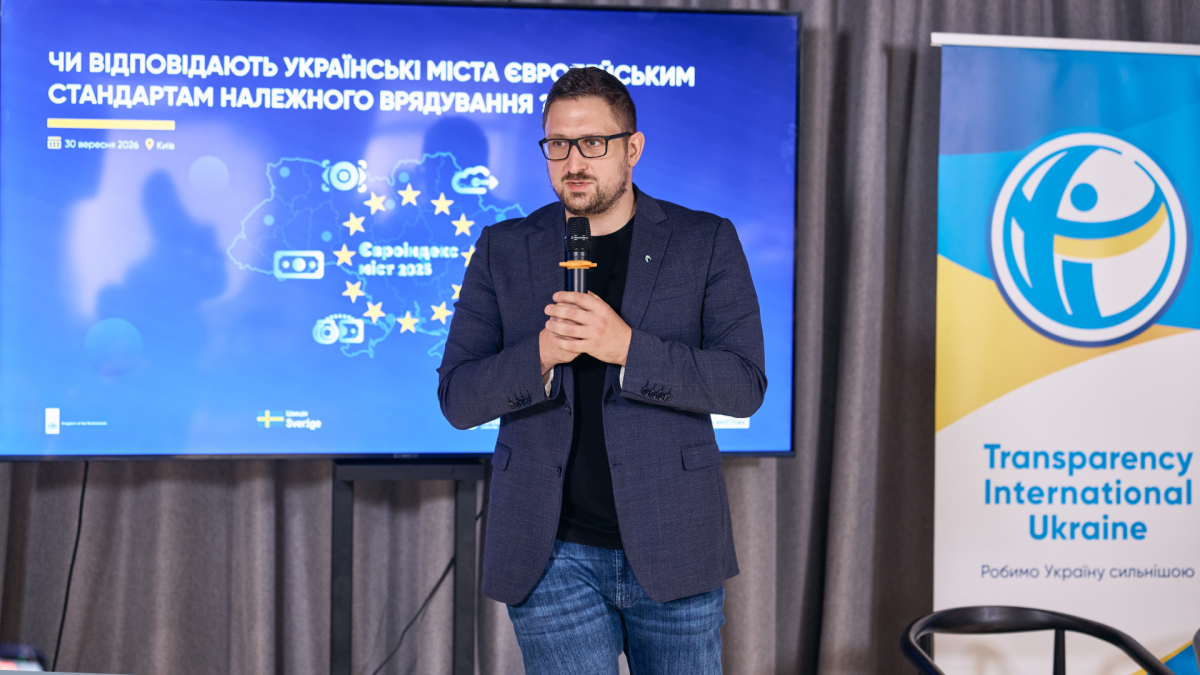 Presentation of the European City Index
For all these 12 years, we have analyzed, tracked, monitored, advocated, explained, recommended, assisted, supported, protected, defended, and strengthened the fight against corruption in Ukraine. And we will keep doing so. Because our goal is to make Ukraine stronger. And a strong Ukraine will be our greatest achievement!


